China Intensifies Military Drills Around Taiwan, Issuing 'Stern Warning' to 'External Forces'
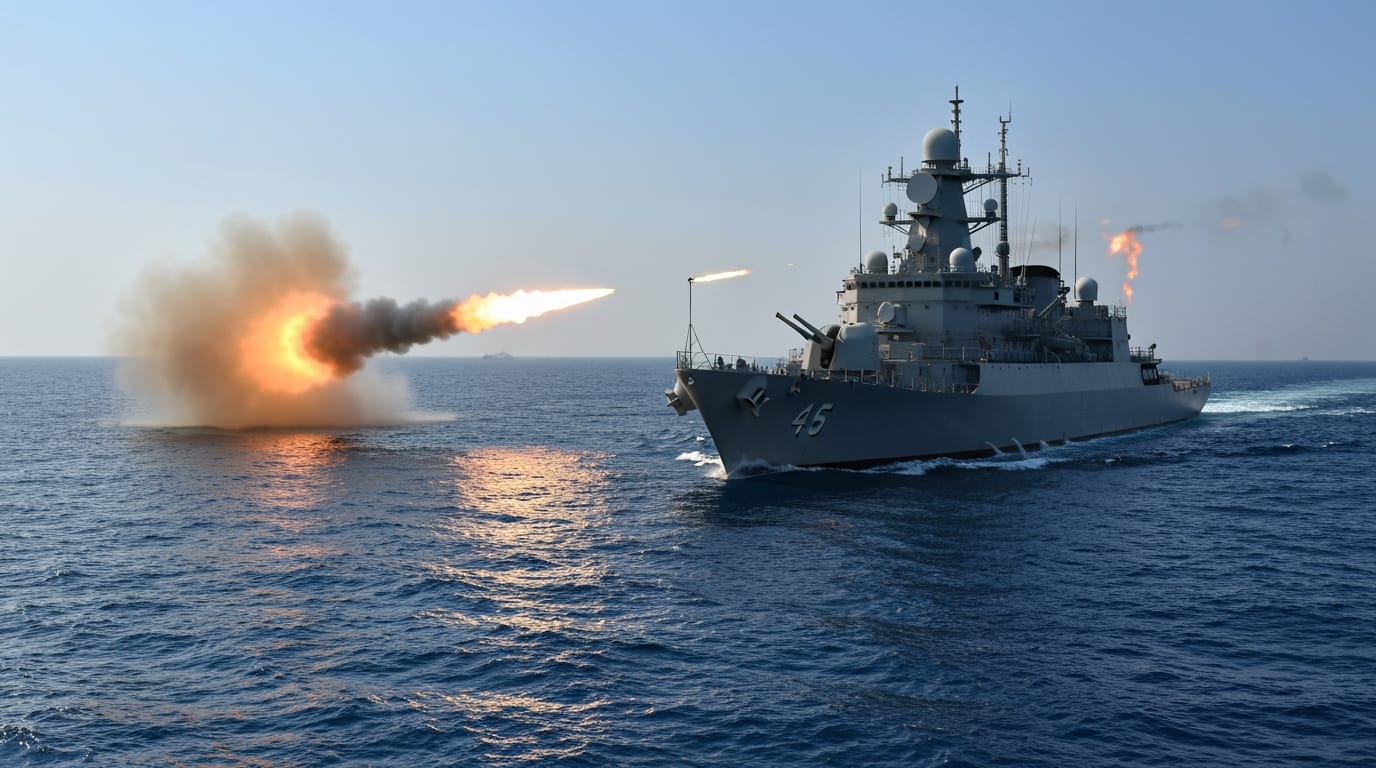
BEIJING — China's military has commenced a new round of large-scale drills around Taiwan, mobilizing a formidable array of forces in what Beijing asserts is a direct "stern warning" against both perceived separatist elements on the island and the intervention of "external forces." The exercises, code-named "Justice Mission 2025," underscore escalating tensions in the critical Taiwan Strait, following recent actions by the United States and Japan that have drawn Beijing's ire.
Escalation in the Taiwan Strait: 'Justice Mission 2025' Unfolds
On Monday, the People's Liberation Army (PLA) initiated its "Justice Mission 2025" drills, deploying army, naval, air force, and rocket force units to five designated zones surrounding Taiwan. These military maneuvers, announced by the PLA's Eastern Theatre Command, are designed to test combat readiness and send an unequivocal message regarding Beijing's territorial claims over the self-governed island. Live-fire exercises are scheduled to commence on Tuesday, imposing sea and air space restrictions for a 10-hour period.
The stated objectives of "Justice Mission 2025" include training for "maritime and aerial combat readiness patrols, gaining integrated control, sealing off key ports and areas and conducting multi-dimensional deterrence." This explicit mention of "deterrence" of outside military intervention marks a notable shift, as it is the first time the PLA has publicly framed its drills around Taiwan with this specific aim. The military also released a propaganda poster titled "Shields of Justice: Smashing Illusions," featuring symbols of the PLA and the Great Wall of China alongside military aircraft and ships, visually reinforcing the message of national resolve. These drills represent the sixth major round of war games conducted by China around Taiwan since 2022, a period of heightened activity that began following a visit by then-U.S. House Speaker Nancy Pelosi to the island.
The 'External Forces' Factor and International Scrutiny
A primary driver behind "Justice Mission 2025" appears to be Beijing's strong objection to perceived foreign interference in what it considers an internal matter. The drills were announced shortly after a significant $11.1 billion weapons sale to Taiwan by the United States, which drew immediate protest from China's defense ministry. Further exacerbating tensions, Japanese Prime Minister Sanae Takaichi recently suggested that a hypothetical Chinese attack on Taiwan could legally constitute a "survival-threatening situation" for Japan, potentially triggering a military response from Tokyo. This statement provoked a strong backlash from Beijing.
PLA Navy Senior Captain Li Xi, a spokesperson for the Eastern Theater Command, explicitly stated that earlier drills in May 2024 served as a "strong punishment for the separatist acts of 'Taiwan independence' forces and a stern warning against the interference and provocation by external forces." This rhetoric has been consistently echoed by Shi Yi, another spokesperson for the Eastern Theatre Command, in relation to the current exercises. Meanwhile, Russia has publicly backed China's stance, with Foreign Minister Sergey Lavrov stating that Moscow opposes "any form of independence" for Taiwan and would support China in "protecting national unity and territorial integrity." This alignment highlights the complex geopolitical dimensions surrounding the Taiwan Strait, drawing the attention of global powers.
A Pattern of Pressure: Historical Context and Tactical Evolution
The recent drills are part of an intensifying pattern of military pressure exerted by Beijing on Taiwan. The frequency and sophistication of the PLA's military exercises have increased significantly, particularly since the Democratic Progressive Party (DPP) came to power under Tsai Ing-wen, a party China views as pro-independence. For instance, the "Joint Sword-2024A" drills conducted from May 23-24, 2024, just days after Taiwan's new President William Lai Ching-te's inauguration, were a direct response to what China deemed "separatist acts."
These earlier exercises involved all branches of the military, including 111 aircraft and 46 naval vessels, with 82 Chinese military aircraft crossing the median line of the Taiwan Strait. Advanced platforms like J-20 and J-16 fighter jets, Type 052D destroyers, and Dong Feng ballistic missiles were prominently featured. Notably, the China Coast Guard (CCG) participated in joint operations with the PLA for the first time, signaling an integration of non-military assets into military scenarios. The PLA has been increasingly simulating realistic combat scenarios, including blockades and amphibious assaults, and showcasing advancements in military technology such as drones, cyber warfare capabilities, and missile systems. Experts observe that these drills are designed to improve the PLA's capabilities to impose a total blockade around Taiwan, targeting key ports and areas.
Taiwan's Response and Broader Implications
In response to China's escalating military maneuvers, Taiwan's government and military have been actively ramping up their response training. Taiwan's President Lai Ching-te has consistently emphasized the necessity of strengthening the island's indigenous defense capabilities to deter China. He stated that Taiwan must continue to "raise the cost of aggression" so that China "can never meet that standard," ensuring Taiwan's safety. Taiwan's Ministry of National Defense has previously condemned such drills as "irrational and provocative actions" that intensify tension and damage peace across the strait.
Beyond the immediate military standoff, the ongoing tensions in the Taiwan Strait carry significant economic and geopolitical implications. The Taiwan Strait is a crucial international shipping lane, vital for global trade and energy supplies. Any disruption or blockade in this area would severely impact global supply chains, particularly given Taiwan's pivotal role in the manufacturing of advanced semiconductors, which are essential for industries worldwide. The international community, including close U.S. allies like Japan and the Philippines, is closely monitoring the situation, preparing for a range of contingency scenarios, and strengthening their security cooperation to address the potential for regional instability.
The latest "Justice Mission 2025" drills underscore a volatile and complex geopolitical landscape in the Indo-Pacific. While China views these exercises as legitimate measures to safeguard its sovereignty and territorial integrity, Taiwan and its international supporters interpret them as coercive and destabilizing. The delicate balance in the Taiwan Strait remains precarious, with the rhetoric and actions of all parties carrying profound implications for regional stability and global economic order.


