Deadly Train Blast Rocks Balochistan, Claiming Lives in Quetta
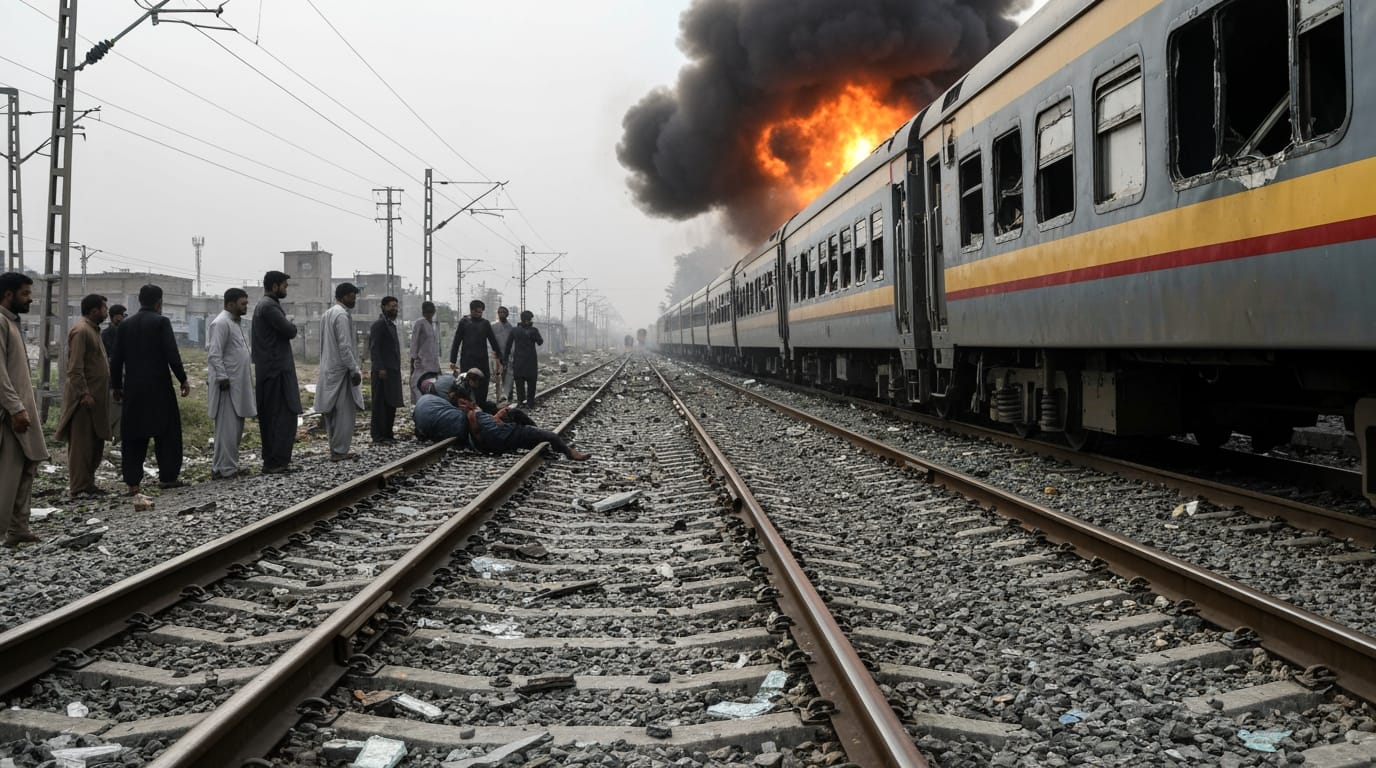
QUETTA, PAKISTAN – A powerful and deadly blast ripped through a shuttle train in Pakistan's restive Balochistan province on Sunday, May 24, 2026, resulting in a significant loss of life and numerous injuries. The explosion, which occurred near the Chaman Phatak railway station in Quetta, unleashed devastation, derailing several carriages and igniting a fire, further compounding the tragedy. The banned Baloch Liberation Army (BLA) swiftly claimed responsibility for the attack, asserting that the targeted train was carrying military personnel, underscoring the persistent and escalating threat of militancy in the region.
The Devastating Attack Unfolds
The incident unfolded on Sunday morning as the shuttle train was en route from Quetta Cantonment to the city's railway station. According to officials, the explosion was immense, with its force heard across distant parts of Quetta, causing widespread panic and chaos. Initial reports indicated at least 20 to 24 fatalities, including military servicemen, and between 50 to 100 people injured in the catastrophic event. Witnesses described a scene of horror, with a mangled train carriage overturned and on fire, spewing thick black smoke into the sky. The blast also wreaked havoc on the surrounding area, badly damaging nearby buildings and destroying vehicles parked along the road.
Authorities, including Pakistan's Railways Minister Hanif Abbasi, confirmed the explosion struck the train's engine and three bogies. The BLA's Majeed Brigade, a "fidayeen" (self-sacrificing) unit, claimed responsibility, stating the assault specifically targeted Pakistani army personnel traveling on the train. This assertion highlights a dangerous escalation in militant tactics, as the BLA increasingly focuses on infrastructure and personnel targets within the province. Emergency services, alongside local residents, rushed to the site to initiate rescue operations, transporting victims to various hospitals in Quetta, including the local civil hospital, FC Hospital, and CMH. Security forces promptly sealed off the area, as rescue and investigation efforts continued amidst fears that the death toll could still rise.
Emergency Response and Mounting Casualties
The immediate aftermath of the explosion saw a coordinated response from various emergency and law enforcement agencies. Medical facilities in Quetta, including those treating the wounded, were placed on high alert, with doctors and medical staff ordered to remain on duty to cope with the influx of casualties. The injured, many in critical condition, necessitated urgent medical attention. Railway authorities dispatched relief trains and rescue trucks to the scene to assist in the extensive recovery operations. The derailment of three coaches, with two overturning, presented significant challenges for rescue teams sifting through the wreckage.
While initial reports varied slightly on the exact casualty figures, the gravity of the situation was undeniable. The government of Balochistan confirmed multiple deaths, including personnel from the Frontier Corps, a paramilitary force. Babar Yousafzai, a special assistant for the provincial home department, indicated that an investigation into the nature of the explosion was launched, with security forces striving to determine the full scope of the incident. The attack, believed by police sources to be a suicide bombing where an explosives-laden vehicle rammed into the train, signaled a harrowing shift in the methods employed by militant groups in the province.
Balochistan's Enduring Insurgency
This latest attack is set against the backdrop of a long-running and violent insurgency in Balochistan, Pakistan's largest and most resource-rich, yet economically underdeveloped, province. Separatist groups, primarily the Baloch Liberation Army (BLA), have waged a low-level insurgency for decades, demanding greater autonomy or outright independence from Islamabad. They accuse the Pakistani government of exploiting the province's vast natural gas and mineral resources without adequately benefiting the local population.
The BLA has a history of targeting security forces, government installations, and infrastructure, including railway lines. In a significant incident on March 11, 2025, the BLA hijacked the Jaffar Express, a passenger train carrying hundreds of people from Quetta to Peshawar. That complex assault involved blowing up tracks and a 30-hour standoff that eventually led to a military operation, resulting in dozens of deaths, including militants, security personnel, and some passengers, while over 300 hostages were rescued. The BLA had also claimed responsibility for a November 2024 suicide bombing at the Quetta railway station that killed 26 people, including security personnel. These attacks underscore a pattern of targeting rail travel, which was once considered a safer alternative to increasingly precarious road transport for both civilians and security personnel.
Broader Implications and Security Challenges
The recurrent acts of violence in Balochistan have profound implications for regional stability and human security. The targeting of civilian infrastructure, even when claiming to aim for military personnel, inevitably results in civilian casualties and instills fear among the populace. Such attacks disrupt vital transportation networks, affecting economic activity and daily life across the province and beyond. The China-Pakistan Economic Corridor (CPEC), a multi-billion dollar infrastructure project, passes through Balochistan, making the region a critical but vulnerable component of Pakistan's economic future. Militant groups, including the BLA, have openly opposed CPEC and have targeted Chinese workers and related projects, further complicating the security landscape.
Pakistani officials have frequently accused neighboring countries, particularly India and Afghanistan, of supporting anti-Pakistan militants in Balochistan, a charge both nations deny. The Pakistani military remains actively engaged in counter-terrorism efforts, emphasizing its resolve to quell the insurgency. However, the persistence of sophisticated and deadly attacks, such as Sunday's train blast, demonstrates the enduring challenge posed by well-entrenched militant networks. The incident serves as a stark reminder of the complex security environment in Balochistan, where political grievances, economic disparities, and a determined insurgency continue to fuel cycles of violence, demanding comprehensive and sustainable solutions beyond military operations alone.