European Broadcasters Boycott Eurovision 2026 Amid Israel Participation Controversy
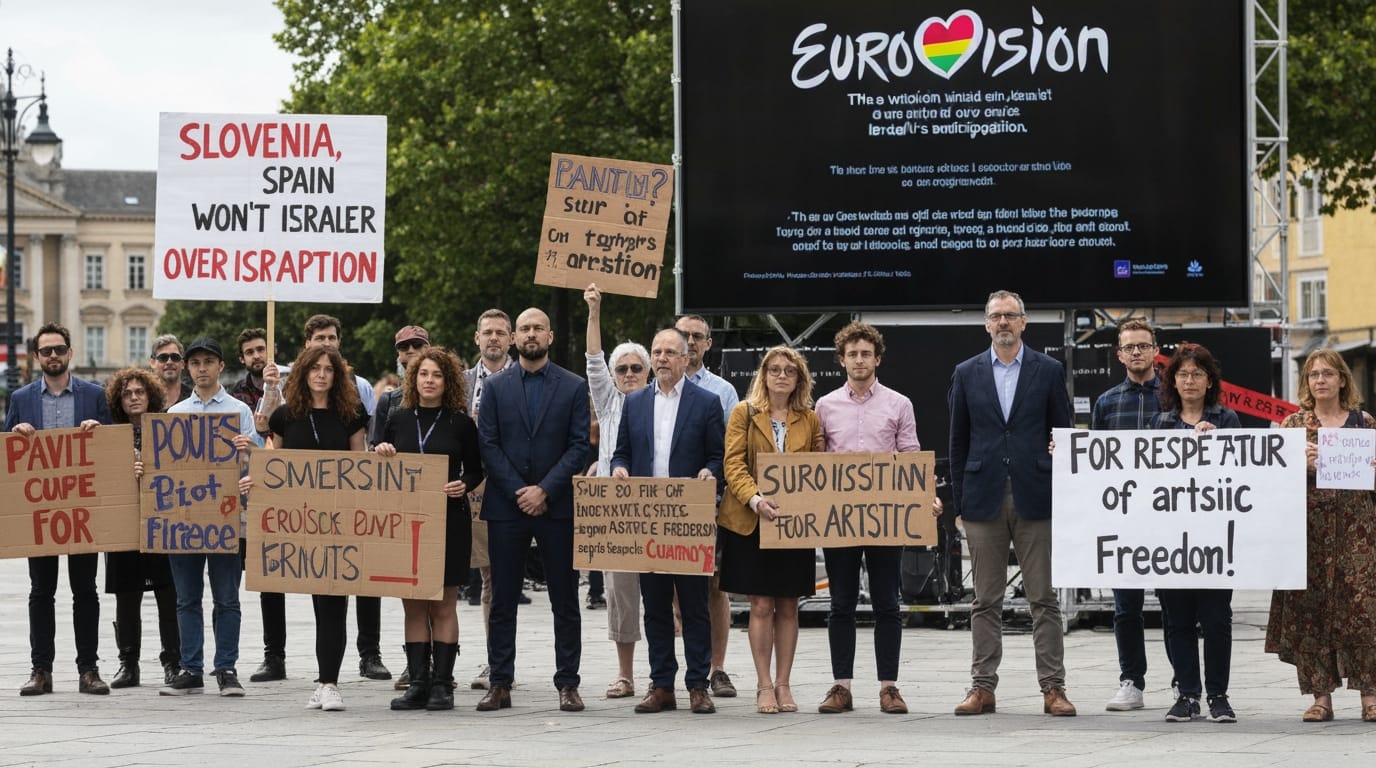
The 2026 Eurovision Song Contest faces significant disruption as public broadcasters in Slovenia, Spain, and Ireland have independently announced their decision not to air the event. This unprecedented collective action stems from ongoing controversy surrounding Israel's continued participation in the contest amid the conflict in Gaza, challenging the European Broadcasting Union's (EBU) long-standing stance on the competition's apolitical nature. The decisions mark a historic moment for the contest, with some nations ceasing broadcasts for the first time in decades.
The decisions by Slovenia's RTVSLO, Spain's RTVE, and Ireland's RTÉ to forgo airing the 2026 contest underscore a growing sentiment among some European broadcasters that Israel's involvement is incompatible with the contest's values, or at least creates an untenable broadcast environment. RTV Slovenia's director, Ksenija Horvat, confirmed that the Slovenian national broadcaster would not be airing Eurovision, opting instead to broadcast a film series titled "Voices of Palestine." This follows a December 2024 resolution by RTV Slovenia's council, which had explored scenarios including non-participation or a blackout of Israel's performance if Israel remained in the contest. Similarly, Spain's RTVE announced it would not broadcast the event, scheduling its own musical variety show in the Eurovision slot. This marks the first time Spain will not air the contest since 1961 and comes after RTVE's board voted in September 2025 to withdraw if Israel participated. Ireland's RTÉ also confirmed it would not broadcast the 2026 contest, instead showing a 2023 film during the usual Eurovision final slot. This decision follows a September 2025 statement from RTÉ deeming it "unconscionable" to participate if Israel remained a contestant, marking the first time in Ireland since 1963 that Eurovision will not be broadcast.
At the core of the dispute is the European Broadcasting Union's consistent position that Eurovision is a non-political music event. The EBU, an alliance of public service media organizations, has repeatedly defended Israel's right to participate, citing its broadcaster KAN as a full and eligible member. This stance was reiterated leading up to the 2024 contest and again for the 2026 event. In December 2025, after a general assembly meeting, the EBU approved new rules to reinforce trust and neutrality in the contest. Member broadcasters voted in favor of these reforms, which implicitly allowed Israel to remain a participant without holding a direct vote on its exclusion. Critics, however, argue that maintaining an apolitical façade has become increasingly difficult amidst geopolitical tensions. During the 2024 contest, Israel's initial song submission, "October Rain," was deemed too political by the EBU due to references to the October 7 Hamas attacks, leading to a modified version, "Hurricane," being accepted.
The controversy surrounding Israel's participation has generated widespread calls for boycotts and protests across Europe. Beyond the three nations opting out of broadcasting, Iceland and the Netherlands also withdrew their entries for the 2026 contest in protest, though their respective public broadcasters are still slated to air the event. The debate frequently draws parallels with the EBU's decision to exclude Russia from Eurovision in 2022 following its full-scale invasion of Ukraine, with many questioning a perceived double standard. Activists and some public figures argue that if political actions warrant exclusion for one nation, similar criteria should apply universally. The EBU, however, has maintained that Russia's suspension was based on its state broadcaster's breach of public service values and not directly on governmental actions in the same way. The persistent pressure and public outcry highlight the challenge the EBU faces in upholding its "United by Music" motto in an increasingly politicized global landscape.
The decisions by Slovenia, Spain, and Ireland carry significant implications for the Eurovision Song Contest. Spain's withdrawal is particularly impactful, as it is one of the "Big Five" nations that contribute the most financially to the contest and automatically qualify for the Grand Final. This withdrawal represents a direct financial and political blow to the contest's established framework, potentially reducing the automatic qualifier group from five to four. The cumulative actions of these broadcasters underscore a growing internal dissent within the EBU's membership regarding the handling of political controversies. The contest, originally conceived as a means of fostering unity through music in post-war Europe, is now grappling with how to reconcile its founding principles with contemporary geopolitical realities. The ongoing debate tests the limits of "apolitical" cultural events and raises questions about Eurovision's future direction, audience engagement, and its ability to maintain credibility across its diverse European viewership.
The refusal of public broadcasters in Slovenia, Spain, and Ireland to air the 2026 Eurovision Song Contest represents a critical juncture for the popular competition. Driven by the controversy surrounding Israel's participation, these decisions reflect a deepening divide between the EBU's insistence on an apolitical event and the increasing demands from some member states and their populations for the contest to acknowledge broader humanitarian and political concerns. As the event approaches, the absence of these national broadcasts will serve as a visible manifestation of the ongoing tensions, forcing a broader conversation about the role of culture in times of global conflict and the fundamental integrity of international spectacles that claim neutrality.


