Germany's Merz Sounds Alarm: EU Must Act Decisively to Regain Economic Edge
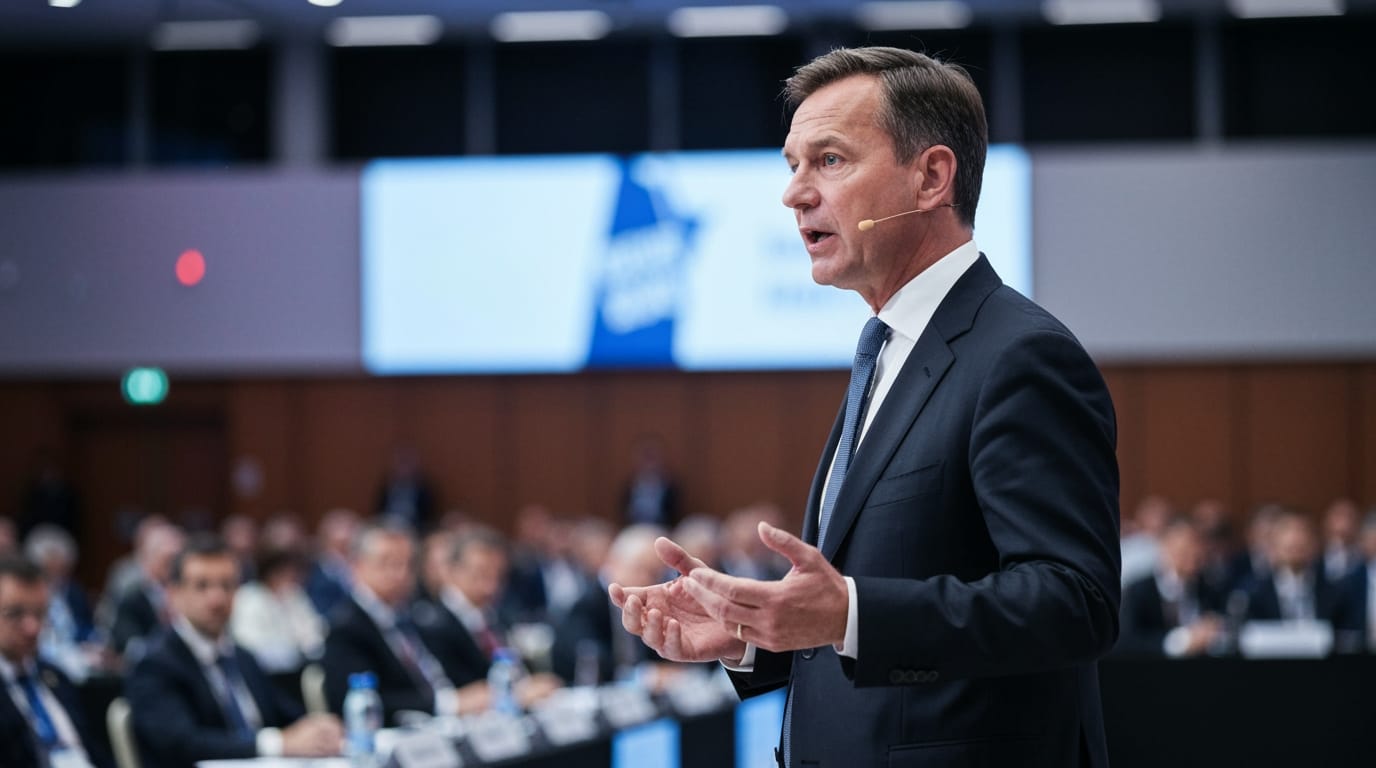
DAVOS, Switzerland — German Chancellor Friedrich Merz has issued a stark warning, asserting that the European Union risks falling behind global competitors unless it implements urgent and far-reaching reforms to boost its economic competitiveness. Speaking at the World Economic Forum in Davos and in subsequent statements, Merz unequivocally stated that the bloc has become "the world champion of over-regulation," a burden that has crippled growth and innovation, hindering its ability to contend with the economic might of the United States and China. His call to action, punctuated by proposals for an "emergency brake" on bureaucracy and a renewed focus on a dynamic single market, signals a pivotal moment for Europe's economic trajectory.
The Clarion Call for Deregulation
Chancellor Merz's message from Davos was unambiguous: the European Union's inherent potential is being stifled by an increasingly complex regulatory landscape. He lamented that both Germany and the broader EU have "wasted incredible potential for growth in recent years by dragging its feet on reforms and unnecessarily and excessively curtailing entrepreneurial freedoms and personal responsibility." This critique of Brussels' bureaucratic machinery formed the cornerstone of his argument for a radical overhaul. Merz proposed concrete measures to reverse this trend, most notably an "emergency brake" mechanism designed to halt or pause new regulatory initiatives. Complementing this, he advocated for a "principle of discontinuity," which would prevent the automatic renewal of outdated rules, thereby ensuring legislative agility and relevance. Furthermore, Merz stressed the necessity of a modernized EU budget, one that unequivocally places competitiveness at its core, reflecting a fundamental shift in the bloc's financial priorities. His pronouncements highlight a deep-seated belief that "security and predictability take precedent over excessive regulation and misplaced perfection."
Germany's Stakes and European Imperatives
The German Chancellor's impassioned plea is rooted in a sober assessment of the current global economic climate and Germany's own domestic challenges. The EU and Germany are grappling with a confluence of adverse factors, including sluggish growth, persistently high energy costs, and relentless competition from economic superpowers like the United States and China. Merz underscored the urgency by framing the current international landscape as a "new era of great-power politics" where "only power counts," warning that without bold action, Europe risks becoming a "pawn of the U.S. and Asia."
Domestically, Germany's economy has experienced years of anemic growth, with last year's 2% GDP growth deemed "unsatisfactory" for a leading economy. Merz's government has initiated its own reform agenda to address these structural inefficiencies, including plans to reduce corporate taxes to approximately 25% over the next four to five years and a preliminary €3 billion cut in bureaucratic costs for industry. Reforms to labor costs, pensions, health systems, and working times are also underway, alongside efforts to optimize energy efficiency and introduce new gas power plants. Merz emphasized that Germany's prosperity is intrinsically linked to the EU's success, stating, "We are only strong together in Europe. Or we are weak as individual states." This interdependence fuels his drive for EU-wide economic rejuvenation, arguing that there is "no knowledge problem, but an implementation problem" when it comes to vital reforms. German industry, as exemplified by the German Retail Federation (HDE), echoes these concerns, calling for stronger action to shield EU firms from unfair competition posed by non-EU entities and warning against the debilitating effects of escalating regulatory complexity.
The Rome-Berlin Axis and the Draghi Blueprint
A significant development in the push for EU competitiveness is the emerging alliance between Chancellor Merz and Italian Prime Minister Giorgia Meloni. This pragmatic partnership, dubbed "Merzoni" by some, has quietly begun to reshape Europe's political dynamics. Their collaboration culminates in a joint policy paper and a planned pre-summit for February 12, aimed at galvanizing EU partners towards crucial reforms. A central tenet of their shared vision is the revitalization of the single market, with a particular emphasis on capital market independence and simplifying EU regulations.
Both leaders are strong proponents of implementing the blueprint for a more competitive Europe outlined in former European Central Bank president Mario Draghi's 2024 report. Merz has repeatedly highlighted that only a mere 10% of Draghi's comprehensive proposals have been enacted, underscoring a critical "failure that risks long-term economic decline." The upcoming extraordinary European Council meeting on February 12th, focused exclusively on competitiveness, represents a concerted effort by Merz and his allies to "unlock growth and attract new investment" by "walking the talk" on economic reform. This concerted effort aims to overcome regulatory inertia and fragmentation, which, according to European Commission estimates, impose substantial internal tariffs on goods and services, inhibiting the true potential of the single market.
Navigating Internal Divisions and Future Hurdles
Despite the growing consensus on the need for enhanced competitiveness, the path forward is fraught with diverging solutions and internal divisions within the European Union. A notable contrast in approach exists between Merz and French President Emmanuel Macron. While Merz champions deregulation and trade openness, Macron advocates for more joint EU debt to invest at scale and a "Buy European" strategy to favor domestic firms. Merz views the "Buy European" push as "too narrow," suggesting it should only be applied to "critical strategic sectors" and as a "last resort."
These differing philosophies underscore the complex political landscape in which economic reforms must be forged. European Commission President Ursula von der Leyen has even floated the idea of a "two-speed" Europe, where some member states might integrate their markets more rapidly than others, signaling the difficulty of achieving unanimous agreement on radical changes. Furthermore, the bloc faces the looming shadow of several critical elections, including the French presidential race in 2027 and elections in Italy and Poland, which could further complicate the reform agenda and potentially shift political priorities. Merz himself acknowledges the need for "expectation management" ahead of upcoming discussions, recognizing the inherent challenges in unifying 27 diverse nations behind a singular, transformative economic vision.
A Defining Moment for Europe's Economic Future
Chancellor Merz's impassioned call to action represents a defining moment for the European Union. His diagnosis of over-regulation as a debilitating force and his proposed solutions, backed by a growing alliance with Italian Prime Minister Meloni, underscore a palpable urgency to recalibrate Europe's economic strategy. The bloc stands at a critical juncture, confronted by intensifying global competition and internal economic stagnation. While the vision for a more competitive Europe is widely shared, the means to achieve it remain a subject of intense debate, highlighting the complex political ballet required to translate rhetoric into tangible reforms. The success or failure of these efforts will undoubtedly shape Europe's standing on the world stage for decades to come, determining whether it reclaims its economic dynamism or continues to cede ground in a rapidly evolving global order.


