Hichilema Secures Second Term in Zambian Presidential Election
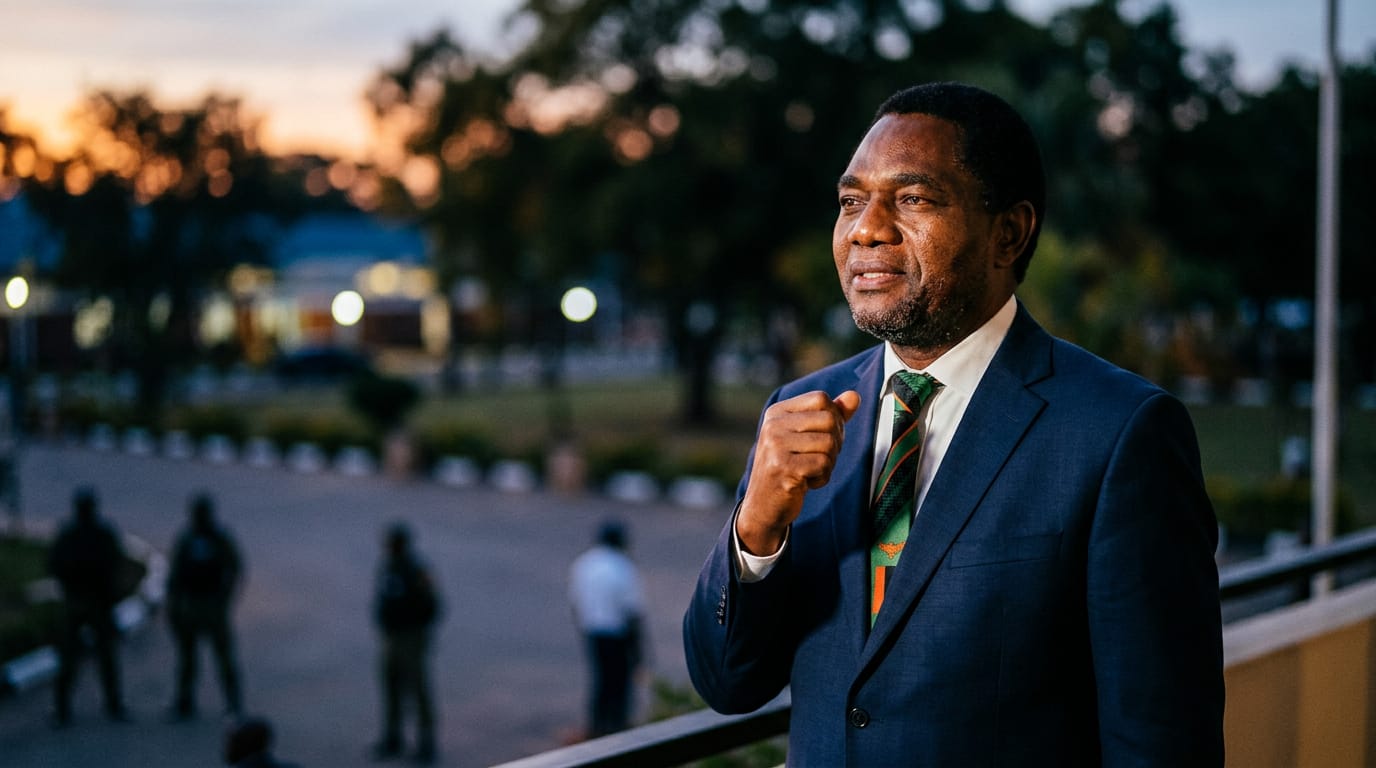
Hakainde Hichilema has been re-elected as President of Zambia, securing a second five-year term following a closely watched election that concluded with official results announced early Tuesday. The victory for the incumbent, a former opposition leader who campaigned on an economic recovery platform, reaffirms his mandate to steer the southern African nation through ongoing financial reforms and development initiatives. While his win was decisive, the electoral process drew scrutiny from international observers regarding the fairness of the campaign environment.
A Resounding Mandate Amidst Scrutiny
The Electoral Commission of Zambia officially declared Hakainde Hichilema the winner in the early hours of August 18, 2026, after polls closed last Thursday, August 13. Hichilema, representing the United Party for National Development (UPND), garnered approximately 61.4% of the roughly 5 million votes cast, equating to 2,965,326 votes. This substantial margin allowed him to avoid a run-off election. His closest contender, Brian Mundubile of the National Reconciliation Party for Unity and Prosperity (NRPUP), secured about 38% of the vote, totaling 1,856,217 votes. Commission chairperson Mwangala Zaloumis formally declared Hichilema president-elect, marking his seventh bid for the nation's highest office and second successful attempt. Following the announcement, jubilant supporters of Hichilema gathered in the capital, Lusaka, celebrating with dancing, singing, and firecrackers, donning the red colors of the UPND.
Economic Promises and Public Expectations
Hichilema’s re-election campaign centered heavily on his administration's economic record since taking office in 2021. His first term was largely defined by efforts to stabilize Zambia's economy, which was grappling with a significant debt crisis. Key achievements highlighted included the successful restructuring of Zambia's sovereign debt, a move that restored credibility with international lenders and attracted fresh investment, particularly in the copper sector, a cornerstone of the nation’s economy. His government also pointed to reining in inflation and stabilizing the national currency as signs of progress. In addition to macroeconomic reforms, Hichilema expanded social spending, notably introducing free secondary education, which brought an estimated 2.3 million children back into classrooms, and increasing social cash transfers and funding for community projects.
However, despite these reported economic advancements, many Zambians continue to face significant challenges. The high cost of living, widespread poverty affecting over 70% of the population, and persistent power shortages remained salient concerns for voters during the election period. Critics argued that the benefits of economic recovery had not sufficiently "trickled down" to the ordinary citizen, who still struggled with daily necessities. The election, therefore, served as a referendum on whether Hichilema's reforms were adequate to overcome these daily hardships.
Democratic Process Under the Microscope
While the Electoral Commission affirmed the peaceful conduct of the election, the broader process faced criticism from various quarters. International observers, including the European Union, noted that despite being largely peaceful, the election took place within an environment that limited fundamental freedoms. Concerns were raised regarding "late legal changes, legal uncertainty, and unequal campaign conditions," which observers suggested distorted the playing field.
Allegations of fraud also emerged, with main opposition challenger Brian Mundubile claiming to have received information about the potential alteration of result forms from polling stations and calling for an urgent independent investigation. Hichilema's campaign dismissed these allegations. Further compounding the tensions, authorities arrested 11 people, including leading opposition figures, on election night. Mundubile also reported that his home was raided by police, which he characterized as an attack on his life. These incidents fueled accusations from opposition parties and human rights groups, including Amnesty International, that Hichilema's government was shrinking democratic space and using state institutions to target critics and political rivals—allegations the government denies. Hichilema, who himself endured political imprisonment as an opposition leader, has rejected claims of suppressing dissent, stating that "arresting and prosecuting lawbreakers is not equivalent to loss of democratic space and human rights".
The Path Forward for Zambia
With a second term secured, President Hichilema has outlined ambitious goals for Zambia. He aims to build on the country's economic recovery by doubling the size of the economy, creating more jobs, and expanding opportunities for households. His administration will likely continue its focus on fiscal discipline and attracting foreign investment to sectors beyond copper, such as agriculture and tourism. Zambia's position as Africa's second-largest copper producer also places it centrally in the global critical minerals competition, a factor that will likely influence its international standing and economic strategy.
However, the challenge remains for Hichilema to translate macroeconomic stability into tangible improvements in the daily lives of all Zambians. Addressing the high cost of living, pervasive poverty, and ensuring equitable distribution of economic growth will be crucial to fulfilling the aspirations of a population that largely supported his vision for a more prosperous future. A divided opposition and an increasingly scrutinizing civil society will ensure that Hichilema’s second term is closely watched, both domestically and internationally, as Zambia navigates its economic and democratic trajectory.
The election outcome underscores Zambia's continued commitment to democratic transfers of power, a tradition that has largely held strong since the return to multiparty politics. As President Hichilema embarks on his second term, the nation looks ahead to the implementation of his vision for sustained growth and improved livelihoods, while also seeking assurances of an inclusive and open democratic landscape.