India Hosts Landmark AI Summit, Bolstering Global South's Role and Drawing Tech Giants
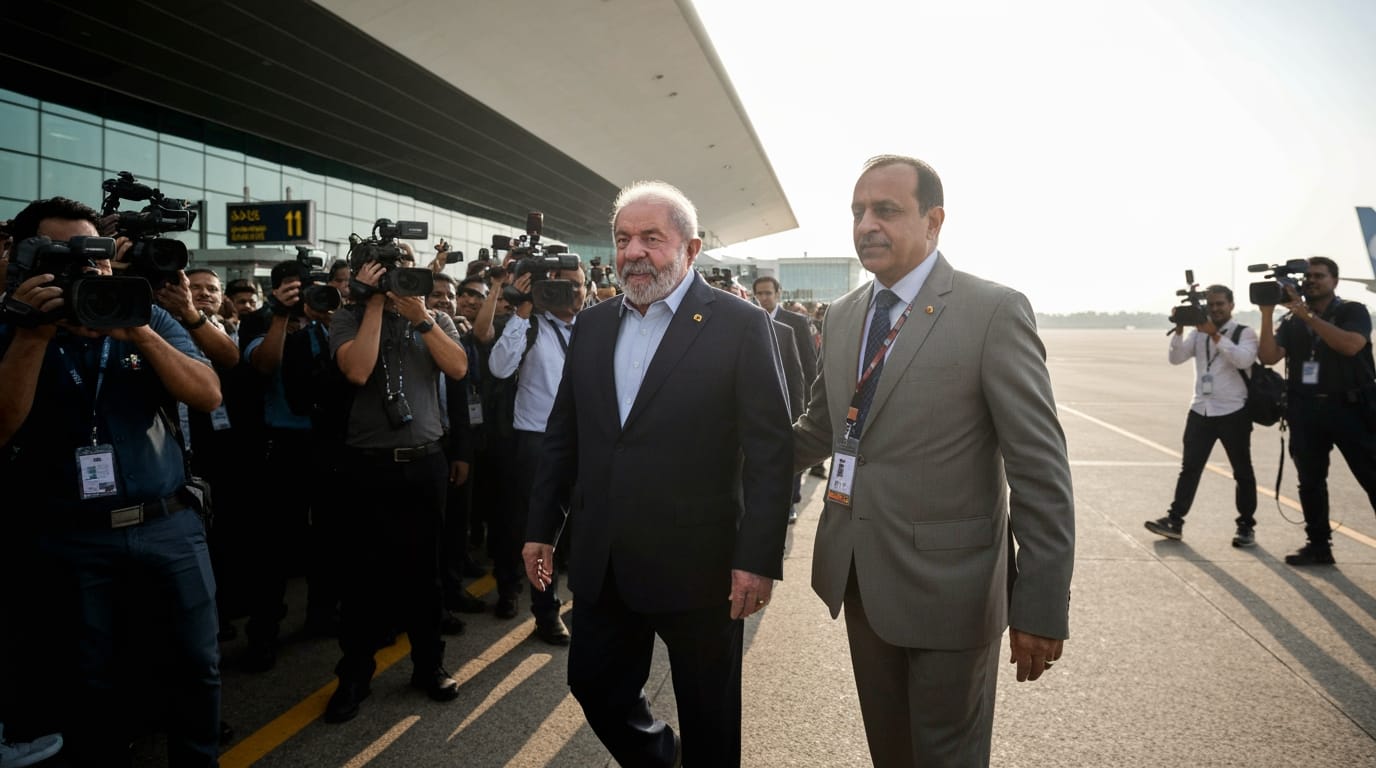
NEW DELHI, India – India has taken center stage in the global artificial intelligence discourse, hosting the impactful India AI Impact Summit 2026, an event that has drawn world leaders, tech titans, and a quarter-million attendees to its capital. Brazilian President Luiz Inácio Lula da Silva arrived with his largest-ever delegation to strengthen bilateral ties and discuss technology, while major U.S. tech companies outlined ambitious plans, signaling a significant shift in AI development towards inclusive, human-centric progress. The summit, held from February 16-20 in New Delhi, aims to forge a "shared roadmap for global AI governance and collaboration," positioning India as a crucial bridge between advanced economies and the Global South in shaping the future of AI.
The multi-day event at Bharat Mandapam, a state-of-the-art convention center, represents the fourth international gathering on AI, following discussions in Bletchley Park, Seoul, and Paris. However, it distinguishes itself as the first hosted in the Global South, shifting the focus from abstract safety concerns to the tangible, real-world applications and societal impact of artificial intelligence. Indian Prime Minister Narendra Modi, who inaugurated the summit, emphasized a vision of "AI for all" and "human-centric progress," advocating for responsible and ethical AI use that benefits humanity.
A Global Convergence on AI's Future
The India AI Impact Summit has emerged as a pivotal forum for international collaboration on artificial intelligence, attracting an impressive array of participants from over 110 countries and 30 international organizations. Approximately 20 heads of state and 45 ministerial-level delegations, alongside more than 150 global AI experts, converged in New Delhi to tackle the complex challenges and immense opportunities presented by AI. The sheer scale of the event, with an estimated 250,000 visitors and thousands engaging in virtual sessions, underscores the widespread interest and India's growing influence in the technological arena.
Discussions at the summit spanned a wide range of critical topics, including AI and global health, education and skilling, data governance, and machine learning workshops. A key theme was bridging the AI adoption gap between the Global North and South, advocating for deployable tools that can strengthen public services, empower entrepreneurs, and support sustainable development across developing nations. United Nations Secretary-General António Guterres is also expected to address the summit, highlighting concerns that AI should not become "just a privilege of the most developed countries or a division only between two superpowers".
Brazil's Strategic Push into India's Digital Landscape
A significant highlight of the summit was the state visit of Brazilian President Luiz Inácio Lula da Silva, who arrived in New Delhi on February 18, leading his largest-ever delegation to India. Comprising over a dozen ministers and a substantial contingent of top Brazilian CEOs, the visit underscores a strategic intent to elevate the India-Brazil Strategic Partnership. President Lula's engagements, including participation in the AI Impact Summit on February 19 and 20, and bilateral talks with Prime Minister Modi on February 21, are set to chart a forward-looking agenda covering technology, trade, and global issues.
The robust nature of the Brazilian delegation signals a concerted effort to accelerate trade flows, foster investment partnerships, and deepen commercial integration between the two burgeoning economies. Bilateral trade between India and Brazil reached $12.54 billion in 2024, with Brazil viewing India as an under-tapped market for exports such as cotton, seeds, teak, soybean oil, and crucial rare earth minerals. India's recent assumption of the BRICS bloc presidency from Brazil further emphasizes the deepening geopolitical and economic alignment between the two nations. President Lula's visit, his sixth to India, builds on a relationship rooted in shared democratic values and a common global vision for inclusive growth.
US Tech Giants Unveil Ambitious AI Investment Plans
The India AI Impact Summit also served as a critical platform for major U.S. technology companies to articulate their strategic plans and investments in the rapidly expanding Indian AI ecosystem. Leaders from Silicon Valley's most influential firms, including Google CEO Sundar Pichai, OpenAI chief Sam Altman, and Anthropic CEO Dario Amodei, were among the prominent tech executives attending. Microsoft founder Bill Gates and Google DeepMind head Demis Hassabis were also scheduled to speak, highlighting the significant interest from American tech in India's AI trajectory.
Executives expressed considerable optimism regarding the growing role of the U.S.-India partnership in shaping global AI development. Jay Puri, executive vice president at NVIDIA, noted the gathering as a "defining moment" for the industry, citing India's extensive developer base, vibrant startup ecosystem, and ambitious digital initiatives. NVIDIA cemented its commitment by announcing plans to collaborate with three Indian cloud computing providers to supply advanced processors crucial for data centers that train and run AI systems. In a landmark announcement, Mumbai-based cloud and data center provider L&T revealed its partnership with NVIDIA to construct what is touted as "India's largest gigawatt-scale AI factory". Furthermore, Google's substantial $15 billion project to establish its largest AI data center hub outside the U.S. in Visakhapatnam, India, underscores the country's strategic importance as an AI innovation powerhouse. These investments align with India's expectation of attracting over $200 billion in AI-related investments in the next two years, with approximately $90 billion already committed.
India's Vision: "Techno-Gandhism" and Global Leadership
India's hosting of the AI Impact Summit reflects its aspiration to emerge as a global leader in AI, distinctively advocating for a model often referred to as "techno-Gandhism," where AI serves social justice and benefits marginalized populations. This approach contrasts with some Western narratives that have focused primarily on the competitive race for AI supremacy and potential job displacement, particularly in sectors like call centers and tech support, which employ millions in India.
Prime Minister Modi stressed the importance of preparing a global framework for the ethical use of AI, suggesting mechanisms like a software watermark for AI-generated content and an audit system to categorize AI tools based on their capabilities. India's experience in building large-scale digital public infrastructure, such as digital identity and payment platforms, offers a compelling model for deploying AI at scale while maintaining accessibility and affordability. This inclusive vision aims to ensure that AI governance "cannot succeed if it ignores the priorities of the majority of humanity".
Charting a Collaborative Future for AI
The India AI Impact Summit 2026 has solidified India's position as a critical player in the global AI landscape, fostering dialogue and collaboration between diverse stakeholders. The confluence of high-level diplomatic engagements, such as President Lula's strategic visit, and significant investment pledges from leading U.S. tech firms, highlights a shared recognition of AI's transformative power and the imperative for responsible development. By emphasizing human-centric progress, equitable growth, and the unique needs of the Global South, India is not only charting its own course in the AI revolution but also aspiring to guide a collective, inclusive future for artificial intelligence worldwide. The summit's outcomes are expected to lay the groundwork for ongoing international cooperation, ensuring that AI serves as a tool for widespread welfare and happiness.