India Propels into New Space Era with Heaviest Satellite Launch
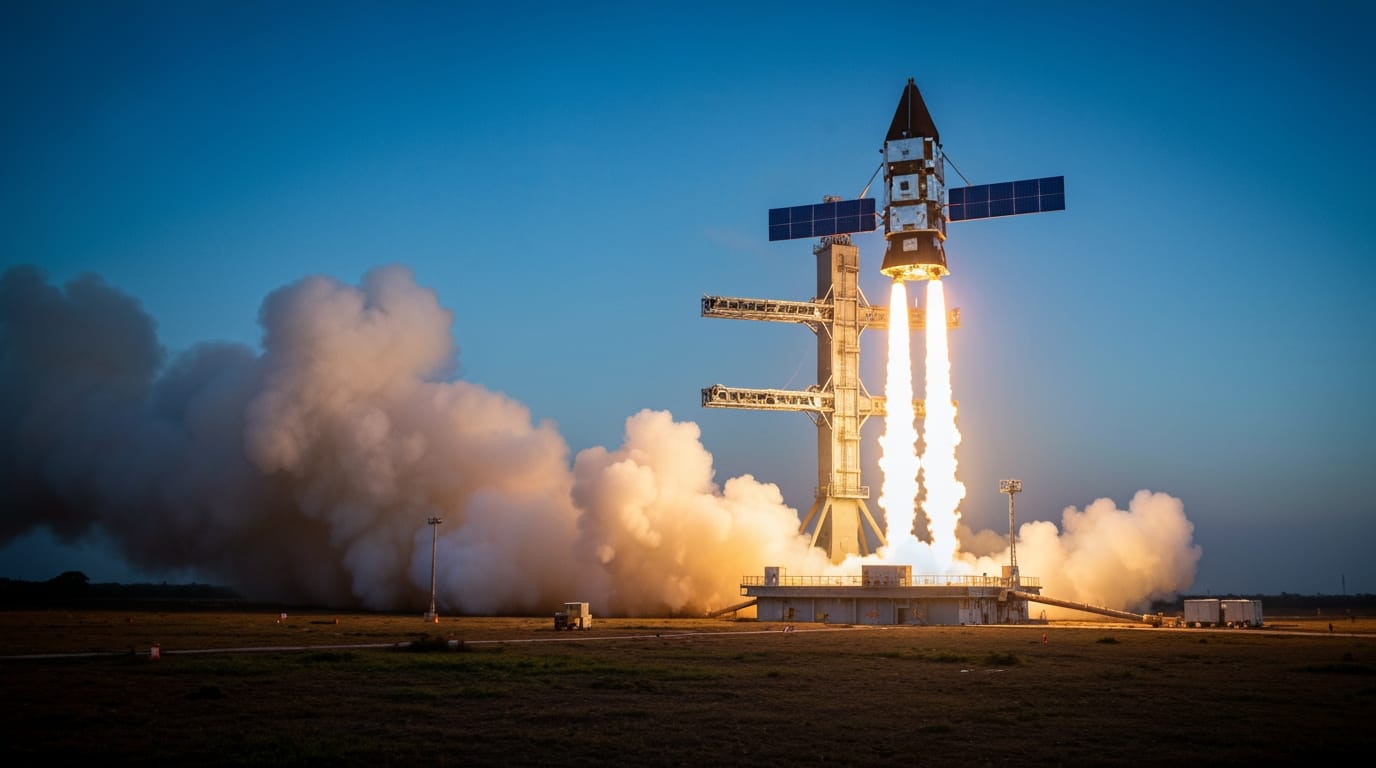
SRIHARIKOTA, India — India's space agency achieved a monumental feat on Christmas Eve, successfully launching its heaviest satellite to date and significantly bolstering the nation's burgeoning commercial space capabilities. The Indian Space Research Organisation (ISRO) utilized its powerful Launch Vehicle Mark-3 (LVM3-M6), affectionately known as 'Bahubali,' to deploy the BlueBird Block-2 communication satellite, a massive 6,100-kilogram payload for U.S.-based AST SpaceMobile, into Low Earth Orbit. This landmark mission, executed from the Satish Dhawan Space Centre, not only marks a crucial step in global connectivity but also solidifies India's position as a formidable player in the international space market, demonstrating an advanced heavy-lift capacity unprecedented on its home soil.
A New Standard for Heavy-Lift from Indian Shores
The LVM3-M6, ISRO's most robust launch vehicle, roared off the Second Launch Pad at 8:54 AM IST on December 24, 2025, carrying the BlueBird Block-2, which represents the heaviest payload ever launched by an LVM3 rocket from Indian territory into Low Earth Orbit (LEO). This mission surpassed previous records, including the 4,410 kg CMS-03 communication satellite launched in November 2025, which was the heaviest domestic satellite placed into Geosynchronous Transfer Orbit (GTO) by an Indian rocket. While ISRO had previously launched heavier satellites like GSAT-11 (5,854 kg) in 2018, those missions relied on the European Ariane-5 rocket from foreign launchpads. The success of the LVM3-M6 underscores India's growing self-reliance and technological prowess in handling substantial payloads.
The 43.5-meter tall, three-stage LVM3, with a lift-off mass of 640 tonnes, consists of two S200 solid strap-on boosters, an L110 liquid core stage, and a C25 cryogenic upper stage. Its flawless performance in accurately injecting the BlueBird Block-2 satellite into its intended 520-600 km LEO within approximately 15 minutes of liftoff has been hailed by ISRO officials. ISRO Chairman Dr. V. Narayanan remarked that the mission marked a new milestone for India, with the LVM3 continuing its excellent track record and delivering orbital performance with less than 2 km of dispersion, which is among the best in the global space arena. Prime Minister Narendra Modi lauded the launch as a "significant stride" and a "proud milestone" in India's space journey, emphasizing that it strengthens the nation's heavy-lift capability and reinforces its expanding role in the global commercial launch market.
Revolutionizing Global Connectivity with Direct-to-Phone Broadband
The BlueBird Block-2 satellite, a pivotal component of AST SpaceMobile's constellation, is designed to deliver a revolutionary service: direct-to-smartphone cellular broadband. Equipped with a massive 223 square-meter phased-array antenna, the satellite is engineered to beam 4G/5G signals directly to unmodified smartphones, eliminating the need for specialized ground equipment or satellite phones. This cutting-edge technology promises to bridge the digital divide by providing seamless connectivity to remote and underserved regions, including mountainous terrains, vast oceans, and arid deserts, partnering with over 50 mobile operators globally.
AST SpaceMobile aims to build the world's first and only space-based cellular broadband network, offering 4G and 5G voice and video calls, texts, streaming, and data services to users "everyone, everywhere at all times." The successful deployment of BlueBird Block-2 is a critical step in realizing this ambitious vision, setting the stage for a new era of universal mobile connectivity. The company has already launched precursor BlueBird satellites (BlueBird 1-5) in September 2024 to provide continuous coverage in select regions.
India's Expanding Commercial Space Footprint
This mission represents the third fully commercial outing for the LVM3, underscoring India's growing prominence and reliability in the competitive global commercial launch market. The commercial agreement between NewSpace India Limited (NSIL), the commercial arm of ISRO, and U.S.-based AST SpaceMobile, highlights India's strategic intent to capture a larger share of the booming satellite launch business.
India's competitive pricing and proven reliability are attracting international clients, as demonstrated by previous successful commercial missions, including the launches of 36 OneWeb satellites in 2022 and 2023. These missions were secured partly due to geopolitical shifts, positioning India as a viable alternative for satellite deployment. The LVM3's consistent success not only strengthens NSIL's market share but also advances the 'Atmanirbhar Bharat' (Self-Reliant India) initiative in the space technology sector.
Strategic Implications and Future Horizons
Beyond its immediate commercial and connectivity benefits, the successful LVM3-M6 mission carries significant strategic implications for India's future space endeavors. The LVM3, initially designed for Geosynchronous Transfer Orbit (GTO) missions, has now unequivocally proven its versatility and reliability for heavy payloads into LEO. This demonstrated capability is crucial as ISRO prepares for its ambitious Gaganyaan program, which aims to send Indian astronauts into space. The LVM3 rocket, with modifications to ensure human safety, will be the workhorse for these crewed missions.
Furthermore, a robust heavy-lift capacity is essential for India's long-term space aspirations, including plans for an uncrewed orbital mission before its first human spaceflight in 2027 and potentially sending an astronaut to the Moon by 2040. The ability to launch substantial payloads independently provides India with strategic autonomy and enhances its bargaining power in international collaborations. The precise injection of the BlueBird Block-2 satellite with minimal dispersion further solidifies ISRO's reputation for precision engineering and operational excellence, ensuring that India remains a frontrunner in the global space race.
Conclusion
The successful Christmas Eve launch of BlueBird Block-2 by ISRO's LVM3-M6 rocket marks a watershed moment for India's space program. It represents not only a triumph of engineering and a significant leap in heavy-lift capability but also a strategic stride toward transforming global digital access. By delivering the heaviest foreign satellite ever from Indian soil, ISRO has reinforced its commercial viability and operational prowess, positioning India as an indispensable player in the rapidly evolving international space landscape. This mission sets the stage for a future where India's space endeavors will continue to break new ground, driving both technological advancement and fostering greater global connectivity.