Interstellar Comet 3I/ATLAS Makes Historic Close Approach to Earth, Offering Unprecedented Cosmic Glimpse
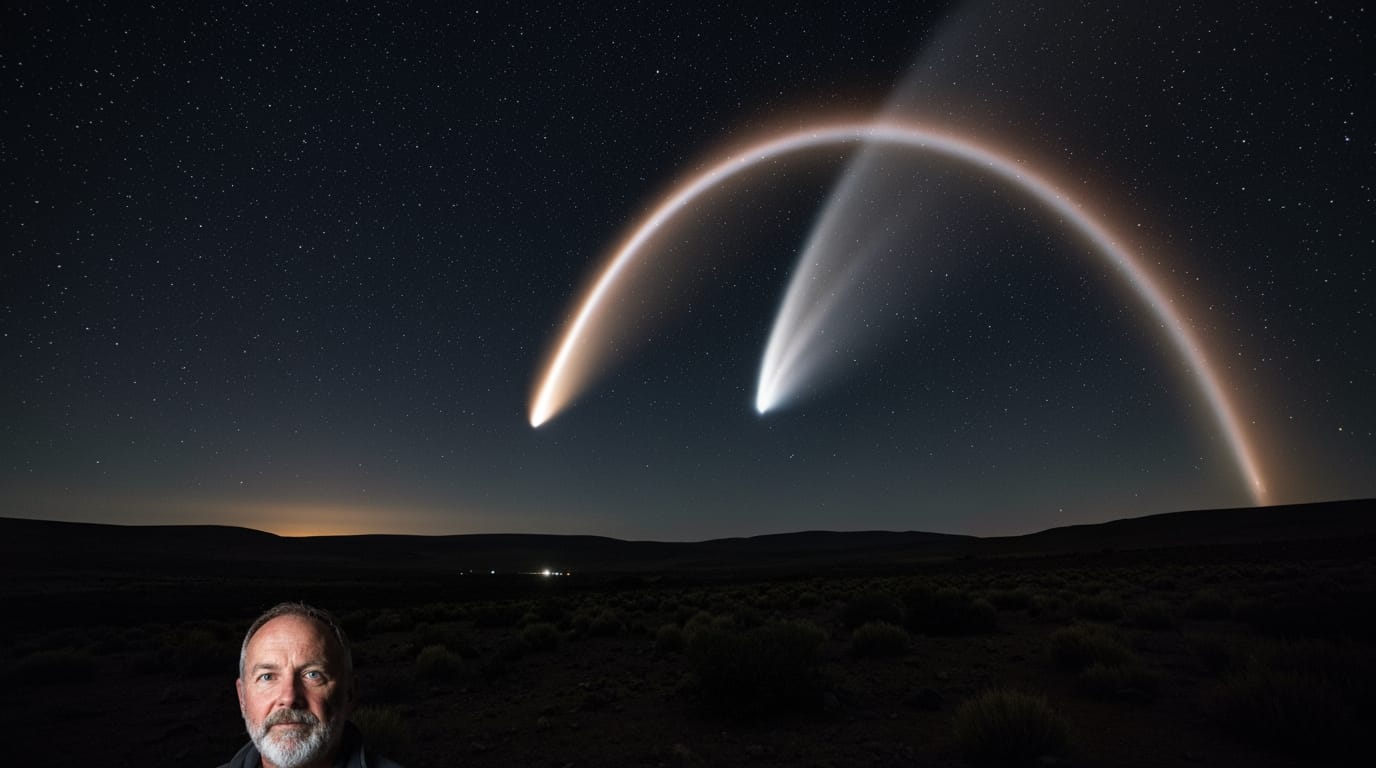
An enigmatic visitor from beyond our solar system, interstellar comet 3I/ATLAS, recently made its closest approach to Earth, providing scientists with an extraordinary opportunity to study an object born in a distant star system. Discovered just months ago, this celestial wanderer's fleeting passage underscores the dynamic nature of our galaxy and offers a rare window into the primordial building blocks of other planetary environments. Its journey has captivated astronomers worldwide, who have mobilized an extensive array of ground and space-based telescopes to glean as much data as possible from this unique encounter before 3I/ATLAS embarks on its permanent exit from our cosmic neighborhood.
A Serendipitous Discovery from Deep Space
Comet 3I/ATLAS, officially designated C/2025 N1 (ATLAS), was first identified on July 1, 2025, by the Asteroid Terrestrial-impact Last Alert System (ATLAS) survey telescope located in Río Hurtado, Chile. Initially appearing as a faint speck, its unusual trajectory quickly caught the attention of astronomers. Subsequent observations confirmed its hyperbolic orbit and high velocity, definitive characteristics that mark it as an interstellar object—meaning it did not originate within our solar system and is merely passing through. This designation makes 3I/ATLAS only the third confirmed interstellar object ever observed, following 1I/ʻOumuamua in 2017 and 2I/Borisov in 2019, cementing its status as a significant astronomical event. Scientists trace its origin to interstellar space, likely having drifted for millions or even billions of years from the direction of the constellation Sagittarius, near the Milky Way's Galactic Center.
The Close Encounter: Earth and the Sun
On December 19, 2025, 3I/ATLAS reached its closest point to Earth, passing at a distance of approximately 168 million miles (270 million kilometers), or 1.8 astronomical units (AU). While this distance is roughly twice that between Earth and the Sun, it presented no threat to our planet. This relatively close flyby, for an interstellar object, provided an optimal viewing window for observers. Avid stargazers, equipped with powerful binoculars or small telescopes, were able to catch a glimpse of the comet in the predawn sky, appearing as a glowing star beneath Regulus in the constellation Leo. For those unable to observe it directly, various online livestreams offered views of the rare event.
Prior to its Earth flyby, 3I/ATLAS also made its closest approach to the Sun, known as perihelion, on October 29, 2025 (or October 30, 2025). At perihelion, the comet was approximately 1.36 AU (203 million kilometers; 126 million miles) from the Sun, a position located between the orbits of Earth and Mars. During this period, the comet was moving at its maximum speed of about 153,000 miles per hour (246,000 kilometers per hour) relative to the Sun, a velocity too high to be gravitationally bound and confirming its hyperbolic trajectory. Its high velocity, 58 km/s (36 miles/s) relative to the Sun, is the highest among the three known interstellar objects. Notably, the comet's trajectory was closely aligned with the orbital planes of the solar system's planets.
Unveiling Cosmic Composition and Origins
One of the most compelling aspects of 3I/ATLAS is the invaluable information it carries regarding its birthplace. Scientists have categorized it as an active comet, characterized by a solid icy nucleus surrounded by a dynamic coma—a cloud of gas and icy dust escaping from its core. Observations by the Hubble Space Telescope estimated the comet's nucleus diameter to be between 0.32 kilometers (1,050 feet) and 5.6 kilometers (3.5 miles).
The composition of 3I/ATLAS has revealed intriguing details. Observations from the James Webb Space Telescope indicate it is unusually rich in carbon dioxide and contains traces of water ice, water vapor, carbon monoxide, and carbonyl sulfide. The Very Large Telescope detected emissions of cyanide gas and atomic nickel vapor at concentrations similar to comets originating within our solar system. Furthermore, the Neil Gehrels Swift Observatory detected hydroxyl (OH) gas, a clear chemical marker of water, even when the comet was far from the Sun. This suggests water activity at distances where it is not typically expected, potentially indicating a unique internal structure or composition. The detection of water and other volatiles provides crucial data for comparing the chemistry of planetary systems across the galaxy.
Remarkably, scientists estimate 3I/ATLAS could be among the oldest known comets, potentially over seven billion years old, and possibly as ancient as 11 billion years—approximately twice the age of our own solar system. This immense age suggests it may have originated from the Milky Way Galaxy's thick disk, a region home to older stars. Studying such ancient objects can provide insights into the early history of galaxy formation and the processes that shaped stellar nurseries billions of years ago.
A Fleet of Observers and Future Insights
The transient nature of interstellar objects makes every observation precious. An unprecedented global effort was launched to study 3I/ATLAS, involving a vast network of ground-based telescopes and advanced space missions. NASA's Hubble Space Telescope and James Webb Space Telescope provided high-resolution images and spectroscopic data. The Europa Clipper spacecraft, on its journey to Jupiter, made unique observations in November, viewing the comet when Earth-based perspectives were obscured by the Sun. Other missions, including NASA's TESS, Swift, Psyche, Mars Reconnaissance Orbiter (MRO), MAVEN, Lucy, PUNCH, and ESA's Juice mission, Mars Express, and ExoMars Trace Gas Orbiter, all contributed to the data collection. Notably, 3I/ATLAS became the first interstellar comet to be observed in X-ray light by XRISM and XMM-Newton. This comprehensive observational campaign is crucial as the comet quickly moves away, destined never to return to our solar system.
The ongoing analysis of the collected data promises to deepen our understanding of planet formation processes in other star systems. Each interstellar object detected so far has presented a distinct chemical profile, indicating a wide diversity of planetary environments throughout the cosmos. By examining the unique characteristics of 3I/ATLAS, scientists hope to gain critical clues into how exoplanetary systems evolve and the distribution of water and organic materials—essential ingredients for life—across the Milky Way. The detection of such objects also fuels the development of future missions, such as ESA's Comet Interceptor, which aims to be ready to study a pristine comet or, ideally, another interstellar visitor up close.
Conclusion
The fleeting visit of interstellar comet 3I/ATLAS represents more than just a cosmic spectacle; it is a profound scientific opportunity. As the third confirmed object of its kind to traverse our solar system, 3I/ATLAS has allowed astronomers to directly sample material from another star system, offering insights into conditions far beyond our Sun's influence. Its extreme age, unique composition, and hyperbolic trajectory make it a veritable "message in a bottle" from interstellar space. While 3I/ATLAS now recedes into the vastness of the galaxy, the extensive data gathered during its brief passage will continue to be analyzed for years to come, unlocking secrets about the origins of other worlds and enriching our understanding of the universe's intricate tapestry.