Myanmar Junta Airstrike on Hospital Kills Dozens, Deepening Humanitarian Crisis
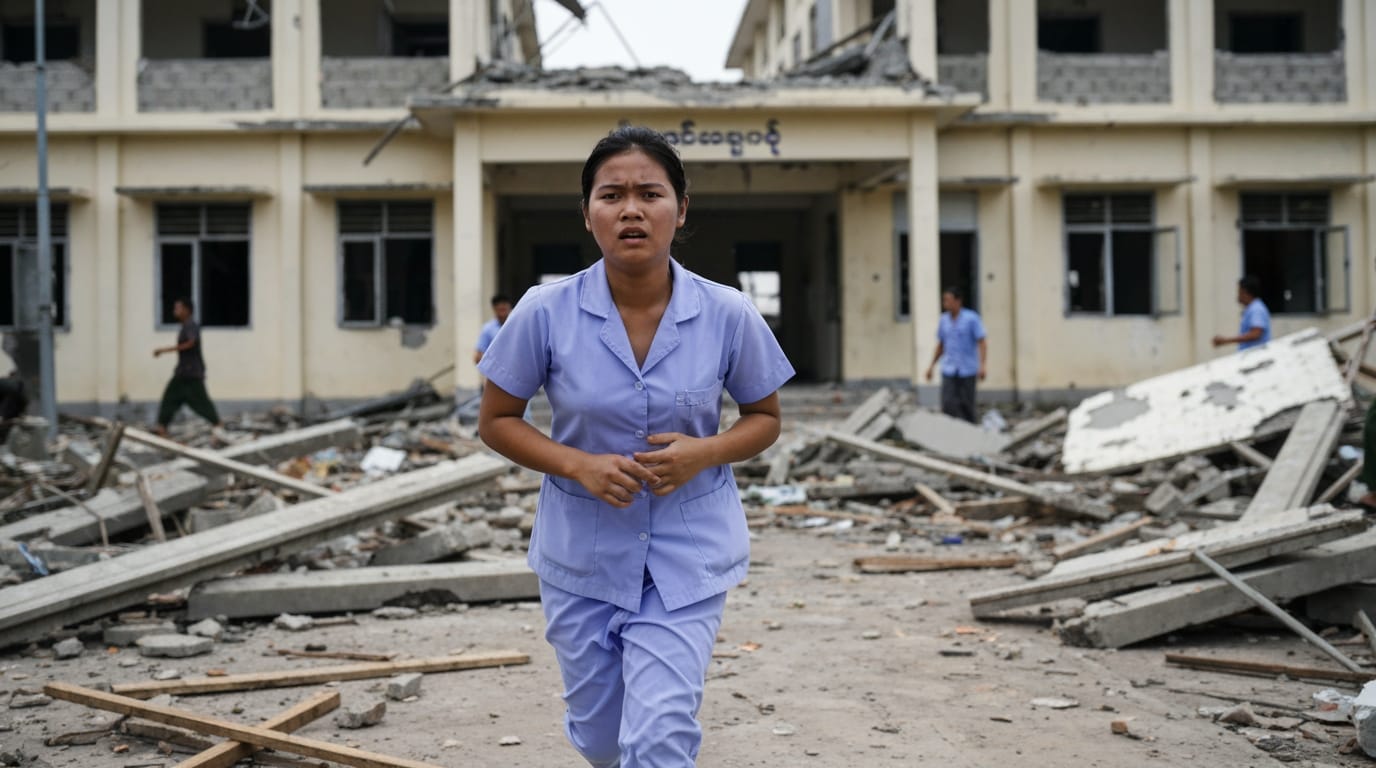
A recent airstrike by Myanmar's military junta on a hospital in Mrauk-U, Rakhine State, has resulted in the deaths of at least 33 people and left more than 70 wounded, further intensifying the nation's profound humanitarian catastrophe. The attack, which occurred on the evening of December 10, 2025, International Human Rights Day, destroyed critical medical infrastructure and underscores a disturbing pattern of deliberate targeting of civilian facilities amidst an escalating conflict that has gripped the country since the 2021 military coup.
Devastation in Mrauk-U
The Mrauk-U General Hospital, a vital medical center serving multiple townships under the control of the Arakan Army (AA), became the direct target of a military jet attack. Initial reports indicated 31 fatalities and 68 injuries, but the death toll quickly climbed to 33, comprising 16 men and 17 women, with injuries exceeding 70. Among the deceased were patients and caregivers, with at least 10 hospital patients killed instantly during the strike. Many of the wounded remain in critical condition, raising fears that the casualty figures could continue to rise. The aerial bombardment obliterated key sections of the hospital, including the main hall, operating theater, orthopedic ward, and staff quarters. Nearby residential homes were also damaged in the assault, which an aid worker described as occurring amidst the junta's escalating pre-election offensive. The Arakan Army has maintained control over Mrauk-U since February 8, 2024.
A System Under Siege: Attacks on Healthcare
This assault on the Mrauk-U hospital is not an isolated incident but rather a stark continuation of the military junta's systemic targeting of healthcare facilities and personnel since it seized power in February 2021. Data compiled by various organizations paints a grim picture of a healthcare system under deliberate siege. Between the 2021 coup and September 2022, 671 incidents of violence against healthcare were reported across Myanmar. This figure escalated to 1,687 incidents of violence against or obstruction of healthcare identified between February 2021 and June 2025. Almost three-quarters of these incidents involved the Myanmar Armed Forces utilizing drone and plane-delivered explosive weapons, missiles, and shelling. The human cost to medical professionals has been severe, with 151 health workers killed and 209 injured during the same period. The military has also arrested over 872 health workers associated with the anti-coup movement, drastically reducing healthcare operations, particularly in areas affected by conflict.
Myanmar's Deepening Civil War
The attack in Rakhine State unfolds against the backdrop of a protracted and brutal civil war that has intensified since the 2021 military coup, which abruptly ended a decade of democratic transition. The military takeover sparked widespread public opposition, leading to the formation of People's Defense Forces (PDFs) and a renewed alliance with various ethnic armed organizations (EAOs) that have historically fought for greater autonomy. The Arakan Army (AA), which controls Mrauk-U, is one of the most formidable opposition forces, reportedly holding sway over nearly all of Rakhine State's 17 townships.
The junta's strategy has increasingly relied on airstrikes to combat these resistance forces and regain control, leading to a surge in aerial bombardments each year since the coup. Despite these efforts, the military government now controls only an estimated 21 percent of the country's territory, while rebel forces and ethnic armies hold 42 percent. The conflict has displaced over 3.5 million people internally as of March 2025, exacerbating an already dire humanitarian situation.
Humanitarian Crisis and International Calls for Action
The ongoing violence has plunged Myanmar into a profound humanitarian crisis, with widespread human rights abuses reported by the United Nations. Civilian deaths since the 2021 coup have tragically surpassed 6,000 as of December 2024. UN experts have documented unlawful killings, torture, arbitrary detentions, and enforced disappearances as common tactics employed by junta forces.
International observers and human rights organizations have repeatedly condemned the junta's actions, particularly the targeting of civilians and essential infrastructure like hospitals. UN experts have called for a "course correction" in the international response, emphasizing that existing measures, while having some impact on reducing the junta's access to weapons, remain "grossly inadequate." They advocate for increased assistance to civil society organizations that document abuses and deliver humanitarian aid. The upcoming elections, scheduled to begin on December 28, are widely criticized by international observers and UN experts as a "fraud," designed to legitimize the junta's rule rather than reflect the will of the people.
Conclusion
The recent airstrike on Mrauk-U General Hospital represents a new low in Myanmar's escalating civil conflict, demonstrating the junta's continued disregard for international humanitarian law and the sanctity of civilian life. With dozens killed and critical medical facilities destroyed, the attack not only adds to the staggering death toll but also severely compromises access to life-saving care for a population already suffering immensely. As the conflict grinds on and the humanitarian crisis deepens, urgent and coordinated international action is imperative to protect civilians, hold perpetrators accountable, and push for a lasting resolution to the violence that has engulfed Myanmar. The international community faces a critical moment to recalibrate its approach and ensure that the people of Myanmar, particularly those in vulnerable conflict zones, receive the protection and assistance they desperately need.


