Robotic Runners Shatter Human Half-Marathon Record in Beijing
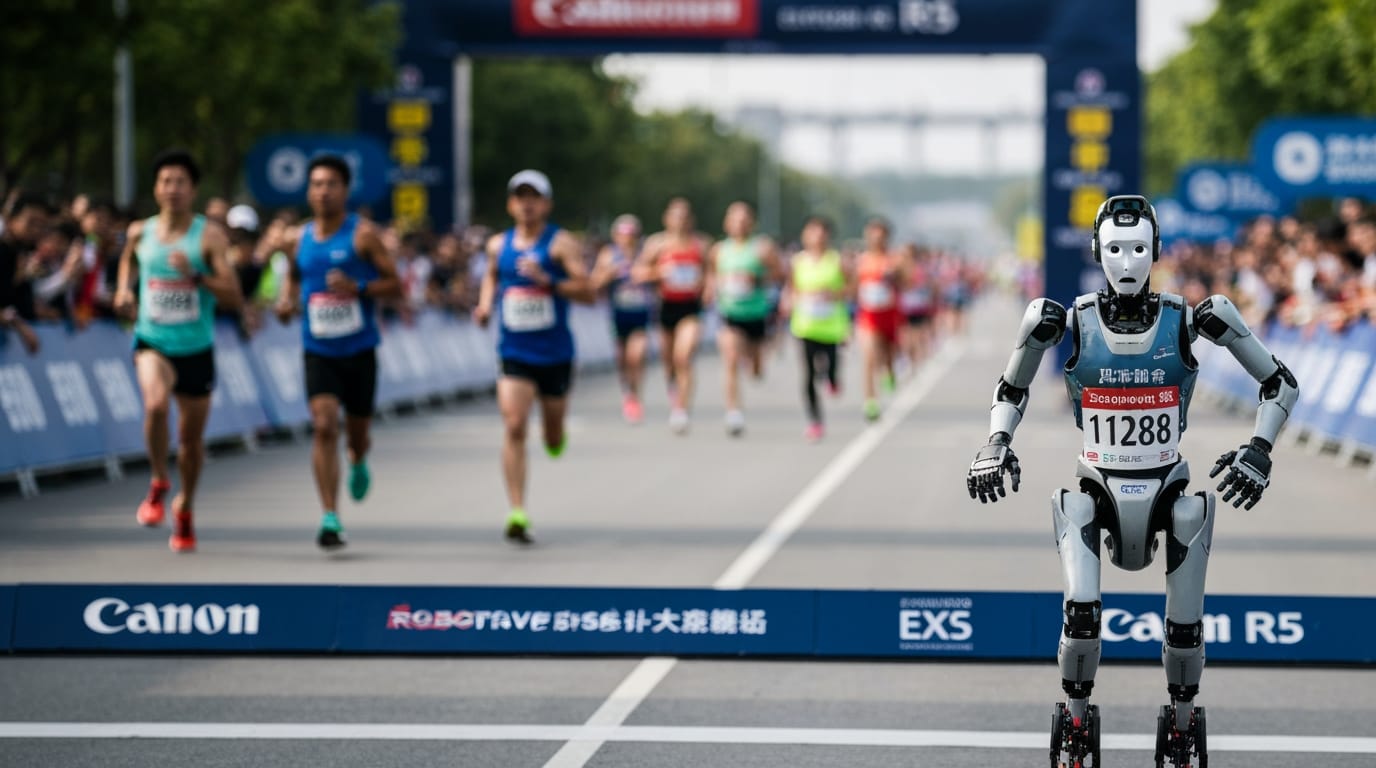
BEIJING – In a stunning display of advancing artificial intelligence and mechanical engineering, a humanoid robot on Sunday eclipsed the human world record for a half-marathon, completing the 21-kilometer race in Beijing in just 50 minutes and 26 seconds. The groundbreaking performance marks a significant milestone in robotic development and signals a new era for advanced machines.
The event, part of the second Beijing E-Town Half Marathon and Humanoid Robot Half-Marathon, saw a cutting-edge unit developed by Honor, a prominent Chinese smartphone manufacturer, cross the finish line with a time that decisively outpaced the current human male world record. Uganda's Jacob Kiplimo holds that distinction with a time of approximately 57 minutes, set just last month in Lisbon. The robot's achievement, which occurred in the Beijing Economic-Technological Development Area, has ignited discussions worldwide about the future capabilities of humanoid robots and China's rapid ascent in the field of advanced robotics.
A Leap Forward in Robotic Athletics
The dramatic improvement in robotic performance is particularly striking when compared to the inaugural event held just one year prior. In 2025, the winning robot completed the half-marathon distance in a considerably slower 2 hours, 40 minutes, and 42 seconds. This year's race showcased a stark reversal in capabilities, with over 100 domestically produced humanoid robots participating, a substantial increase from the approximately 20 teams in the previous year. Several robots demonstrated speed and stability that rivaled, and in the case of Honor's champion, surpassed, professional human athletes.
The winning Honor robot, along with its autonomous runners-up who finished around 51 and 53 minutes, represented a triumph of specialized engineering. Engineers specifically designed the champion unit to mimic elite human biomechanics, featuring legs proportioned at 90 to 95 centimeters to replicate the stride of a professional distance runner. Furthermore, it incorporated liquid cooling technology, adapted from Honor's smartphone division, to manage heat efficiently during sustained exertion, a critical factor for endurance in high-performance robotics. While approximately 40% of the robots navigated the course autonomously, others were remotely controlled, indicating a diverse range of technological approaches within the competition. Despite the impressive speeds, the race was not without its challenges; some robots faltered at the starting line, others collided with barriers, and the winning unit itself required assistance after impacting a guardrail near the finish. These minor setbacks, however, did little to detract from the overall spectacle and the overriding message of rapid technological advancement.
China's Strategic Drive in Robotics
This unprecedented robotic feat is not merely a sports novelty but a potent symbol of China's aggressive national strategy to dominate the frontier humanoid robotics industry. The event underscores Beijing's commitment to its latest five-year plan (2026-2030), which explicitly vows to "target the frontiers of science and technology." Speeding up the development and application of products like humanoid robots is a cornerstone of this ambitious plan for the world's second-largest economy.
The government has implemented a comprehensive suite of policy support measures, including substantial industrial subsidies and massive infrastructure projects, all designed to cultivate a competitive ecosystem for local firms. This strategic focus was also prominently featured during China's most-watched television event, the CCTV Spring Festival gala in February, which included sophisticated demonstrations of robotic dexterity. As the technology transitions from controlled environments to complex real-world scenarios, the implications for global industry and national security are profound, intensifying the technological competition with nations like the United States.
Implications for a New Era
The success of humanoid robots in an endurance event like the half-marathon extends far beyond the realm of athletics. It serves as a proof-of-concept for deployments in numerous industrial and commercial applications, where robustness, speed, and endurance are paramount. Experts suggest that advancements in robotic running can transfer directly into enhanced structural reliability and improved cooling systems, opening doors for robots to perform more complex and demanding tasks in various sectors.
The event captivated spectators, many of whom expressed awe and excitement at witnessing history unfold. Sun Zhigang, a returning spectator, noted the "enormous changes" from last year, remarking, "It's the first time robots have surpassed humans, and that's something I never imagined." Another observer, Wang Wen, commented that the robots seemed to have "stolen much of the spotlight" from human runners, adding, "This may signal the arrival of sort of a new era." For younger generations, the spectacle proved inspiring. Eleven-year-old Guo Yukun, for instance, indicated that the competition motivated him to pursue robotics studies. These reactions highlight a growing societal acceptance and anticipation of advanced robotics integrating more deeply into daily life.
Conclusion
The Beijing Half-Marathon's robotic division has provided a powerful demonstration of how rapidly technological boundaries are being pushed. The ability of humanoid robots to achieve and surpass human athletic records underscores not only China's significant investment and progress in AI and robotics but also foreshadows a future where the physical capabilities of machines could routinely exceed those of their human creators. This race is more than just a competition; it is a vivid illustration of a world on the cusp of an era where the lines between human and machine performance continue to blur, ushering in new possibilities and challenges across industries and society at large.


