South Korean President Lee Jae Myung Arrives in India, Setting Stage for Major Economic Overhaul with Modi
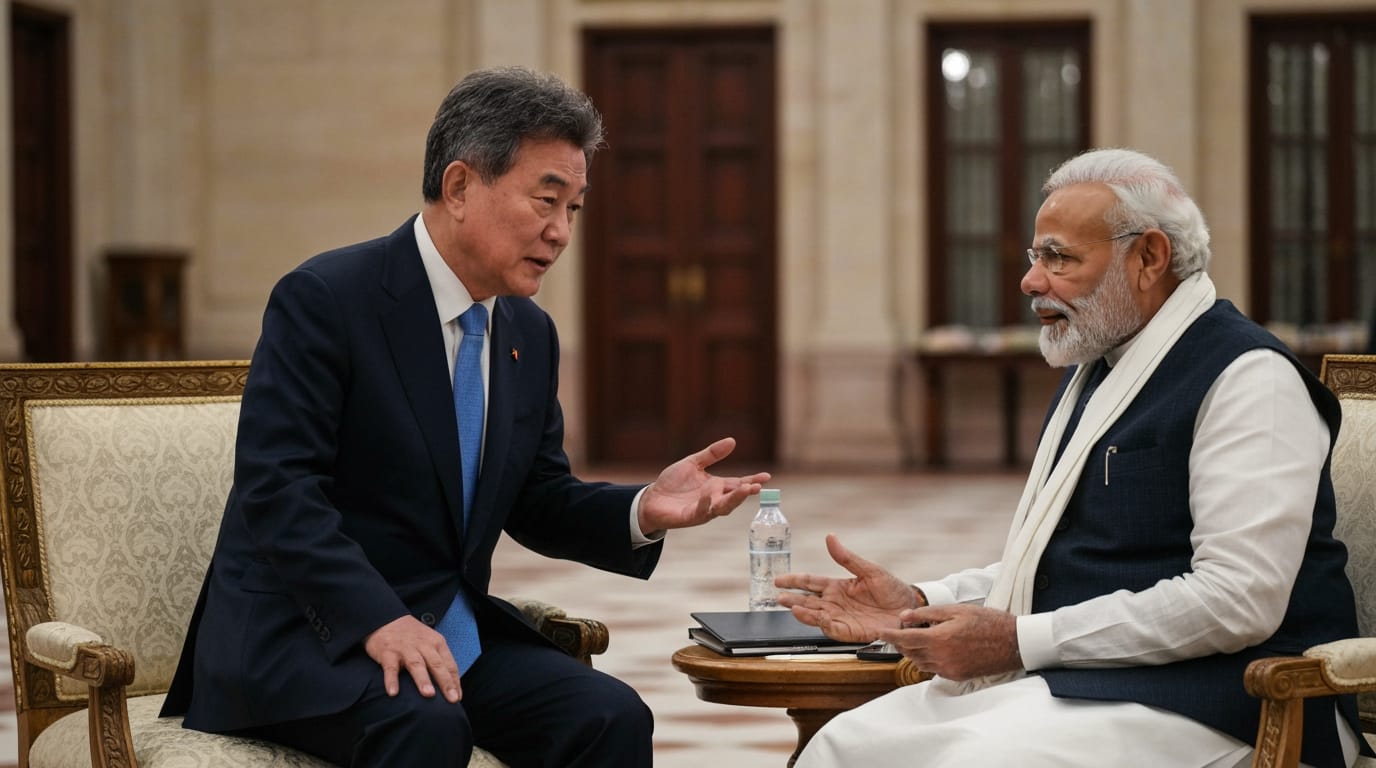
New Delhi, India – South Korean President Lee Jae Myung commenced a pivotal three-day state visit to India on Sunday, April 19, marking the first such presidential delegation in eight years and signaling a robust commitment to deepening economic and strategic ties with Prime Minister Narendra Modi's administration. The high-profile visit, extending until April 21, aims to significantly elevate the "Special Strategic Partnership" between the two nations, with a bold ambition to nearly double bilateral trade to an unprecedented $50 billion by 2030. Discussions between the leaders are poised to cover a comprehensive agenda, including shipbuilding, advanced technology, investments, artificial intelligence, semiconductors, defense production, and green energy, highlighting a mutual drive to forge closer cooperation amidst evolving global dynamics.
Renewed Economic Ambitions Drive Bilateral Dialogue
The core of President Lee's visit revolves around an ambitious economic agenda, particularly the goal of boosting bilateral trade from the current $25.7 billion to $50 billion within the next seven years. This target underscores a shared recognition that the existing level of economic cooperation, while substantial, remains below its full potential. The Comprehensive Economic Partnership Agreement (CEPA), in effect since January 2010, has served as a foundational framework for trade relations, leading to a significant increase in trade volume over the years. However, both nations are keen to improve and expand this agreement to unlock further growth.
Key discussions during the visit are expected to focus on specific sectors where South Korea's advanced industrial capabilities can complement India's burgeoning market and manufacturing aspirations. Shipbuilding, a sector where South Korea holds a dominant global position, is high on the agenda, offering potential for significant collaboration and investment in India's maritime industry. Furthermore, the talks will delve into accelerating cooperation in critical technologies such as artificial intelligence, semiconductors, and green energy, areas vital for future economic growth and technological independence for both countries. Investments are also a crucial component, with South Korea already a significant foreign direct investor in India, particularly in metallurgy, automotive, and electronics sectors. This visit seeks to foster an environment conducive to further Korean investments in India and to explore avenues for Indian companies to expand their presence in South Korea.
Addressing Trade Imbalances and Bolstering Supply Chain Resilience
A significant aspect of the trade discussions will be addressing the persistent trade imbalance, which has seen India facing a growing deficit with South Korea. While South Korean exports to India have surged, India has sought greater market access for its products, particularly in agriculture, marine products, information technology, and services. The current negotiations to improve the CEPA aim to rectify this disparity by reviewing tariffs and non-tariff barriers that impede Indian exports.
The global landscape, marked by supply chain instabilities and economic uncertainties, including those linked to conflicts in the Middle East, has amplified the urgency for both nations to diversify their partnerships and strengthen supply chain resilience. President Lee emphasized that these global strains position India and South Korea as "the most important strategic partners" for each other. In a tangible sign of this, South Korea recently appealed to India to expand naphtha supplies to mitigate potential disruptions, with India currently accounting for approximately 8% of South Korea's naphtha imports. This highlights India's evolving role from merely a consumer market to a crucial player in global production and supply chains, a sentiment echoed by President Lee.
Deepening the "Special Strategic Partnership"
Beyond economic considerations, President Lee's visit aims to reinforce the "Special Strategic Partnership" established between India and South Korea in 2015. This partnership encompasses cooperation across a wide spectrum, including defense production, a sector where both countries see considerable potential for collaboration and co-production, aligning with India's "Make in India" initiative. The discussions will also touch upon regional and global issues of mutual interest, reflecting a convergence of views on maintaining stability and prosperity in the Indo-Pacific region.
The leaders are expected to explore new avenues for cooperation in emerging technologies, which are increasingly seen as strategic assets. This includes joint ventures and research in areas like semiconductors, considered vital for national security and economic competitiveness. The engagement extends to people-to-people connections and cultural exchanges, recognizing the importance of fostering deeper understanding and goodwill between the two vibrant democracies. External Affairs Minister S. Jaishankar met President Lee upon his arrival, praising the South Korean President's dedication to strengthening bilateral relations across various domains and expressing confidence that the talks with Prime Minister Modi would further solidify the special strategic partnership.
Historical Context and Future Vision
The economic relationship between India and South Korea has witnessed substantial growth over decades, evolving from modest beginnings in the early 1990s. Bilateral trade surged from $530 million in 1992-1993 to $15.6 billion in 2008, prior to the CEPA's implementation. The CEPA's operationalization in 2010 further spurred this growth, leading to bilateral trade reaching over $17.11 billion in its first year and $20.55 billion by the end of 2011. Major South Korean conglomerates like Samsung, Hyundai, and LG have established a significant manufacturing presence in India, while Indian firms such as Tata Motors have invested in South Korea.
This current visit, coming eight years after the last South Korean presidential state visit, serves as a testament to a renewed focus on accelerating this partnership. President Lee's assertion that the relationship should become "completely different from what it is now" underscores a vision for a more integrated and strategically aligned future. This includes leveraging India's large market and skilled workforce, and South Korea's technological prowess and manufacturing expertise, to create a synergistic relationship that benefits both economies and contributes to regional stability.
Conclusion
President Lee Jae Myung's state visit to India marks a critical juncture in the bilateral relationship, emphasizing a mutual desire for an amplified strategic and economic partnership. The ambitious trade target of $50 billion by 2030, coupled with focused discussions on areas ranging from shipbuilding and advanced technology to defense cooperation and supply chain resilience, reflects a comprehensive approach to engagement. Amidst a complex global environment, the leaders' commitment to improving existing trade agreements and exploring new avenues of collaboration underscores a shared understanding of the need for stronger alliances. As India emerges as a global production hub and South Korea seeks diversified partnerships, this visit lays the groundwork for a more robust, interconnected, and strategically aligned future, poised to shape the dynamics of the Indo-Pacific region.