SpaceX Soars in Historic IPO, Propelling Elon Musk to "Paper Trillionaire" Status
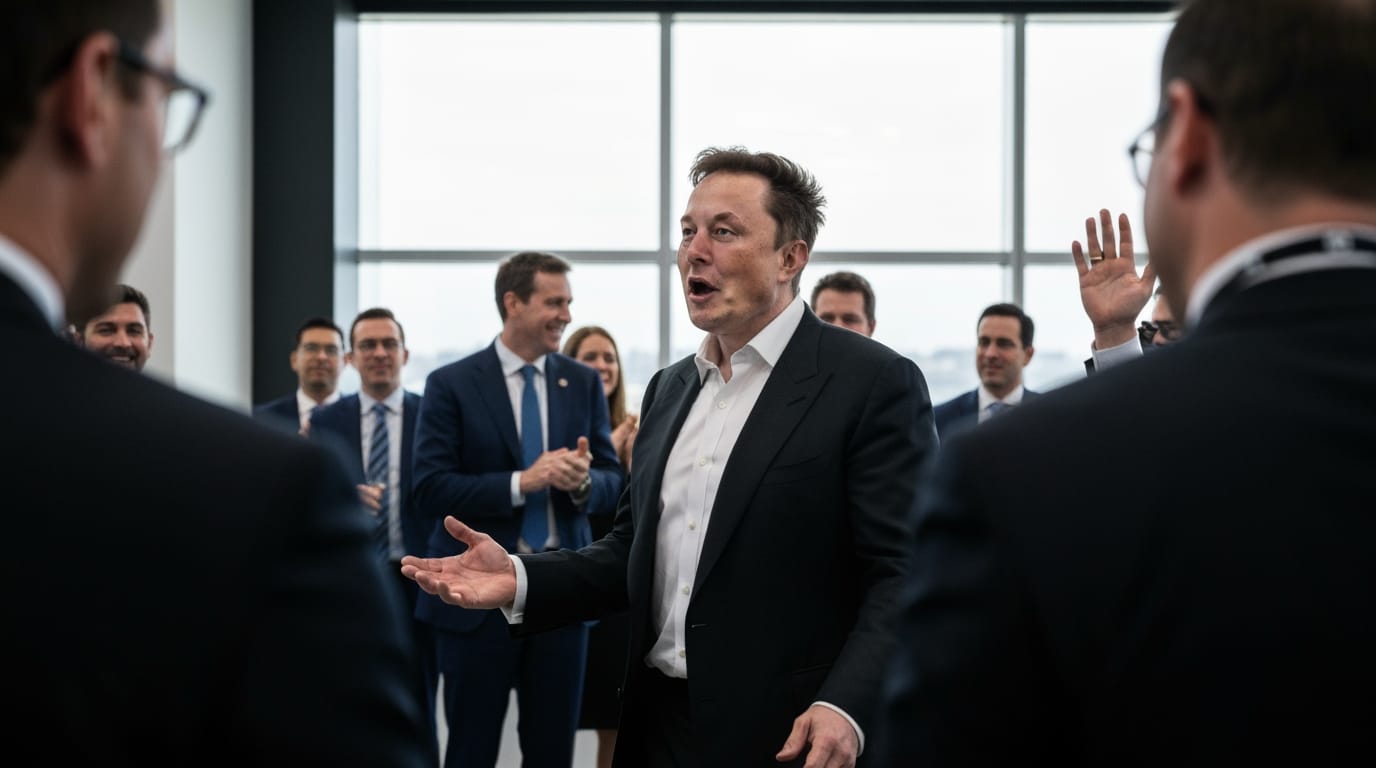
In a monumental shift for global finance and the burgeoning space industry, Space Exploration Technologies Corp. (SpaceX) made its eagerly anticipated public debut on the Nasdaq exchange today, June 12, 2026, under the ticker symbol SPCX. The record-breaking initial public offering (IPO), which valued the company at an astronomical $1.77 trillion, immediately solidified its position as the largest IPO in history and, perhaps more notably, elevated its founder and CEO, Elon Musk, to the unprecedented status of the world's first "paper trillionaire." The successful listing marks a pivotal moment for a company that began with modest ambitions and has since grown into a multi-faceted enterprise spanning rocket technology, global satellite internet, and artificial intelligence.
A New Era of Public Markets: SpaceX's Unprecedented Debut
SpaceX priced its shares at $135 each, a figure that attracted overwhelming investor demand, reportedly three to four times oversubscribed, leading to a raise of approximately $75 billion. This offering far surpassed the previous record held by Saudi Aramco in 2019, underscoring the extraordinary market appetite for ventures at the frontier of technology and space. Public trading commenced with a strong surge, with shares opening at $150 and climbing as high as $168.75 in early trading, pushing the company's market capitalization above $2 trillion.
The IPO was not without its distinctive features. SpaceX opted for a fixed IPO price rather than the customary range, a move some analysts attributed to Musk's desire to control the terms of the listing and capitalize on immense investor enthusiasm. Retail investors also saw an unusual opportunity, with up to 30% of the float allocated to them, a significantly higher percentage than typically observed in mega-cap IPOs. This broad accessibility, facilitated by online brokerages, reflects a growing trend towards democratizing access to high-profile public offerings. During the ceremonial bell-ringing from Starbase, Texas, Musk reiterated his ambitious vision, declaring SpaceX's mission "to make life multi-planetary" and extending an invitation to "whoever you are watching this, SpaceX wants to be able to take you to the moon, take you to Mars and ultimately beyond."
Elon Musk: The World's First Paper Trillionaire
The immediate aftermath of the IPO propelled Elon Musk's net worth to an estimated $1.1 trillion, based on his substantial ownership stakes in both SpaceX and Tesla. As the founder and CEO, Musk holds approximately 42% of SpaceX's equity and an commanding 85% of its voting shares, providing him with significant control over the company's direction. This unprecedented accumulation of wealth, primarily in the form of company stock, defines his status as a "paper trillionaire"—a fortune realized on paper through market valuation rather than immediate liquid assets.
Prior to the IPO, Musk was already the world's wealthiest individual, with his net worth nearing $971 billion according to Bloomberg and $982 billion by Forbes' estimates, primarily driven by his holdings in Tesla and his private stake in SpaceX. The successful public offering has further cemented this lead, placing his wealth far beyond that of other financial titans. The non-profit organization Oxfam highlighted the stark implications of this milestone, noting that Musk's net worth now exceeds the combined wealth of the poorest 46% of the global population, or approximately 3.8 billion people.
The Galactic Scope of SpaceX's Empire
SpaceX has evolved significantly since its founding in 2002, moving beyond its foundational work in reusable rocket technology to encompass a vast array of ambitious projects. The company's operations are now broadly categorized into three main pillars: advanced launch services (featuring its Falcon rockets and the ambitious Starship program), the global satellite internet constellation Starlink, and the recently merged artificial intelligence entity, xAI.
Starlink, the satellite internet service, has emerged as a significant revenue driver, accounting for $11.4 billion of SpaceX's total $18.7 billion revenue in 2025. Despite this robust top-line growth, SpaceX reported substantial net losses, including $4.94 billion in 2025 and $4.28 billion in the first quarter of 2026. These losses are largely attributed to heavy capital expenditures in developing the Starship program, expanding the Starlink constellation, and significant investments in AI infrastructure, particularly following the February 2026 merger with xAI, which was valued at $1.25 trillion. The company's future plans include deploying orbital data centers, establishing a human settlement on Mars, and competing with leading AI firms like Anthropic and OpenAI. These ventures, while requiring immense capital, underscore SpaceX's commitment to pushing technological boundaries and realizing what Musk describes as a "multi-planetary future."
Balancing Vision with Market Realities
The extraordinary valuation and record-breaking nature of the SpaceX IPO have garnered widespread attention, but also sparked considerable debate among financial analysts. While many investors are captivated by the "Elon premium" – a perceived confidence in Musk's ability to execute his audacious visions – others express significant caution. Investment research firm Morningstar, for instance, suggested that SpaceX is "significantly overvalued," assigning a fair value of $63 per share, a stark contrast to the $135 IPO price. Morningstar analysts pointed to a "major disconnect between market expectations and underlying fundamentals," particularly regarding the unproven nature of many technologies underpinning the valuation, especially within the AI business.
Concerns also revolve around the company's corporate governance structure. With Elon Musk retaining 85% of voting power through a dual-class share structure, critics highlight a lack of independent board oversight and potential risks for public shareholders. The capital-intensive nature of SpaceX's operations, the inherent risks associated with advanced aerospace and AI development, and the current lack of profitability are additional points of scrutiny. Despite these reservations, the immense demand for SpaceX shares and the company's clear trajectory in both space and artificial intelligence signal a transformative moment, not just for the company, but for the broader investment landscape and the future of technological innovation.
In conclusion, SpaceX's historic IPO has undeniably reshaped the financial world, creating a new benchmark for public offerings and crowning Elon Musk as the first paper trillionaire. This landmark event not only provides SpaceX with a massive influx of capital to fuel its audacious goals of space colonization and advanced AI development but also ignites a global conversation about wealth concentration, market valuation in an era of unprecedented technological ambition, and the future role of private enterprise in shaping humanity's destiny. The coming years will reveal whether the market's current enthusiasm for SpaceX's grand vision will translate into sustained profitability and the realization of its multi-trillion-dollar potential.


