Trump Tariffs Stoke Fears of US-China Decoupling
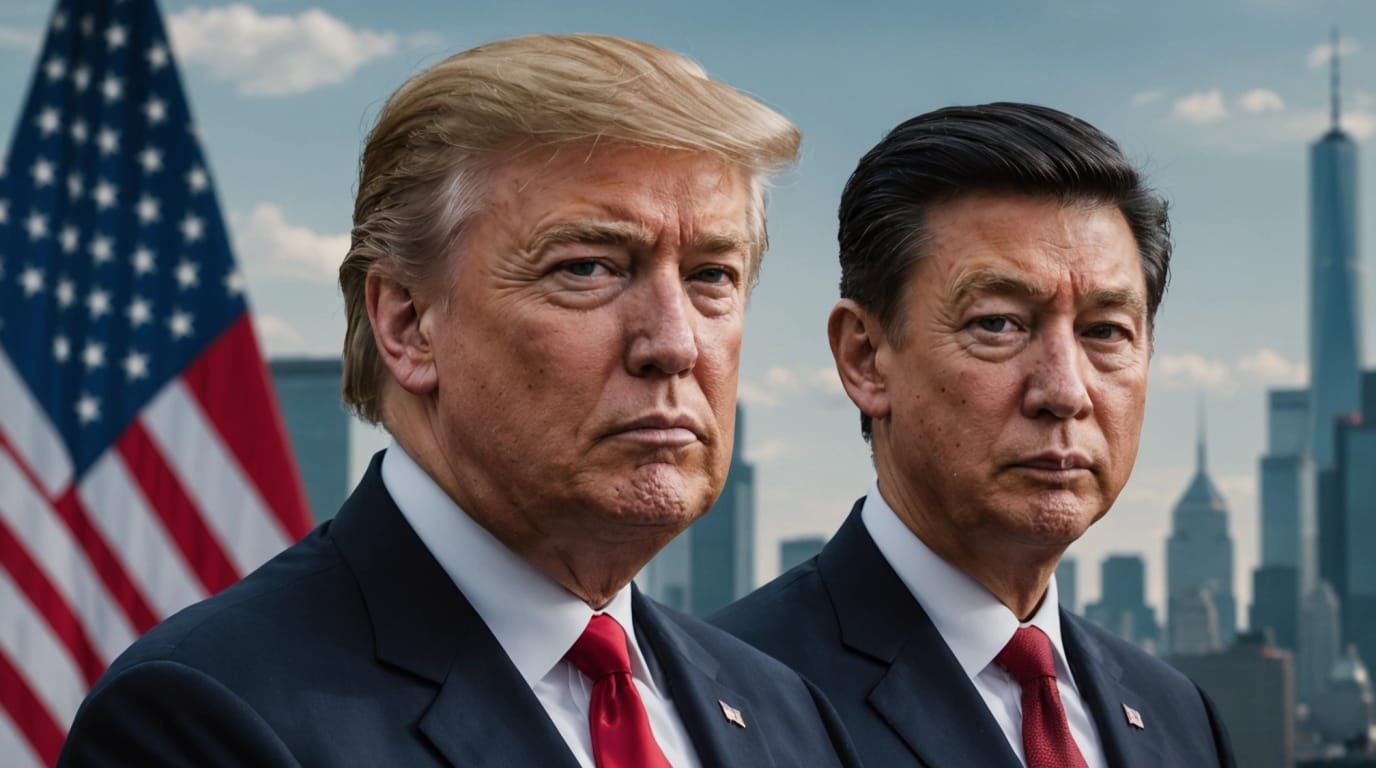
A renewed trade war between the United States and China is intensifying concerns about a potential decoupling of the world's two largest economies. Increased tariffs imposed by the Trump administration are raising costs for businesses and consumers, disrupting supply chains, and fueling geopolitical tensions.
The latest escalation began after President Donald Trump, on what he termed "liberation day" on April 2, implemented sweeping tariffs on nearly every country, including those with no trade relations with the U.S. China was hit with a 34% tariff in addition to a pre-existing 20% levy on all Chinese goods. Beijing retaliated with a 34% counter-tariff on U.S. imports and vowed to "fight to the end." Trump responded by raising the duty rate on Chinese goods further to 125%.
Tariff Increases and Global Impact
On April 9, Trump announced a 90-day pause on higher-than-10% reciprocal tariffs for most countries, excluding China. Instead, he raised the duty rate on Chinese goods to 125%, resulting in a minimum tariff rate of 145% on all exports to the United States. These tariffs are in addition to the previous 20% tariffs imposed.
Economists estimate that after 50%, increasing tariffs has a limited impact because trade between the U.S. and China significantly decreases. China has responded in self-defense to Trump's tariffs.
The trade war is already having a significant impact on global markets. The World Trade Organization (WTO) Director-General Ngozi Okonjo-Iweala warned of a "significant risk of a sharp contraction in bilateral trade" between the U.S. and China, with preliminary projections suggesting a potential decrease of as much as 80% in merchandise trade between the two economies.
Decoupling Concerns and Shifting Supply Chains
The trade war is accelerating the decoupling between China and the United States. This shift was already underway during Trump's first administration and continued under President Joe Biden. By 2023, China's exports to the United States were approximately 13% of its total exports, compared to nearly 20% in 2016. Imports had decreased to 7% from almost 10%.
The U.S.-China trade war has led many multinational corporations to reconsider their dependence on China-centric supply chains. Countries like Vietnam, India, and Indonesia have emerged as attractive alternatives for manufacturing relocation due to their large labor forces and competitive production costs. Vietnam's exports to the U.S. grew by nearly 35% between 2018 and 2019 as companies shifted production.
However, this transition is not without challenges. China possesses unparalleled infrastructure, a vast skilled labor pool, and efficient logistics networks. Scaling up manufacturing in alternative hubs is hampered by bureaucratic hurdles, insufficient infrastructure, and political instability.
Winners and Losers
While the trade war creates uncertainty and disruption, some countries may benefit. Brazil could increase exports of soybeans to China, while Taiwan and South Korea could increase purchases of U.S. soybeans. The U.S. battery-storage sector faces uncertainty due to the tariffs but could emerge stronger over the long term.
The tariffs have come as a major shock to Chinese companies, for whom the U.S. is a key export market. China's exports to the U.S. are mostly electrical goods and vehicles. On the other hand, the U.S. exports mainly agricultural produce, machinery, aircraft, and pharmaceuticals to China.
Analysts expect China's markets to shrink due to the U.S. tariffs. Morgan Stanley estimates that the Chinese economy could weaken by 1.5 to 2 percentage points this year. China could test further retaliatory measures on the U.S., including halting imports of U.S. agricultural produce and restricting exports of critical metals and minerals.
Geopolitical Implications
The U.S.-China decoupling extends beyond economic ramifications, significantly influencing global politics. The competition between these superpowers has led to a realignment of international alliances and policies. The U.S. aims to curb China's technological advancements, particularly in AI and 5G, by imposing export restrictions and encouraging allies to follow suit.
Some experts believe that the trade war could escalate security tensions and potentially turn violent. The U.S. government is focused on weakening and containing China because they see China as the only country powerful enough to challenge the global dominance of the United States economically, technologically, militarily, and politically.
Long-Term Outlook
The long-term effects of the U.S.-China trade war are uncertain. Some analysts believe that the decoupling of the two economies is inevitable, while others argue that the two countries will find a way to coexist.
China may see an abrupt decoupling from the United States as unpleasant, but it also fits in with China's long-term goal of rebalancing its economy toward one that is far more reliant on domestic consumption.
The trade war is a complex issue with no easy solutions. The outcome will depend on the decisions made by leaders in both countries.
Conclusion
The escalating trade war between the U.S. and China is raising concerns about a potential decoupling of the world's two largest economies. Increased tariffs are disrupting supply chains, raising costs for businesses and consumers, and fueling geopolitical tensions. While some countries may benefit from the trade war, the overall impact on the global economy is likely to be negative. The long-term effects of the trade war are uncertain, but it is clear that the relationship between the U.S. and China is undergoing a significant transformation.


