Albanian Police Clash with Protesters as 'Flamingo Revolution' Intensifies
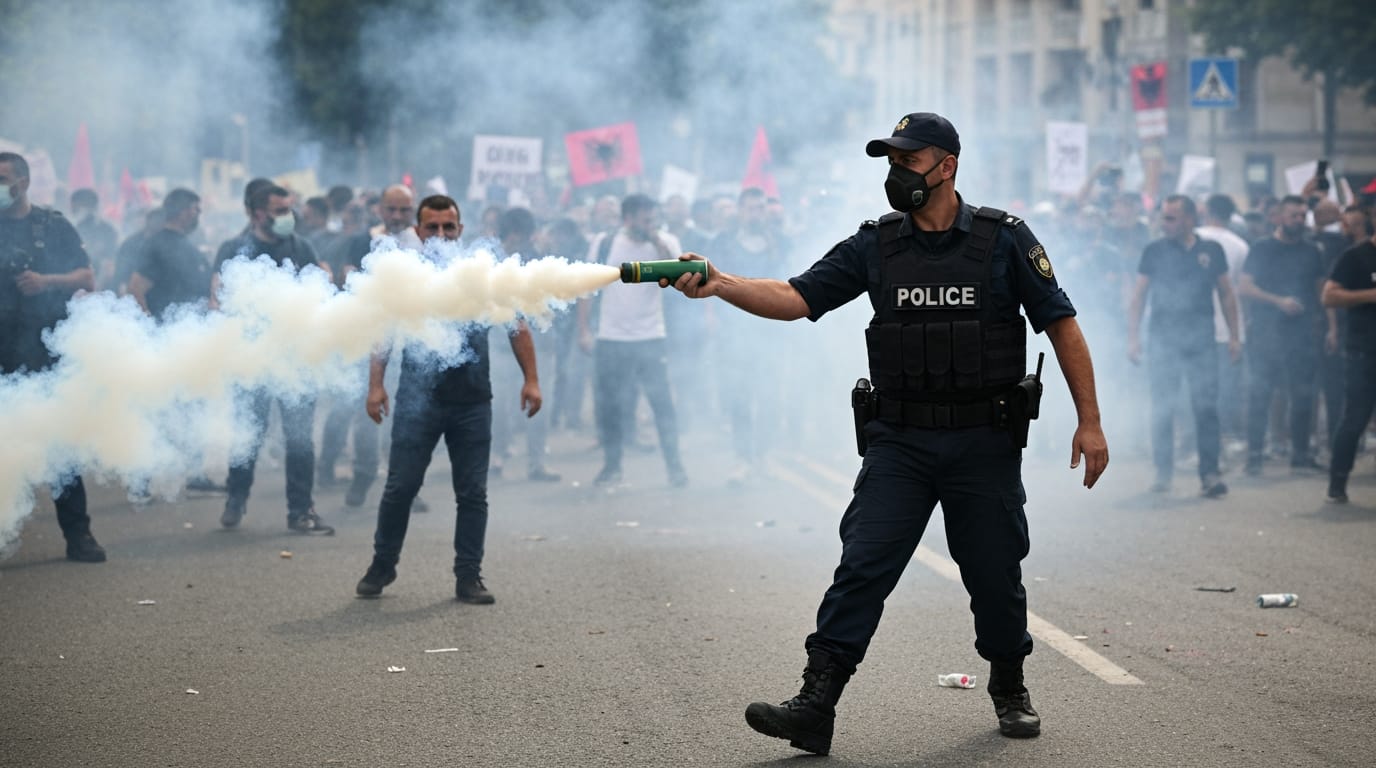
Tirana, Albania – Albanian police deployed tear gas, pepper spray, and water cannons on Thursday to disperse anti-government protesters in downtown Tirana, as a month-long movement dubbed the "Flamingo Revolution" escalated into violent clashes. The demonstration, centered around the parliament building, saw hundreds of citizens confronting security forces, leading to injuries on both sides and multiple arrests. The protests, initially sparked by a controversial luxury resort development linked to American investor Jared Kushner, have since broadened into a nationwide outcry against corruption, environmental degradation, and perceived governmental opacity.
The confrontations on Thursday marked a significant escalation in the "Flamingo Revolution," a movement that began as a local environmental struggle and has transformed into a powerful expression of discontent against Prime Minister Edi Rama's administration. Protesters hurled rocks, eggs, and plastic bottles at police, with some using a metal barrier to smash the windows of a police car. Authorities reported that at least 12 police officers were injured, and 18 protesters were detained during the unrest. This incident follows weeks of daily demonstrations that have seen tens of thousands take to the streets, with a major rally on June 20 drawing an estimated quarter-million participants across the country.
The Genesis of a Movement: Environmental Outcry Meets Development Ambitions
The seeds of the "Flamingo Revolution" were sown on May 23, 2026, in the small village of Zvërnec, near the ecologically vital Narta Lagoon. Local residents and environmental activists gathered to protest the barbed-wire fencing of the Pishë Poro-Narta beach, a protected area slated for a large-scale luxury tourism development. This project, involving the construction of resorts on Sazan Island and in the Narta Lagoon, has garnered international attention due to the involvement of Jared Kushner, son-in-law of former U.S. President Donald Trump, and his company, Affinity Partners.
The Vjosa–Narta wetland ecosystem, designated as a protected landscape, is a critical habitat for over 200 species, including the Greater Flamingo, loggerhead turtles, and the critically endangered Mediterranean monk seal. Environmentalists and local communities argue that the proposed development threatens to irreversibly damage this pristine natural environment. Critics point to amendments made in 2024 to Albania's Law on Protected Areas, which they claim weakened existing environmental safeguards and paved the way for such projects by subordinating conservation objectives to private interests. Initial confrontations in Zvërnec on May 30, where private security personnel reportedly attacked protesters while state police did not intervene, served as a catalyst, propelling the movement beyond local concerns.
From Local Grievances to National Discontent
Following the Zvërnec incident, the protests rapidly expanded, reaching Tirana on May 31 and subsequently spreading to other Albanian cities, Kosovo, and Albanian diaspora communities worldwide. The initial environmental focus quickly evolved into a broader critique of governance, corruption, and what many perceive as a lack of transparency in large-scale development projects. Protesters have increasingly called for the resignation of Prime Minister Edi Rama and demanded greater political accountability and anti-corruption measures.
The movement's evocative name, the "Flamingo Revolution," emerged from the widespread use of flamingo cutouts and inflatable flamingos as symbols during demonstrations. This imagery serves as a powerful, non-partisan emblem of the threatened biodiversity and the civic nature of the protests. Slogans like "Albania is not for sale" and "Albania belongs to Albanians, not to oligarchs" resonate widely, reflecting deep-seated public anger over alleged sweetheart deals benefiting politically connected business interests and foreign investors.
A Crisis of Trust and Representation
The "Flamingo Revolution" is characterized by a decentralized leadership, with a significant role played by Generation Z and Millennial protesters, civil society groups, and environmental activists. This distinguishes it from previous mobilizations in post-communist Albania, as it targets both the ruling party and the traditional opposition, highlighting a profound crisis of political representation and public trust in established institutions. Commentators suggest the protests expose "systemic weaknesses" in Albania, including concerns about oligarchic influence, opaque decision-making processes, and a media landscape perceived as compromised.
The Albanian government, for its part, has defended the Kushner-linked project as a transformative investment essential for boosting high-end tourism and supporting the nation's aspirations for European Union membership. Prime Minister Rama has largely dismissed the environmental objections as misinformation and, at times, characterized segments of the movement as part of a "hybrid war" driven by disinformation. However, public pressure has led to official action, with Albania's Special Structure Against Corruption and Organized Crime (SPAK) initiating an investigation into the project, particularly focusing on the controversial 2024 amendments to the Law on Protected Areas.
Implications for Albania's Future
The clashes in Tirana underscore the deep divisions within Albanian society regarding the country's development path and governance. What began as a focused environmental protest has blossomed into Albania's largest civic movement since the fall of the Stalinist regime in the early 1990s, signaling widespread dissatisfaction with the political elite and the socio-economic model that has defined the nation for decades.
As the "Flamingo Revolution" continues, its trajectory remains uncertain. However, it has undeniably forced a national reckoning with issues of environmental protection, transparency, and accountability. The sustained mobilization of citizens, particularly the youth, coupled with the increasing international scrutiny, suggests that the calls for a different Albania – one where natural heritage is safeguarded and public interests genuinely prioritized – will not easily be silenced. The coming weeks will likely determine whether these protests can translate their momentum into concrete political and policy changes, shaping the future landscape of both Albania's environment and its democracy.


