Ancient Planetary Collision: Earth's Long-Lost Neighbor Revealed as Moon-Forming Impactor
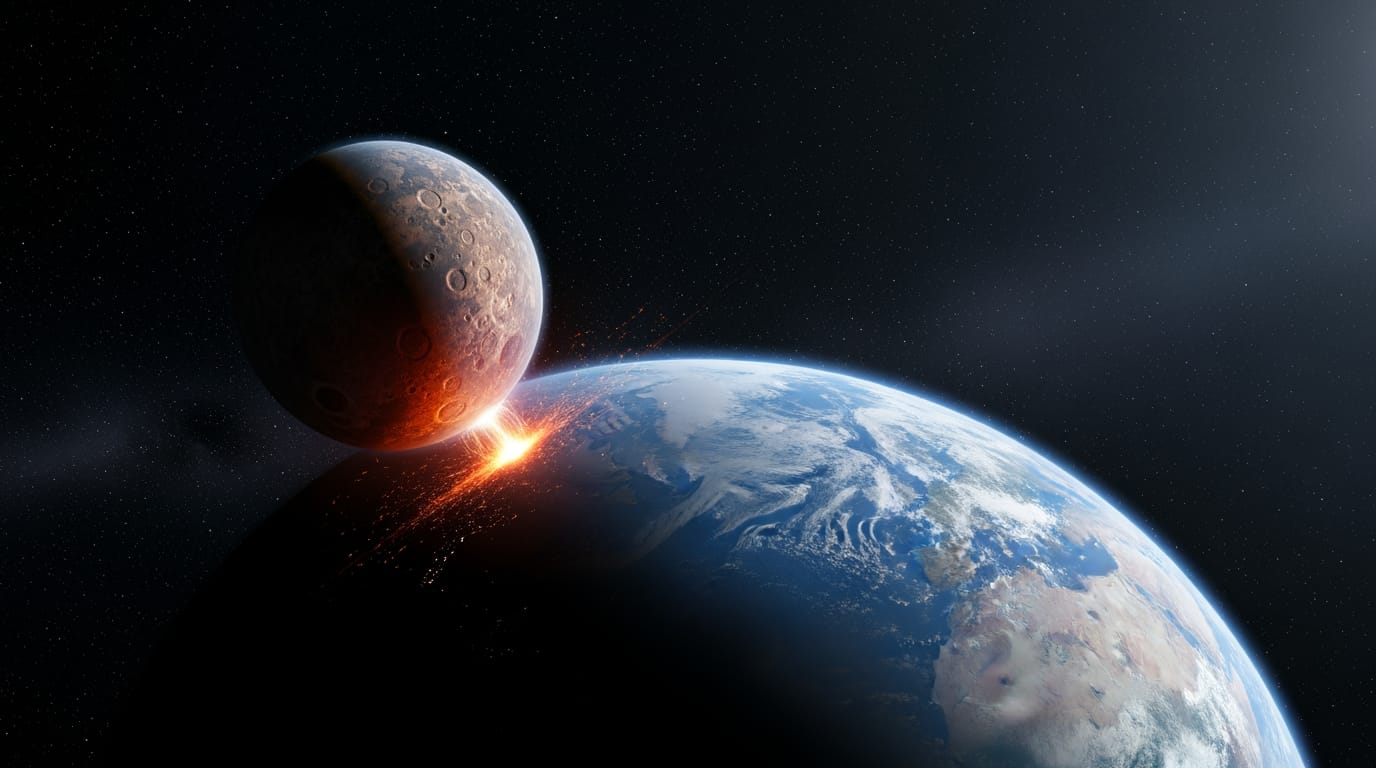
A groundbreaking revelation in planetary science has shed new light on the cataclysmic birth of Earth's Moon, identifying the enigmatic ancient planet Theia as a "neighbor" that originated in the inner Solar System, potentially even closer to the Sun than our own proto-Earth. This discovery not only refines the widely accepted giant impact hypothesis but also offers compelling evidence of Theia's enduring legacy deep within our planet, reshaping our understanding of the violent early days of our cosmic home.
For decades, scientists have largely agreed that the Moon formed approximately 4.5 billion years ago from the colossal collision between a Mars-sized protoplanet, dubbed Theia, and the early Earth. This monumental event, known as the giant impact hypothesis, explained many lunar characteristics, such as its relative lack of iron core, its orbital dynamics, and its molten past. However, the precise origin of Theia and the striking isotopic similarities between lunar and terrestrial rocks remained persistent puzzles. Recent research, integrating advanced isotopic analysis with sophisticated computer simulations, has now provided critical answers, painting a more detailed picture of this pivotal moment in Earth's history.
The Cosmic Cataclysm: A Foundation Reaffirmed
The giant impact hypothesis posits that shortly after its formation, Earth experienced a collision of unimaginable scale. A celestial body, named Theia after the mythical Greek Titan who was the mother of Selene (the Moon goddess), slammed into the nascent Earth. This impact generated immense energy, vaporizing vast quantities of material from both bodies and ejecting a massive cloud of debris into orbit around Earth. Over time, this debris coalesced, gradually forming our Moon. Evidence supporting this theory includes the Moon's relatively large size compared to Earth, the high angular momentum of the Earth-Moon system, and the Moon's composition, which is deficient in volatile elements but remarkably similar to Earth's mantle in many respects. Early hypotheses sometimes suggested Theia might have formed at Earth's Lagrange points or even migrated from the outer Solar System. However, the precise isotopic match between Earth and lunar samples presented a challenge, implying a more intertwined origin than previously assumed for two separately formed planets.
Unmasking Theia's Birthplace: A Nearby Sibling
A significant breakthrough comes from new studies published in late 2025, which meticulously analyzed iron isotopes in lunar samples, terrestrial rocks, and meteorites. This in-depth examination provided crucial clues about the building blocks of both Earth and Theia. Researchers found that all of Theia's constituents and most of Earth's materials originated from the inner Solar System. This suggests that Theia was not a distant interloper but rather formed relatively close to Earth, making them "neighbors" in the cosmic sense. The calculations indicate that Theia might have formed even closer to the Sun than proto-Earth, challenging previous models that placed it at orbital Lagrange points. The analysis of isotopes, which are variants of an element differing only in neutron count, allows scientists to trace the origins of planetary materials, as isotopic ratios were not evenly distributed throughout the early Solar System. By employing a form of "reverse engineering" for planets and running hundreds of modeled scenarios, scientists determined that Theia was likely a rocky, metal-cored world with an estimated mass of 5 to 10 percent of Earth's. The only configuration that successfully reproduced the observed chemistry of Earth and the Moon was one in which Theia formed within the inner Solar System.
Echoes of the Past: Theia's Lingering Presence
Beyond pinpointing its origin, scientists have also uncovered compelling evidence suggesting that remnants of Theia endure within Earth's mantle today. Deep beneath the African continent and the Pacific Ocean lie two colossal, continent-sized structures known as Large Low-Shear-Velocity Provinces (LLSVPs). Each of these blobs is roughly twice the mass of the Moon, denser and hotter than the surrounding mantle. For decades, their origin remained a mystery. However, recent studies propose that these LLSVPs are in fact fragments of Theia that sank into Earth's mantle following the impact.
Computer simulations indicate that Theia's iron-rich mantle material could have survived the violent collision and, due to its higher density, gradually settled at the core-mantle boundary. The cooler, lower mantle is believed to have been shielded from the full intensity of the impact's energy, allowing these iron-rich fragments to remain largely intact and aggregate over billions of years. This remarkable discovery offers a tangible link to the ancient impactor, providing physical evidence of Theia's existence and its composition. Furthermore, these long-preserved remnants may not be passive relics; some researchers suggest they could play a role in Earth's ongoing geological processes, such as the generation of mantle plumes and the evolution of supercontinents.
Reshaping Planetary Birth Narratives
These findings fundamentally refine our understanding of the chaotic period of planetary formation in the early Solar System. The notion that the Moon-forming impact was a collision between close celestial "neighbors" rather than a distant, unrelated body simplifies some of the previous isotopic conundrums. It suggests that Earth and Theia shared common primordial building blocks, which were then thoroughly mixed during the catastrophic event that formed the Moon. This new narrative strengthens the giant impact hypothesis by providing a more coherent explanation for the striking chemical similarities between Earth and its natural satellite.
The identification of Theia's origin and its potential remnants within Earth underscores the intricate and often violent processes that shaped our Solar System. It highlights the dynamic "cosmic billiards" that characterized the early inner Solar System, where numerous planetary embryos frequently collided and merged. This enhanced understanding not only deepens our appreciation for Earth's unique journey but also provides valuable insights for studying exoplanetary systems and the conditions necessary for planet formation and the potential emergence of life elsewhere in the universe. The ongoing quest to unravel our origins continues to reveal a past more dramatic and interconnected than ever imagined.