Ancient Roman Shipwreck, Laden with Amphorae, Discovered Off Sicily Coast
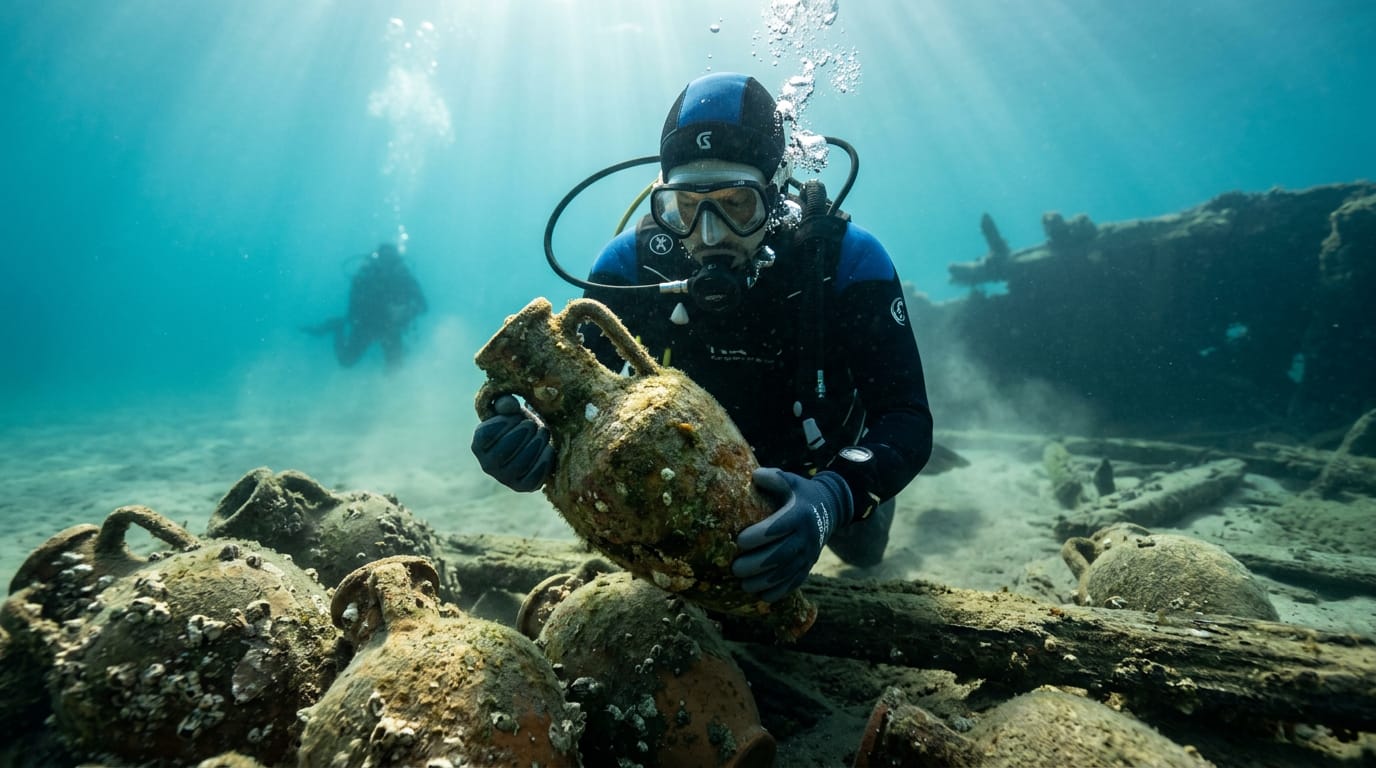
MAZARA DEL VALLO, Sicily – Italian authorities have announced the discovery of a remarkably preserved ancient Roman shipwreck, brimming with hundreds of amphorae, approximately three miles off the coast of Mazara del Vallo, Sicily. Dating back an estimated 2,100 years to the late Roman Republican period, the submerged vessel represents a significant archaeological find, offering a rare glimpse into the extensive maritime trade networks that crisscrossed the Mediterranean Sea in antiquity.
The discovery, hailed by Italy's Culture Minister Alessandro Giuli as "one of the most important underwater archaeological discoveries of recent years," underscores Sicily's pivotal role in ancient commerce and provides invaluable data for understanding Roman economic history. The trove of well-preserved Dressel 1A amphorae suggests the ship was primarily engaged in the wine trade, a crucial commodity in the Roman world.
A Glimpse into the Deep: The Discovery
The initial breakthrough came from a tip-off by local fishermen, including underwater fisherman Giacomo De Mola, whose keen observations led to the identification of the site. De Mola, upon encountering what his sonar initially registered as an unusual rock formation, decided to investigate. Descending to the seafloor, he described the moment as "without a doubt, the most incredible discovery of my life," witnessing a vast expanse of amphorae that had lain undisturbed for two millennia. He promptly reported the find to the Superintendent of the Sea of the Sicilian Region.
Following this report, a joint operation was launched, involving divers from the Carabinieri Cultural Heritage Protection Unit (TPC) of Palermo, the Sicilian Regional Superintendency of the Sea, and the Carabinieri Underwater Unit of Messina. These specialized units confirmed the presence of the shipwreck at a depth of 46 meters (approximately 150 feet) and began preliminary documentation. The collaborative effort highlighted the crucial role of local citizens and specialized forces in safeguarding Italy's rich underwater heritage.
The Vessel and its Valuable Cargo
The shipwreck, provisionally dated to between the 2nd and 1st centuries BC, provides a direct link to a transformative era of Roman expansion and influence. Local media reports suggest the ship measured approximately 21 meters long and 6 meters wide, a typical size for ancient merchant vessels. Its most striking feature, however, is its cargo: hundreds of amphorae, predominantly of the Dressel 1A type. These tall, cylindrical clay jars were a standard container for transporting wine across the vast Roman Empire.
Beyond the amphorae, divers also identified two lead anchor stocks and another lead structure, offering further clues about the ship's construction and operation. The remarkable state of preservation of the amphorae, still largely intact and nestled on the seabed, speaks to the unique conditions of the deep-sea environment, which often protects ancient artifacts from decay and disruption. This wealth of material promises to yield detailed insights into the specific products traded, their origins, and their destinations.
Roman Maritime Trade and Sicilian Significance
This discovery off Mazara del Vallo adds a critical piece to the intricate puzzle of Roman maritime trade, particularly in the western Mediterranean. Sicily, strategically located at the heart of this ancient world, served as a crucial hub for shipping lanes connecting North Africa, mainland Italy, and other key Roman provinces. The presence of a wine-laden ship from the late Roman Republican period underscores the vitality of these routes and the significant demand for agricultural products across the empire.
The Dressel 1A amphorae, characteristic of this era, were primarily produced along the Tyrrhenian coast of Italy, particularly between Etruria and Campania. Their widespread distribution, as evidenced by finds like this, illustrates the sophisticated commercial networks that allowed goods to flow efficiently across vast distances. Such discoveries help archaeologists and historians reconstruct ancient dietary habits, economic systems, and the daily lives of both merchants and consumers. The sheer volume of amphorae suggests a large-scale commercial venture, reflecting the robust economic activity of the period.
The Path Forward: Excavation and Preservation
The identification of the Mazara del Vallo shipwreck marks the beginning of an extensive process of study and conservation. Italian authorities have committed to further documentation, in-depth analysis, and the implementation of necessary measures to safeguard and protect the site. This meticulous work will be crucial for precisely determining the wreck's nature, reconstructing its full archaeological context, and understanding the complete characteristics of its cargo.
Underwater archaeology presents unique challenges, requiring specialized equipment and techniques to excavate and recover artifacts without damaging them or their fragile context. The data gathered from this site will not only enrich academic understanding but also contribute to public appreciation of Italy's unparalleled cultural heritage. As Minister Giuli noted, "The sea continues to reveal precious fragments of our history, and the Mazara del Vallo shipwreck tells us about the people, the routes, and the trade that made the Mediterranean a crossroads of civilizations." Research will continue to uncover its history and share it with the public, ensuring this ancient find contributes to contemporary knowledge.
Conclusion
The recent discovery of a 2,100-year-old Roman shipwreck off Sicily's coast stands as a testament to the enduring allure and historical significance of the Mediterranean Sea. Laden with hundreds of wine amphorae, this vessel offers an extraordinary window into the bustling maritime trade that defined the Roman Republic. As archaeological teams embark on the meticulous process of study and preservation, this remarkable find promises to deepen our understanding of ancient economies, logistical capabilities, and the cultural exchanges that shaped one of history's greatest empires. The sunken ship off Mazara del Vallo now serves as a silent, yet eloquent, chronicle of a bygone era.


