Australia and European Union Forge Landmark Free Trade Agreement After Eight Years of Negotiations
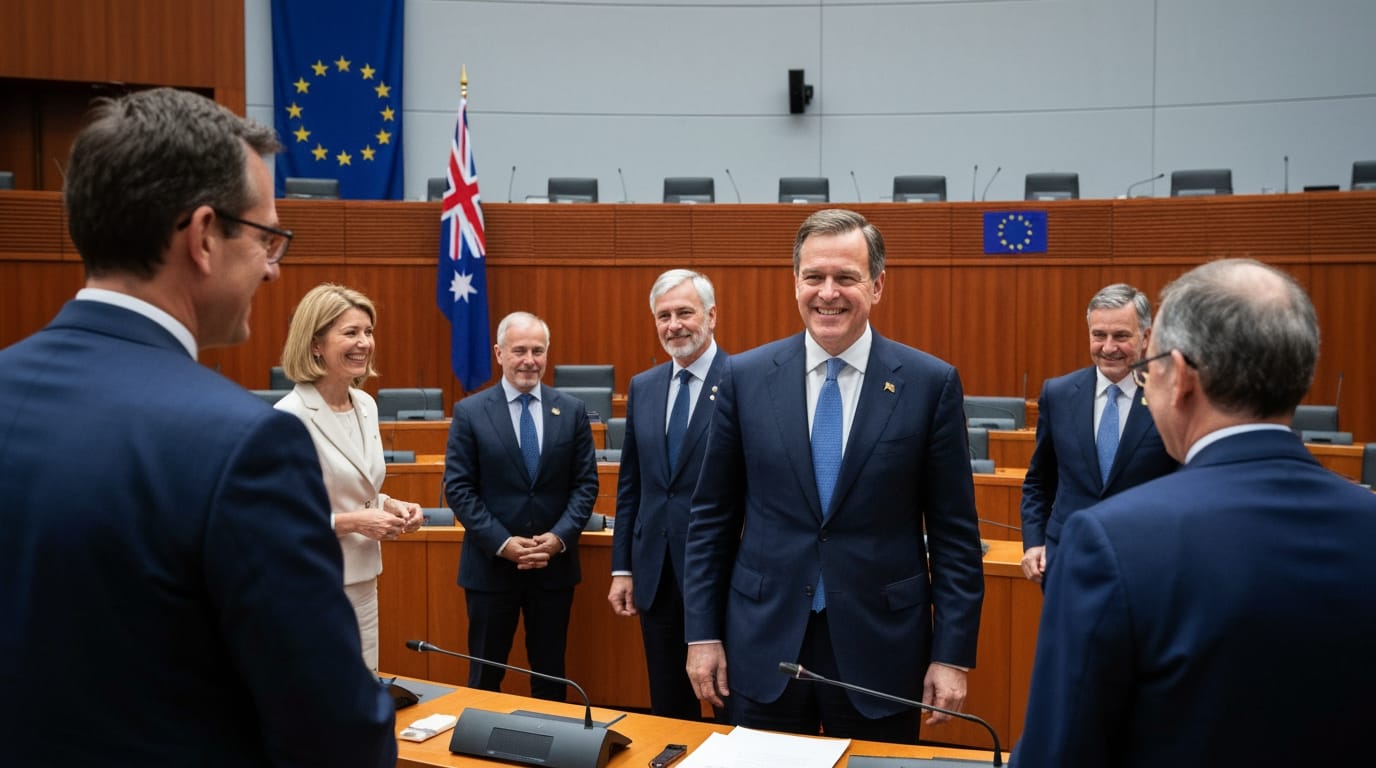
Canberra, Australia – After nearly a decade of intricate negotiations, Australia and the European Union have formally concluded a comprehensive free trade agreement (FTA), a move poised to reshape global trade flows and strengthen strategic ties between the two democratic powers. The landmark deal, announced Tuesday by Australian Prime Minister Anthony Albanese and European Commission President Ursula von der Leyen, is expected to unlock a massive market of 450 million consumers and foster significant economic opportunities across diverse sectors.
The agreement, seven years in the making following the launch of negotiations in June 2018, represents a strategic alignment in an increasingly volatile international landscape. Both leaders emphasized the deal's role in bolstering a rules-based global trading system and diversifying supply chains. The pact is set to eliminate tariffs on 98% of Australia's current goods exports to the EU, while 94.8% of agricultural exports will also benefit from duty-free access, promising a significant boost for Australian producers.
A New Chapter for Trade and Economic Partnership
The newly forged Australia-EU Free Trade Agreement is designed to be comprehensive, balanced, and commercially meaningful, paving the way for substantial economy-wide benefits for Australia and new opportunities for European businesses. The European Union stands as Australia's third-largest two-way trading partner and its second-largest source of foreign investment, with a combined nominal GDP estimated at approximately US$30 trillion. The agreement seeks to deepen this already robust economic relationship, which has traditionally seen the EU maintain a trade surplus with Australia, particularly in manufactured goods, while Australia's exports are dominated by mineral and agricultural products.
Under the terms of the agreement, Australian exporters are set to gain immediate and significant advantages. Tariffs will be completely eliminated on a range of agricultural products, including wine, tree nuts, barley, seafood, onions, carrots, honey, and olive oil. This is particularly noteworthy for the Australian wine industry, which could see annual benefits of around $37 million from the removal of EU import tariffs. For other key agricultural products deemed sensitive by the EU, such as certain dairy items, beef, sheep meat, rice, and sugar, the agreement establishes commercially meaningful tariff rate quotas (TRQs). For instance, the EU will open two TRQs for Australian red meat, totaling 30,600 metric tons, with 55% of this volume entering duty-free. Similar provisions have been made for sheep and goat meat, with two TRQs totaling 25,000 tonnes, gradually phased in over seven years.
Beyond agriculture, the agreement promises substantial gains for Australia's industrial and resource sectors. All tariffs on advanced manufacturing and other industrial goods, with the exception of steel, will be eliminated. This includes a broad spectrum of products such as machinery, textiles, auto parts, aluminum, zinc, lead, silicon, optical and photographic equipment, chemicals, pharmaceuticals, plastics, rubber products, wood, and toys. Crucially, tariffs will also be removed for Australian energy and resource products, encompassing critical minerals, lithium hydroxide, and hydrogen. This aspect of the deal is particularly strategic for the EU, as it aims to secure access to Australia's abundant critical raw materials, thereby diversifying its supply chains and reducing reliance on other geopolitical actors.
The services sector also stands to benefit significantly. The FTA introduces an 'Innovation Mobility Pathway' to facilitate travel and collaboration for Australian researchers within the EU. It will also streamline processes for Australian service suppliers and professionals seeking to operate in the EU, including better recognition of professional qualifications, and enhance access for Australian businesses to lucrative EU government contract opportunities. Furthermore, Australia has committed to raising its foreign investment screening thresholds for private EU investors, aiming to solidify its position as an attractive investment destination.
Navigating the Hurdles: Agriculture and Geographical Indications
The path to this agreement was not without its challenges, marked by negotiations that stalled in 2023 primarily over market access for agricultural products, particularly beef and sheep meat, and the contentious issue of geographical indications (GIs). Geographical indications refer to names used to identify products originating from specific geographical areas, possessing qualities or a reputation attributable to that origin. The EU has a strong interest in protecting such names, while Australia has producers who have historically used some of these terms.
A key point of contention revolved around the use of names like "Prosecco" for sparkling wine and "Feta," "Romano," and "Gruyere" for cheeses. The agreement stipulates that Australian winemakers can continue to produce and sell "Prosecco" domestically, though they will be prohibited from using the name on exports to the EU ten years after the pact comes into force. Grandfathering provisions and lengthy phase-out periods have been secured for a limited number of other terms.
Despite the conclusion of the deal, some agricultural groups in both Australia and Europe have voiced reservations. European farmers, represented by organizations like Copa and Cogeca, expressed "serious concern" that the agreement places a disproportionate burden on sensitive European agricultural sectors. They argued that even marginal increases in market access for Australian products could destabilize EU markets already under pressure from rising production costs and geopolitical instability. Similarly, Australian agricultural bodies, including AgForce and the National Farmers' Federation, expressed disappointment, asserting that the deal did not deliver the level of meaningful market access Australian producers, especially in the beef industry, had sought. These concerns underscore the delicate balance struck in trade negotiations, where the interests of various domestic industries must be carefully weighed against broader economic and strategic objectives.
Broadening the Horizon: Strategic and Geopolitical Dimensions
The signing of the free trade agreement extends beyond purely economic considerations, reflecting a deeper strategic alignment between Australia and the European Union. Both parties emphasized the importance of the deal in a "less predictable" international environment, signifying a mutual commitment to strengthening economic resilience and diversifying global trading networks. It sends a clear message of support for an open and rules-based international order, particularly amidst growing protectionist sentiments in some parts of the world.
The trade agreement was announced alongside a new Security and Defence Partnership, which will foster closer military cooperation, cyber and economic security collaboration, and joint efforts in counterterrorism. This integrated approach highlights the comprehensive nature of the evolving relationship, moving beyond traditional trade to encompass broader geopolitical and security concerns. Furthermore, the two blocs have agreed to launch formal negotiations for Australia to become an associate of Horizon Europe, the world's largest funding program for research and innovation. This initiative promises to facilitate greater collaboration in scientific research and technological development, fostering shared advancements in critical areas.
The FTA's emphasis on critical minerals also plays into a larger geopolitical strategy. For the EU, securing a reliable supply of minerals like lithium, rare earths, cobalt, and nickel from Australia offers a vital alternative to current dominant sources, enhancing its economic security and supporting the transition to green energy and advanced manufacturing. This diversification is a key element in reducing vulnerabilities within global supply chains.
The comprehensive nature of this agreement—encompassing trade, investment, critical minerals, research, and security—marks a pivotal moment in the relationship between Australia and the European Union. It underscores a shared vision for global cooperation and economic stability, aiming to create a more resilient and interconnected future for both regions.
Conclusion
The conclusion of the Australia-EU Free Trade Agreement on March 24, 2026, marks a significant milestone after eight years of intense negotiations. The deal promises substantial economic benefits through extensive tariff elimination, particularly for Australian goods and critical minerals, and enhanced opportunities for service providers and investors on both sides. While some agricultural sectors in both regions have expressed concerns regarding market access and potential competition, the agreement stands as a testament to the commitment of Australia and the European Union to fostering stronger economic ties and upholding a rules-based international trading system. Beyond commerce, the parallel establishment of a Security and Defence Partnership and scientific cooperation initiatives underscore a deepening strategic alignment, positioning this FTA as a cornerstone of mutual resilience and cooperation in a complex global landscape.


