Backlash Over Data Centers Tests Europe's AI Ambitions
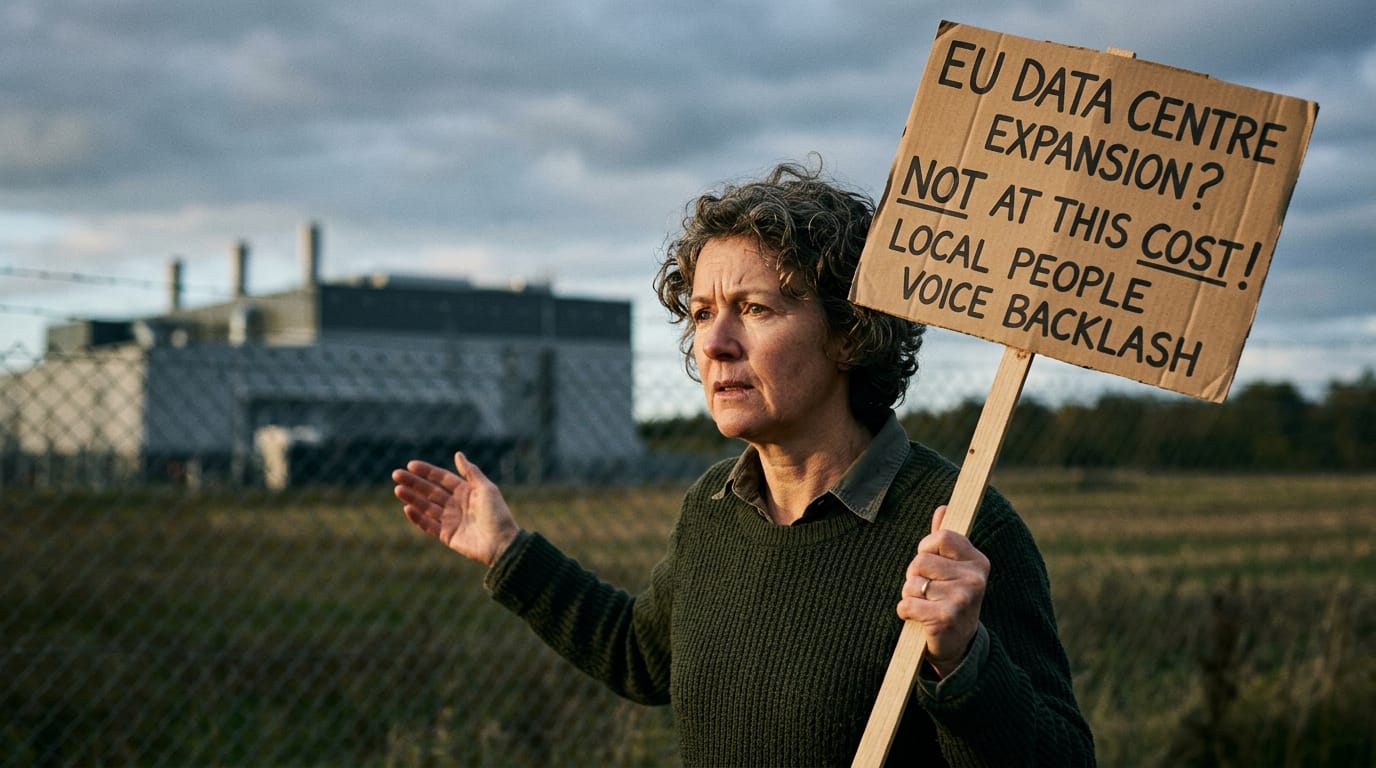
European Union policymakers are pushing to triple the bloc's computing capacity within seven years to avoid falling behind the United States and China in artificial intelligence. That vision of digital independence, however, is colliding directly with communities resisting the massive physical footprint of modern computing. Across towns and cities from Ireland to France and Germany, local residents, environmental advocates, and municipal authorities are fighting proposed server hubs over concerns about strained electric grids, rising utility bills, and water depletion during record summer droughts.
The mounting resistance is turning standard planning disputes into a broader strategic test for Europe. While European leaders in Brussels allocate billions of euros toward domestic cloud and AI infrastructure, national industrial goals do not guarantee local acceptance. The resulting standoff highlights a fundamental tension between Europe's technological future and its strict climate commitments.
A Digital Drive Runs Out of Power
Artificial intelligence algorithms require vast arrays of energy-intensive server racks that operate around the clock. According to projections from the European Network of Transmission System Operators for Electricity, power demand from data centers across the continent could jump by more than 50% between 2025 and 2030, rising from 87 terawatt-hours to roughly 134 terawatt-hours.
The speed of construction creates a persistent logistical mismatch. High-capacity data centers can often be built and operational within two to three years, but upgrading high-voltage transmission lines and regional substations routinely takes a decade or longer due to regulatory reviews and construction delays.
This pressure is already reshaping national energy landscapes. In Ireland, long a major European base for foreign technology investment, data centers accounted for nearly a quarter of all metered electricity consumption by 2025. The resulting strain led grid operators to freeze new connections around Dublin, shifting development pressure outward into regional areas where local infrastructure remains even more vulnerable.
Local Resistance Halts Major Projects
Tensions that once simmered quietly are now stopping projects outright. In western Ireland, planning authorities recently revoked approval for a planned data campus in Killala, County Mayo, after an appeal determined the development conflicted with national statutory climate targets. The decision demonstrated that broad technology commitments made at the state level can crumble when tested against statutory environmental rules.
Water scarcity has emerged as an equally combustible issue. Data center cooling systems can consume between 0.4 and 4.4 liters of water for every kilowatt-hour of electricity used, according to estimates from the German Ministry for Economic Affairs. Following consecutive summers marked by record-setting heat waves, domestic water rationing, and restrictions on agricultural irrigation, proposals to allocate millions of gallons of public drinking water to cool commercial computer equipment have triggered sharp public outcry in dry regions.
Similar friction has surfaced across the Netherlands and Scotland, prompting some local councils to consider moratoria on future server developments until operators can guarantee that local resources will remain secure.
The Fight for European Sovereignty
Proponents of data center expansion argue that the continent cannot afford to halt construction. Without a robust domestic network of high-performance servers, European enterprises and government agencies must rely on computing capacity owned and managed by outside cloud providers, primarily headquartered in the United States.
Technology leaders and European Commission officials maintain that building sovereign computing hubs is vital to protect proprietary commercial data, safeguard national security, and sustain long-term economic competitiveness. Industry groups also note that modern facilities are increasingly designed to capture and redirect waste heat into nearby municipal heating networks, warming thousands of homes during winter months while creating skilled technical employment.
Yet critics counter that corporate promises often fall short in practice. In many rural locations, the direct economic return to the host community is minimal once initial construction ends, leaving behind heavily automated facilities that generate few permanent local jobs while placing permanent demands on the power grid.
Regulatory Measures to Restore Trust
To ease community resistance and keep its technology roadmap intact, the European Union has begun rolling out stricter transparency and efficiency rules. Under a recent regulatory framework, large facilities operating with capacities exceeding 500 kilowatts must publicly disclose their exact electricity and water usage.
The policy establishes a standardized rating system ranging from A to G, similar to labels placed on household consumer electronics, to classify facilities according to energy efficiency, renewable power sourcing, and heat-recycling integration. Policymakers hope the disclosure mandate will encourage operators to generate their own on-site renewable energy rather than competing directly with residential consumers for existing supplies.
Whether these administrative measures can satisfy nervous communities remains uncertain. European officials acknowledge that tripling data processing capacity cannot come at the expense of household utility bills or regional environmental security. As artificial intelligence continues its rapid rollout, the primary barrier to Europe's digital future may no longer be a shortage of capital or advanced microchips, but the physical willingness of local communities to let the machines plug in.


