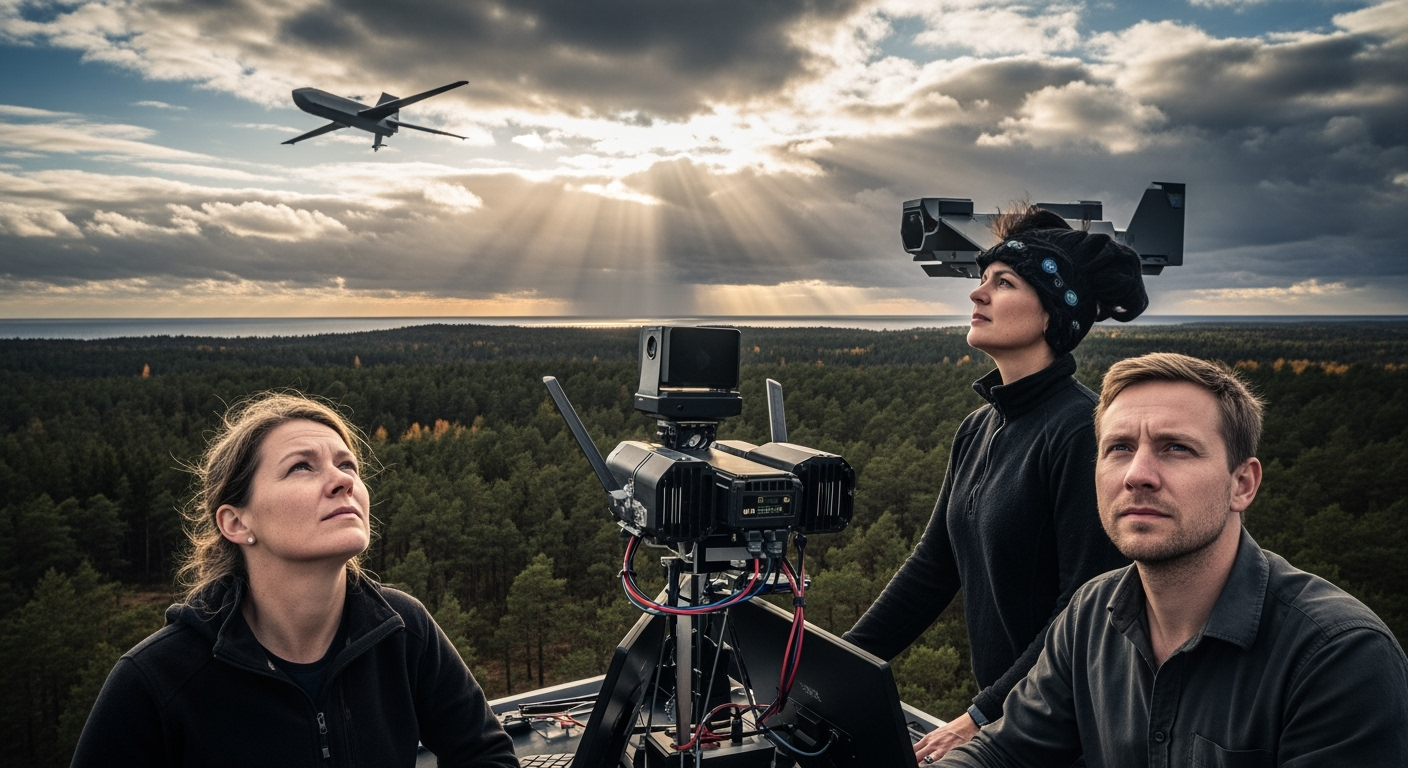
As the shadow of sophisticated and cost-effective drone warfare extends across Europe's eastern flank, NATO faces an urgent imperative to bolster its air defenses against a rapidly evolving threat. Russian drone tactics, refined in the ongoing conflict in Ukraine, pose significant challenges to traditional military doctrines and equipment. Amid this shifting security landscape, small but agile Baltic startups are emerging as unexpected vanguards, leveraging cutting-edge technology and a deep understanding of regional threats to develop innovative, cost-efficient counter-drone solutions that could significantly enhance NATO's collective air defense capabilities.
The Evolving Aerial Threat on NATO's Eastern Flank
The conflict in Ukraine has starkly underscored the pervasive and disruptive power of unmanned aerial vehicles (UAVs). Russian forces have adeptly integrated combined UAV attack tactics, including reconnaissance, strike, and psychological operations, gaining considerable advantages on the battlefield and facilitating advances on key Ukrainian towns. These drones are not merely surveillance tools; they are actively achieving battlefield air interdiction effects, striking targets behind the frontline to disrupt logistics and operations. Russian UAV adaptations, reportedly leveraging AI/ML capabilities, longer-lasting charges, and increased resistance to electronic warfare (EW) interference, are capable of operating at longer distances and higher speeds.
One particularly concerning development is Russia's use of drones to target civilians, with the UN Independent International Commission of Inquiry on Ukraine reporting "human safari" tactics where drones chase and attack individuals, driving thousands from their homes in what amounts to a crime against humanity. Russian tactics also involve launching drones at high altitudes and changing routes to evade detection, overwhelming air defenses with massive swarm attacks that include decoys, allowing more destructive ballistic and cruise missiles to penetrate.
NATO's existing air defense systems, while formidable against conventional aerial threats, face a fundamental challenge when confronted with these inexpensive, numerous drones: cost-effectiveness. Deploying advanced fighter jets or Patriot missiles, costing millions, to intercept a drone worth a few thousand dollars is fiscally unsustainable. This dilemma highlights a critical gap in current defense strategies and necessitates innovative, low-cost solutions capable of countering a wide spectrum of drone threats. Unauthorized drone activity has been observed in at least 10 European countries, with Russian drones violating Polish airspace, prompting NATO to deploy F-16 and F-35 jets for interception. However, only three out of 21 drones were neutralized in a recent incident over Poland, demonstrating the inefficiency of current responses against swarming tactics.
Baltic States Emerge as Innovation Hubs
In response to these pressing threats, the Baltic states — Estonia, Latvia, and Lithuania — are rapidly positioning themselves as crucial innovation hubs for defense technology. These nations, acutely aware of their geographical proximity to Russia and the lessons from Ukraine, are investing heavily in domestic defense industries and fostering a vibrant ecosystem of tech startups.
Latvian defense startup Origin Robotics, for instance, has introduced "BLAZE," an autonomous, artificial intelligence (AI)-driven counter-drone system designed to target and neutralize fast-moving aerial threats. BLAZE offers a cost-effective alternative to traditional air defense, integrating radar detection with AI-driven visual tracking and destroying targets through direct impact or high-explosive fragmentation. Origin Robotics is also behind the "BEAK," a man-portable ISR (Intelligence, Surveillance, and Reconnaissance) drone with precision guidance technology, offering cost-effective precision-strike capability. The BEAK employs advanced computer-vision algorithms and AI for autonomous flight, even under intense radio jamming. The company has secured significant financing, including a €5 million contract with the Latvian armed forces and is working with the UK and Latvia-led Drone Capability Coalition to send drones to Ukraine.
Estonian ingenuity is equally prominent. Defsecintel Solutions has developed "Eirshield," an AI-assisted ultra-short-range air defense system capable of detecting and neutralizing various aerial threats, including multi-rotor and fixed-wing drones. Eirshield, refined through active deployments in Ukraine, uses advanced radar, radio frequency sensors, and electro-optical/infrared cameras to track and jam signals. Another Estonian company, Frankenburg Technologies, is focusing on developing low-cost anti-drone missiles, recognizing the need for affordable interceptors. The Estonian government is actively supporting these ventures, providing 100 million euros for defense startups and investing in factory space for defense companies.
These Baltic companies are not operating in isolation. Latvian Origin Robotics and Estonian Defsecintel Solutions have partnered to support the European Union's cross-border "drone wall" initiative. This collaboration aims to provide a comprehensive, mobile, and cost-effective counter-drone solution, with Defsecintel Solutions bringing long-range detection and electronic warfare capabilities, and Origin Robotics contributing its BLAZE interceptor. The "Drone Wall" concept, initiated by Defsecintel Solutions and the Defence Estonia Cluster, seeks to integrate the best effectors, sensors, and software from Baltic partners into scalable solutions for border protection.
NATO's Embrace of Agile Defense: The DIANA Initiative
Recognizing the need to integrate rapid technological advancements from the private sector, NATO has established the Defence Innovation Accelerator for the North Atlantic (DIANA). DIANA serves as a crucial bridge between defense organizations and cutting-edge technology, aiming to harness civilian innovations for military applications. A regional hub for DIANA was officially opened in Tallinn, Estonia, in May 2024, highlighting the strategic importance of the Baltic region in fostering defense innovation.
DIANA's mission is to accelerate the development and adoption of dual-use technologies — innovations that serve both military and civilian purposes. The Tallinn hub, along with other accelerator sites, provides funding (up to €100,000 initially, with potential for an additional €300,000), mentorship, and access to testing facilities for startups addressing NATO's security challenges. This initiative aims to fast-track new technologies from conception to battlefield implementation, crucial for maintaining a technological edge in modern warfare.
Complementing DIANA, the European Defence Fund (EDF) provides significant funding opportunities for companies focused on innovative drone solutions and autonomous defense systems, with grants available specifically for SME-led projects. The EDF's 2025 work program includes calls for autonomous combat drones, drone-carried munitions, swarm technology, and AI for autonomous control systems, directly aligning with the innovations being developed by Baltic startups. This funding is critical for enabling smaller companies to develop and scale their solutions, and Ukraine's defense industry has also been able to participate in EDF projects.
Overcoming Hurdles: Integration, Scalability, and Standardization
Despite the promising innovations, integrating startup technologies into the complex and often bureaucratic structures of NATO and national militaries presents significant challenges. The traditional defense procurement process is typically slow and cumbersome, leading to delays in updating military capabilities. For startups, this "valley of death" between development and large-scale procurement can be perilous.
However, the urgency of the current geopolitical climate is forcing a shift. The "combat-proven" status of some Baltic technologies, tested and refined in Ukraine, provides a powerful validation that can accelerate their adoption. Furthermore, NATO's DIANA and the EU's "Drone Wall" initiatives aim to streamline this process by providing structured pathways for startups to engage with defense ecosystems and secure funding. The call for standardization (STANAG) is also crucial to ensure interoperability across various systems and allied forces.
The Baltic states themselves are actively working to facilitate this integration. Latvia's Ministry of Defense has signed agreements with local firms like Origin Robotics to develop counter-drone systems for its armed forces. Estonia is encouraging an increase in defense spending and has seen its defense industry grow significantly. Lithuania has even authorized peacetime drone shoot-downs to defend its airspace, reflecting the heightened threat perception. The collective efforts aim to create a layered air defense system that can effectively counter the diverse and numerous drone threats from Russia.
A Collaborative Future for Air Defense
The collaborative efforts between small Baltic startups, national governments, and NATO initiatives represent a vital step towards a more robust and cost-effective air defense strategy. By fostering innovation, streamlining procurement, and prioritizing dual-use technologies, the Alliance can significantly enhance its ability to deter and defend against the evolving threat of Russian drones. The agility and specialized expertise of Baltic tech companies, combined with NATO's strategic vision and resources, offer a compelling model for future defense innovation. This synergy not only strengthens the security of the Baltic region but also provides a blueprint for a more resilient and adaptable European defense architecture against future aerial threats.