Beijing and Moscow Forge Deeper Alliance Amid Escalating Iran Conflict
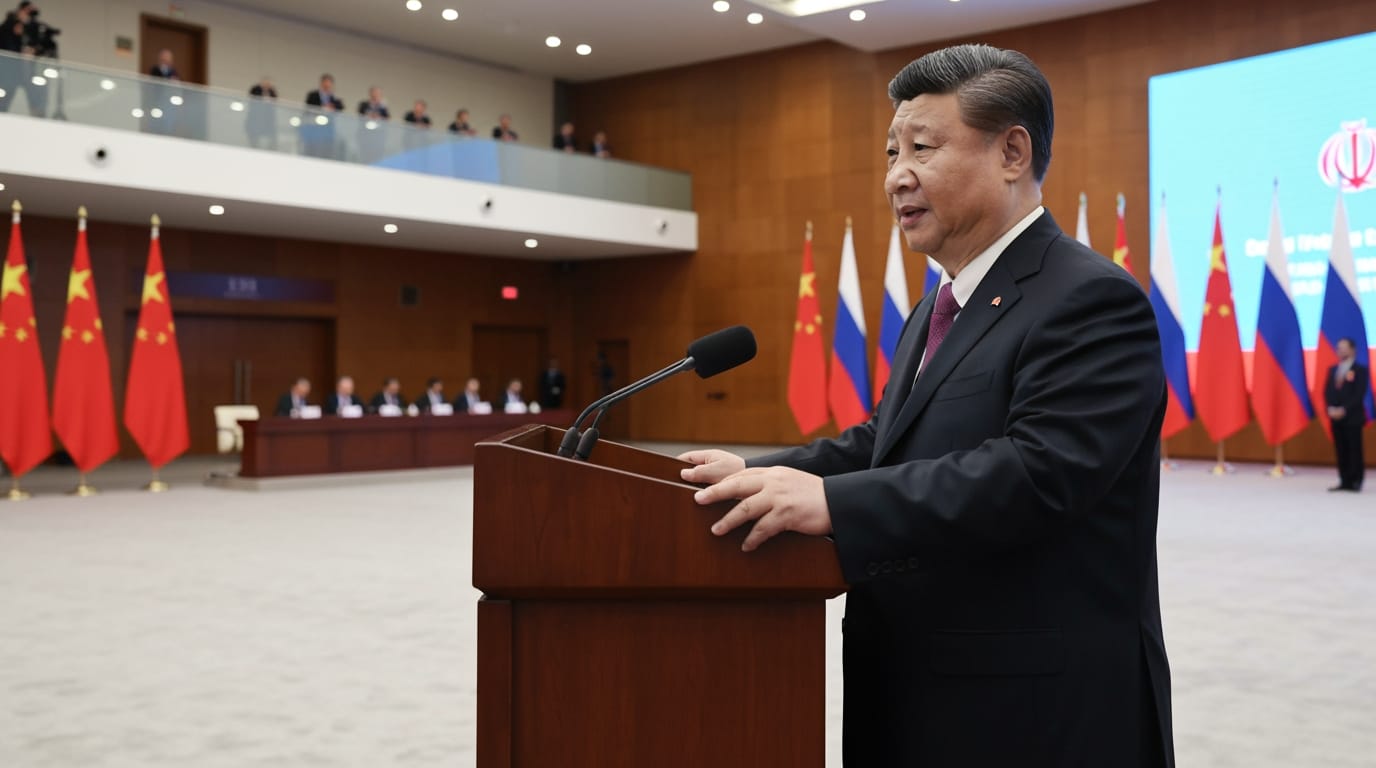
Beijing, China – In a significant display of unified geopolitical ambition, Chinese President Xi Jinping has underscored the "stability and certainty" of China's relationship with Russia, signaling a more coordinated and assertive role for both nations amidst the ongoing conflict in Iran. As the Middle East grapples with an intensifying war between the United States, Israel, and Iran, Beijing and Moscow are increasingly aligning their strategies, advocating for a multipolar global order that challenges traditional Western dominance. The recent high-level talks in Beijing between President Xi and Russian Foreign Minister Sergei Lavrov have solidified a joint front, particularly concerning the volatile situation stemming from the closure of the Strait of Hormuz and the broader regional instability.
A Steadfast Strategic Partnership
President Xi Jinping's recent remarks highlight the growing strategic synergy between China and Russia, a bond he described as "precious" in an international landscape marked by "change and chaos." This sentiment was echoed during his meeting with Russian Foreign Minister Lavrov, where Xi called for "closer strategic coordination" to defend the "legitimate interests of both countries" and bolster "unity among Global South countries." The deepening of these ties has been particularly evident since Russia's invasion of Ukraine in early 2022, prompting a re-evaluation of global alliances.
The two nations are actively working towards a "multipolar world order," a vision that directly contrasts with the existing U.S.-led global framework. This shared objective translates into practical cooperation on various international platforms, including the United Nations Security Council, where China and Russia recently vetoed a resolution concerning the Strait of Hormuz. Beijing and Moscow argue that such proposals are often "unbalanced" and fail to address the underlying causes of regional instability, instead laying blame primarily on Iran. Both leaders emphasized the importance of maintaining high-level exchanges and practical cooperation to uphold "international fairness and justice," thereby contributing to global peace and stability.
China's Diplomatic Push in the Iran War
The war, which erupted on February 28 following attacks by the U.S. and Israel on Iran, has led to a significant disruption of global energy flows due to the effective closure of the Strait of Hormuz. In response, China has adopted a nuanced yet firm stance, characterizing its position as "objective, just and balanced" while actively pursuing a ceasefire and an end to hostilities. Beijing perceives the conflict as a manifestation of the United States' "behavioral pattern of war and aggression," contrasting it with China's preferred multilateral and cooperative approach to international relations.
Under President Xi's leadership, China has engaged in extensive diplomatic efforts, including "shuttle diplomacy" and mediation. Foreign Minister Wang Yi has reportedly made 26 phone calls to various parties, including Iran, Israel, Russia, and Gulf states, while a special envoy of the Chinese government has traveled to the region to facilitate peace. Furthermore, China and Pakistan jointly issued a five-point initiative aimed at achieving a ceasefire and promoting peace.
China has also articulated a four-point peace proposal for the Middle East, advocating for an immediate ceasefire, ensuring the safety of civilians, opening avenues for dialogue and negotiation, and enhancing the role of the UN Security Council. These diplomatic overtures underscore China's desire to play a constructive, albeit non-militarily interventionist, role in de-escalating the crisis. Beijing has been vocal in its criticism of the U.S. naval blockade of Iranian ports, labeling it a "dangerous and irresponsible" maneuver that could exacerbate tensions and jeopardize safe passage through the vital Strait of Hormuz.
Geopolitical Realignment and Economic Stakes
The coordinated actions of China and Russia in the context of the Iran war signify a broader geopolitical realignment. A comprehensive strategic agreement among China, Russia, and Iran has been formalized, covering cooperation in energy, trade, military coordination, and diplomatic strategy. This pact, described as a "cornerstone for a new multipolar order," aims to challenge U.S. alliances in the Middle East and the Indo-Pacific, providing Iran with a lifeline against sanctions and strengthening its deterrence. However, experts caution that this trilateral pact, while significant, does not constitute a mutual defense treaty, indicating a calculated approach by Moscow and Beijing to avoid overcommitting.
For China, the conflict carries substantial economic implications. As Iran's largest trading partner and a major buyer of its oil, China's economic interests are directly impacted by regional instability and disruptions to energy supplies. The closure of the Strait of Hormuz, a critical choke point for global oil and gas trade, has underscored China's vulnerability to energy supply chain disruptions. In this context, Russia emerges as an increasingly valuable partner, capable of helping offset China's energy shortages.
While Chinese officials have vehemently denied reports of providing military weapons to Iran, dismissing them as "sensationalist" and "baseless," China's strategic interest in the region extends beyond immediate conflict resolution. Beijing's long-standing policy has generally avoided direct military backing for Iran, even supporting UN sanctions in the past. Instead, China appears to be playing a "long game," carefully balancing its support for Iran with its broader regional interests and its stated opposition to a nuclear-armed Iran. Chinese media narratives, while officially supporting diplomatic and humanitarian aid to Iran, also frame the conflict as a validation of China's national security strategies, particularly emphasizing the importance of self-reliance.
Conclusion: A Redefined Global Influence
The escalating Iran war has provided a critical juncture for China and Russia to deepen their strategic alignment and assert a more prominent role in global affairs. President Xi Jinping's emphasis on the "precious" nature of China-Russia ties, coupled with their coordinated diplomatic efforts and shared vision for a multipolar world, signals a growing challenge to the existing international order. While China's "bigger role" in the Iran conflict remains primarily diplomatic and economic, rather than directly military, its assertive mediation, criticism of U.S. actions, and unwavering support for its strategic partner, Russia, collectively project a redefined global influence. This evolving dynamic underscores a calculated move by Beijing and Moscow to reshape international relations, with significant implications for global stability and the future balance of power. The continued coordination between these two major powers will likely play a decisive role in the trajectory of the Middle East conflict and the broader geopolitical landscape.


