Berlin's Russian House: A Contested Cultural Center Under Scrutiny for Alleged Espionage and Propaganda
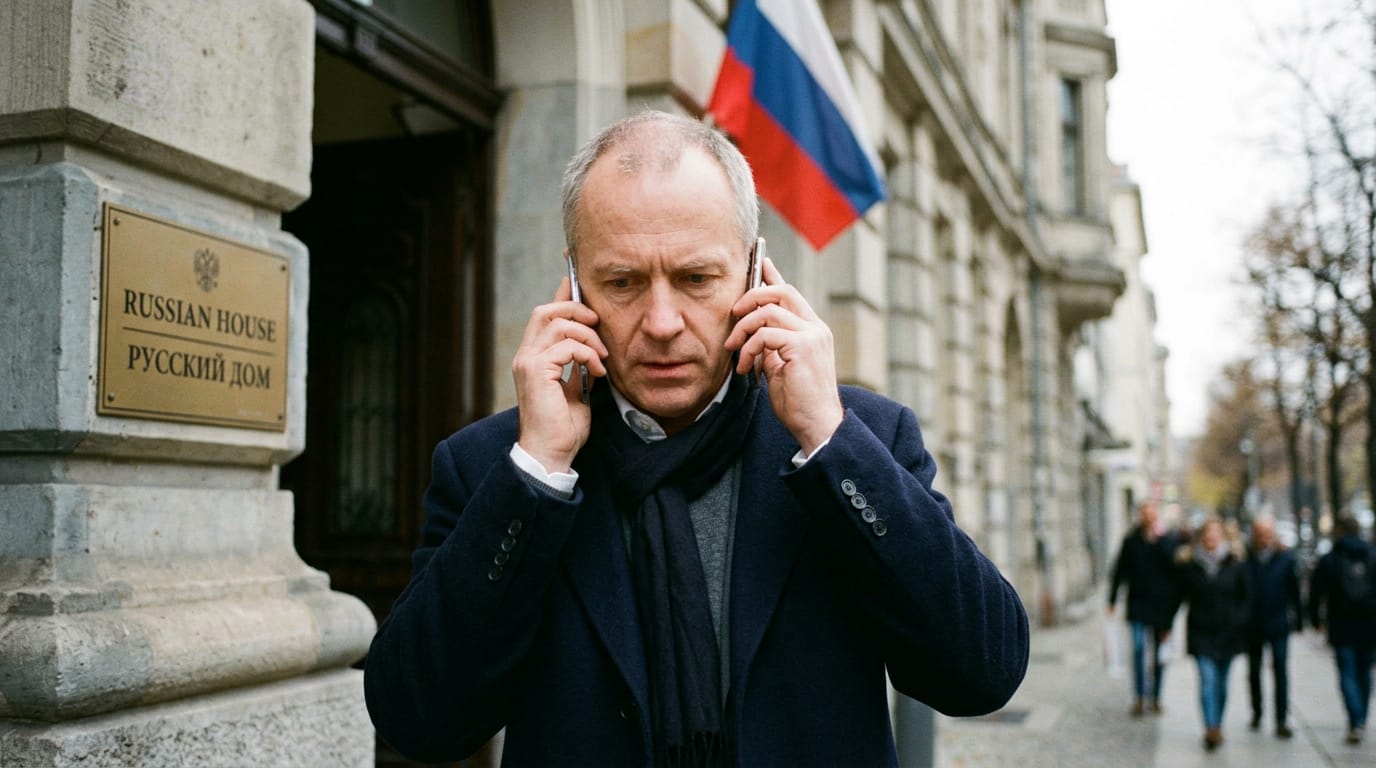
BERLIN – The Russian House of Science and Culture in central Berlin, long a fixture in the city's cultural landscape, finds itself at the epicenter of a growing international controversy, with German lawmakers and intelligence officials intensifying calls for its closure. Accusations have mounted that the institution, officially a cultural center, may serve as a hub for Russian propaganda and espionage activities, raising significant national security concerns amidst Russia's ongoing aggression in Ukraine.
Pressure on the German government to address the activities within the Russian House has escalated in recent weeks, fueled by a joint investigation by public broadcaster WDR and Süddeutsche Zeitung. The investigation cited a French Interior Ministry assessment that explicitly described the house as being "used as a cover by the Russian secret services". This revelation has brought renewed urgency to a debate that has simmered since Russia's full-scale invasion of Ukraine, prompting German politicians to view the facility less as a neutral cultural venue and more as a potential security risk.
The institution, which opened in 1984, operates under the auspices of a structure linked to Rossotrudnichestvo, a Russian state agency that has been under EU sanctions since 2022 due to its role in hybrid influence and propaganda operations. German media have noted that the Russian House continues its operations in Berlin by exploiting loopholes in these sanctions, despite the agency's stated purpose of promoting Russia's political interests and conducting information-psychological operations abroad. Critics, including Marie-Agnes Strack-Zimmermann, an FDP member of the European Parliament, have accused Rossotrudnichestvo of orchestrating pro-Russian propaganda and hybrid influence globally.
Concerns extend beyond mere propaganda. Lawmakers from Germany's Christian Democratic Union (CDU), the Greens, and the Free Democratic Party (FDP) are openly demanding the closure of the Russian House, suspecting its use as a center for espionage. Roderich Kiesewetter, a CDU member of the Bundestag and foreign policy specialist, characterized the site as "a hub which is probably packed with intelligence equipment" and populated by individuals hostile to Germany. He further asserted that the house is a "symbol of our weakness and Russian influence". Echoing these suspicions, Green lawmaker Sara Nanni pointed to unusual mobile and GPS signals emanating from the building, which she believes could indicate the presence of powerful transmitting equipment. She also alleged that staff at the Russian House might be involved in "coordination of cyberattacks and recruitment of spies". These allegations underscore a broader intensification of Russian espionage, sabotage, and disinformation activities within Germany since 2022, as confirmed by the German Federal Office for the Protection of the Constitution. Since the invasion began, Germany has expelled approximately 400 Russian citizens, including over 80 diplomats assessed to be intelligence officers operating under diplomatic cover.
Despite these mounting concerns and political pressure, the German government has, thus far, stopped short of ordering a shutdown of the Russian House. Foreign Office officials emphasize existing bilateral property and cultural treaties that formally link the Berlin site to the Goethe-Institut in Moscow. They warn that any unilateral action by Germany could trigger reciprocal measures from Russia, potentially jeopardizing the operations of German cultural institutions abroad. This diplomatic tightrope walk highlights the complex challenges faced by Germany in balancing national security with international relations. However, the Russian House already operates under financial restrictions imposed by sanctions, with tightly controlled accounts and a limited public program. Security authorities continue to monitor the institution for disinformation and influence activities, grappling with the significant legal and diplomatic constraints that complicate a definitive response.
The situation in Berlin is not isolated but reflects a broader European pattern. Russian Houses and similar centers affiliated with Rossotrudnichestvo continue to operate in several EU capitals, despite the agency's 2022 sanctions. These institutions are consistently used as instruments of influence, spreading propaganda, manipulative narratives, and striving to cultivate a favorable perception of Russian policies under the guise of cultural initiatives. Examples of alleged espionage activities under the cover of cultural centers have emerged elsewhere, such as in Denmark in 2023, where Russian intelligence officers were reportedly engaged in industrial espionage through the local Russian House. The network of these centers, operating in dozens of countries, has been used to justify Russia's war against Ukraine. In 2025, the activities of Russian Houses were reportedly shut down in countries such as Moldova, Syria, and Azerbaijan.
The controversy surrounding Berlin's Russian House presents Germany with a critical dilemma. The institution, once a symbol of cultural exchange, has become entangled in a web of geopolitical tensions and intelligence suspicions. As German lawmakers call for its immediate closure, citing it as an "enemy of freedom" in the heart of Berlin, the government navigates a complex landscape of international law, diplomatic consequences, and the imperative to protect national security. The ongoing debate underscores the multifaceted nature of modern geopolitical conflict, where cultural institutions can inadvertently, or deliberately, become fronts in a larger struggle for influence and information.


