Blue Origin's New Glenn Rocket Explodes on Launch Pad During Test Firing
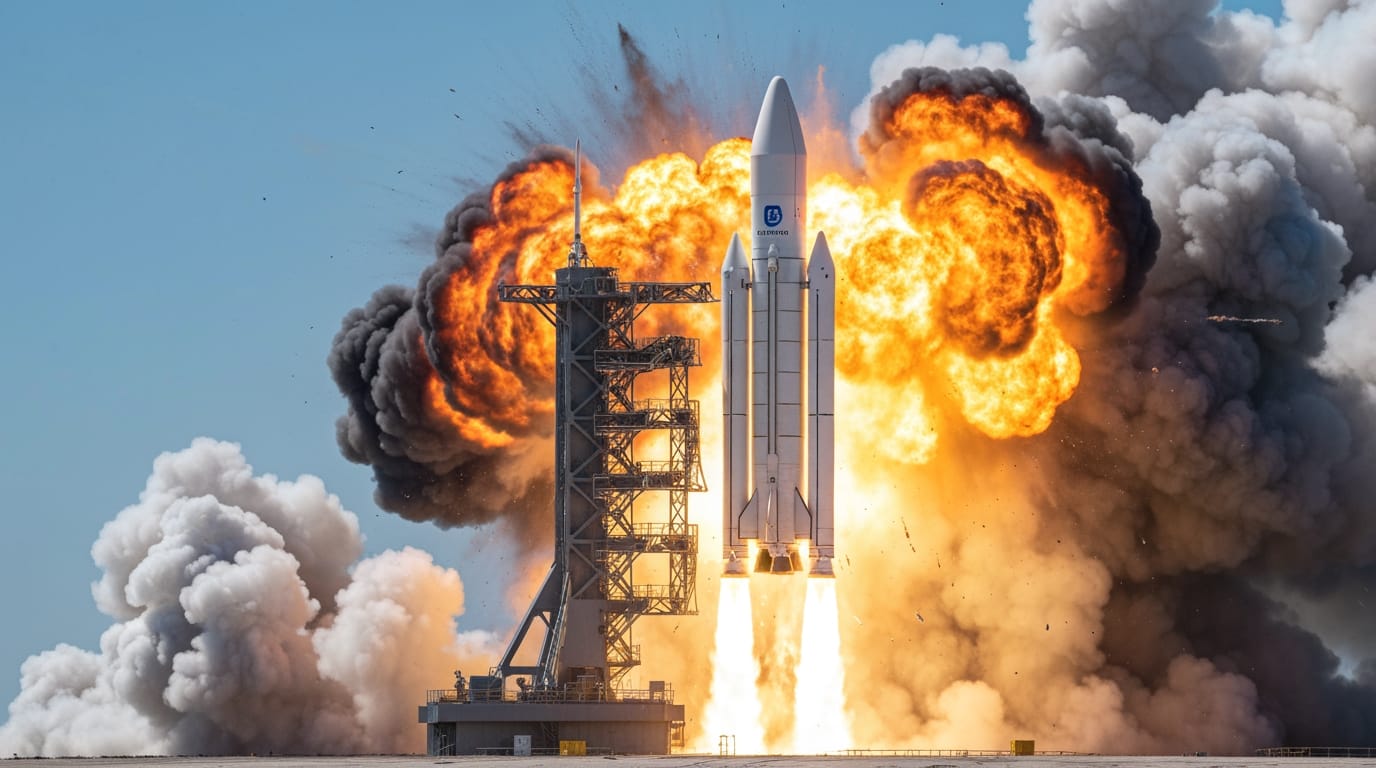
CAPE CANAVERAL, Fla. – A Blue Origin New Glenn rocket exploded Thursday night on a launch pad at Cape Canaveral Space Force Station in Florida, sending a massive fireball into the night sky and marking a significant setback for Jeff Bezos' space venture. The powerful blast, which occurred around 9 p.m. ET during a pre-launch hotfire test at Space Launch Complex 36 (SLC-36), shook nearby homes and illuminated the horizon for miles. Fortunately, Blue Origin and Space Launch Delta 45 confirmed that all personnel were accounted for, with no injuries or fatalities reported from the incident.
The catastrophic anomaly dealt a sharp blow to Blue Origin’s aspirations in the burgeoning commercial space market and its critical role in future lunar missions. The New Glenn, a heavy-lift orbital vehicle, was undergoing a routine static fire test, a crucial step to certify its engines while the rocket remains bolted to the launch pad, in preparation for its fourth mission. This mission was intended to deploy 48 satellites for Amazon's Leo internet service, a direct competitor to SpaceX's Starlink, and had been slated for as early as June 4.
Catastrophic Anomaly Halts New Glenn Program
The explosion, which observers captured in dramatic images and videos circulating on social media, resulted in the complete loss of the New Glenn booster, reportedly named "No, It's Necessary," and its second stage. Witnesses in Cape Canaveral and Cocoa Beach reported homes shaking from the force of the blast, while the towering fireball was visible as far as East Orlando. Emergency crews swiftly responded to the scene, though officials later stated there was no immediate threat from fumes or other hazards, allowing the contained fire to burn itself out.
Early assessments suggest extensive damage to SLC-36, Blue Origin’s dedicated launch complex for New Glenn, and at least one lightning protection tower at the facility was observed toppling after the explosion. The impact of the damage is particularly severe given that SLC-36 is currently the sole operational launch site equipped to handle New Glenn missions. The destruction of the launch vehicle and the infrastructure damage will undoubtedly lead to significant delays for Blue Origin's launch manifest.
A History of Hurdles and High Stakes
This latest incident marks another challenging chapter in the development and operational history of Blue Origin's New Glenn rocket. The vehicle had only recently been cleared to return to flight by the Federal Aviation Administration (FAA) after an anomaly during its third mission (NG-3) on April 19, 2026. That previous flight, carrying AST SpaceMobile's BlueBird 7 satellite, experienced a second-stage malfunction where one of its BE-3U engines failed to produce sufficient thrust, ultimately placing the satellite into an "off-nominal" and unsustainable orbit, leading to its de-orbiting. An investigation into the NG-3 incident pinpointed a cryogenic leak that froze a hydraulic line as the root cause, with Blue Origin implementing corrective measures.
Despite these challenges, New Glenn is a cornerstone of Blue Origin's long-term strategy, designed to be a partially reusable heavy-lift launch vehicle crucial for deploying satellites, undertaking NASA lunar missions, and supporting commercial space endeavors. The rocket's first stage is engineered for multiple re-flights, with a successful recovery on a landing platform at sea having been achieved during its second flight (NG-2) in November 2025. The booster lost in Thursday's explosion was, in fact, a reused first stage that had previously launched NASA's ESCAPADE probes, highlighting the company's commitment to reusability as a cost-saving and efficiency-driving measure.
Broader Implications for Space Exploration
The New Glenn rocket plays a pivotal role in Blue Origin's broader vision, including its involvement in NASA's Artemis program aimed at returning humans to the moon. It is slated to launch Blue Moon landers for lunar missions, with a Blue Moon lander expected to fly as part of the Artemis III mission in low Earth orbit next year. The explosion could therefore have ripple effects across national space exploration efforts, potentially impacting timelines for critical lunar infrastructure and scientific payloads.
Beyond government contracts, Blue Origin has substantial commercial commitments, including numerous launches for Amazon's Project Kuiper broadband constellation. The company has ambitious plans to significantly ramp up production, with targets of producing 60 New Glenn upper stages by the third quarter of 2028 to solidify its position in the competitive heavy-lift market. This latest setback introduces considerable uncertainty into those aggressive expansion plans and Blue Origin's ability to challenge established players like SpaceX.
The Road Ahead: Investigation and Rebuilding
Blue Origin founder Jeff Bezos quickly responded to the incident, stating via X, "All personnel are accounted for and safe. It's too early to know the root cause but we're already working to find it. Very rough day, but we'll rebuild whatever needs rebuilding and get back to flying. It's worth it." This sentiment was echoed by NASA Administrator Jared Isaacman, who noted on social media, "Spaceflight is unforgiving, and developing new heavy-lift launch capability is extraordinarily difficult. We will work with our partners to support a thorough investigation of this anomaly, assess near-term mission impacts, and get back to launching rockets."
The FAA will oversee the investigation into the explosion, a standard procedure for such incidents, working alongside Blue Origin to determine the root cause of the anomaly. The recovery and repair of SLC-36 will be a monumental task, with no clear timeline for when the facility might be operational again. The incident underscores the inherent risks and complexities involved in developing and operating advanced rocket technology, even as the space industry pushes the boundaries of exploration and commercialization. While the immediate future for New Glenn remains uncertain, the commitment from Blue Origin's leadership suggests a determined effort to overcome this significant obstacle and continue its pursuit of establishing a robust presence in space.


