Bolivia Rocked by Widespread Protests, Demands for President Paz's Resignation Amid Economic Crisis
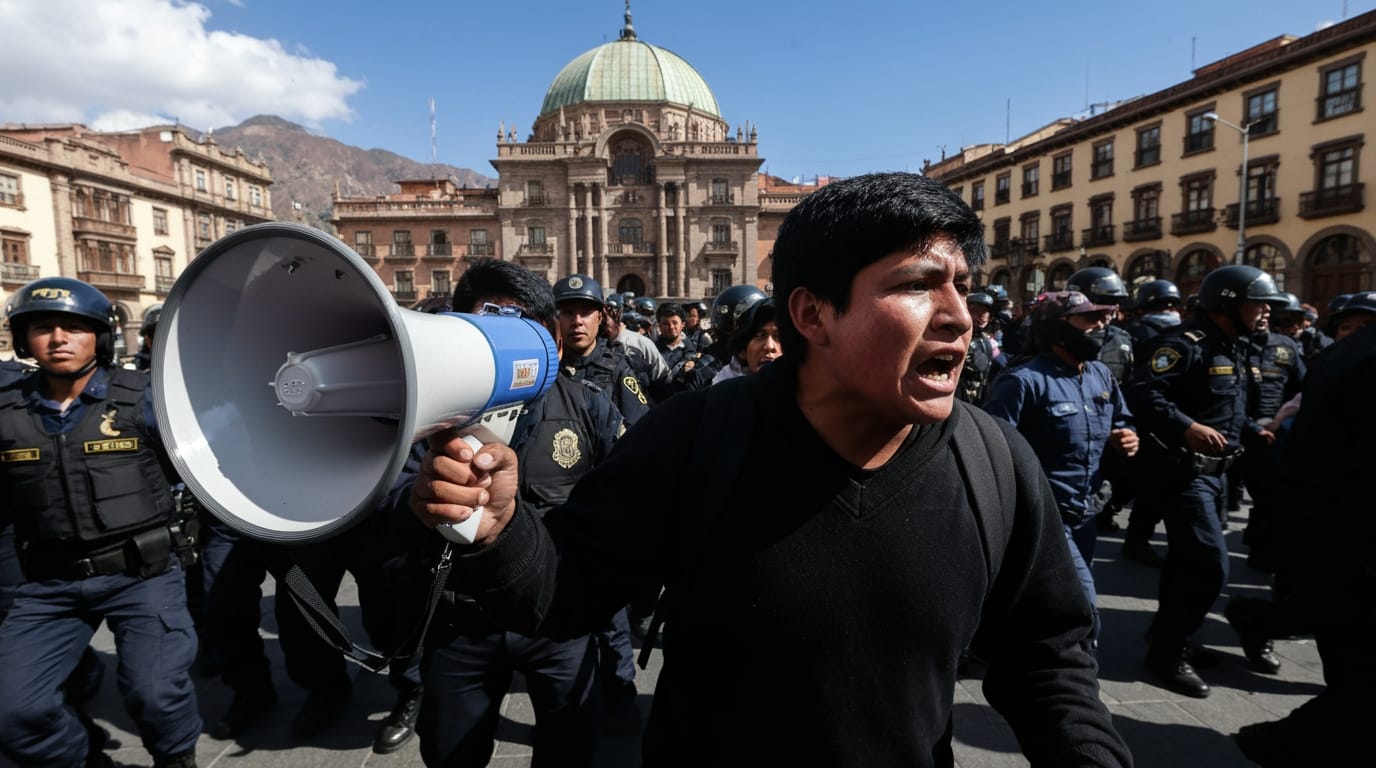
LA PAZ, Bolivia – Bolivia is engulfed in a deepening political and social crisis as widespread protests demanding the resignation of President Rodrigo Paz have paralyzed key regions, leading to violent clashes with security forces and severe shortages of essential goods. The unrest, which has intensified over recent weeks, sees a broad coalition of unions, Indigenous groups, miners, teachers, and farmers blocking roads and confronting authorities, pushing the six-month-old conservative government to its most critical juncture amid the country's worst economic downturn in four decades.
The capital city, La Paz, has become a focal point of the demonstrations, with reports of tear gas exchanges, dynamite detonations, and numerous arrests as protesters attempt to pressure the government. The turmoil underscores profound discontent stemming from a deteriorating economy and contentious policy decisions made by the Paz administration since taking office last year.
Escalation of Unrest Grips the Nation
The current wave of protests, initially sparked by farmers' opposition to a controversial land mortgage law (Law 1720), has rapidly escalated into a nationwide movement with broader demands, including wage increases, labor reforms, and an end to privatization plans. Despite President Paz's decision to repeal Law 1720 on May 13, the demonstrations have not subsided; instead, they have grown in scope and intensity.
Recent days have witnessed significant confrontations, particularly in and around La Paz. On May 16, security forces, numbering approximately 3,500 police and soldiers, launched a major operation to clear roadblocks, deploying tear gas against demonstrators who retaliated with explosives and stones. These efforts aimed to establish "humanitarian corridors" to alleviate critical shortages of food, medicine, and oxygen caused by the blockades. The government's ombudsman's office reported at least 57 arrests during these operations, with some reports indicating as many as 90 detentions.
The Bolivian Workers' Center (COB), the country's largest labor federation, has been instrumental in organizing a general strike, further pressuring the government. Protesters, including supporters of former President Evo Morales, have marched for days to converge on the capital, indicating a unified opposition front against Paz's administration. The presence of mining groups, some reportedly detonating dynamite, has added a volatile dimension to the protests.
Deep Roots of Discontent: Economic Meltdown and Policy Shifts
The underlying cause of the widespread unrest is Bolivia's severe economic crisis, described as the worst in four decades. President Paz, who came to power in October 2025, inherited a challenging economic landscape marked by a dramatic decline in the natural gas sector, which once fueled Bolivia's economy for decades. Mismanagement and dwindling reserves have transformed Bolivia from a significant energy exporter into a net fuel importer.
This economic downturn has led to an acute shortage of foreign currency, chronic fuel shortages, and widespread inflation, with reports of prices surging and long queues at gas stations. One of Paz's early, and highly contentious, moves was to scrap two-decade-old fuel subsidies in December 2025, a measure that drastically increased fuel prices and sparked initial protests in January 2026. While Paz initially backed down on that particular measure due to public opposition, the broader economic woes and subsequent policy decisions have continued to fuel public anger.
Protesters also express deep concerns over alleged plans for the privatization of state-owned companies, although the government has dismissed these claims as "fake news." The now-repealed Law 1720, which allowed agricultural land to be used as collateral for bank loans, was seen by Indigenous communities and farmers as a direct threat to their land rights and collective territories, further solidifying opposition to the government's economic agenda.
Government's Stance and International Response
President Paz's administration has responded to the escalating crisis by deploying a substantial security presence and calling for dialogue, while simultaneously condemning what it describes as attempts to destabilize the democratically elected government. Presidential spokesman Jose Luis Galvez has emphasized the humanitarian imperative of clearing roadblocks to ensure vital supplies reach affected cities. The government has also directly accused former President Evo Morales of orchestrating the protests from exile to destabilize the current administration. Morales, who faces an arrest warrant related to other charges, has had his supporters actively join the demonstrations, adding a significant political dimension to the unrest.
In a move indicating the government's firm stance, an arrest warrant was issued for Mario Argollo, Secretary-General of the Bolivian Workers' Center (COB), on charges of terrorism and inciting crime, further ratcheting up tensions.
Internationally, the United States, through its Bureau of Western Hemisphere Affairs, has publicly backed President Paz's government, condemning actions aimed at destabilization and supporting efforts to restore order. Argentine President Javier Milei has also expressed solidarity with Paz, criticizing protesters as anti-democratic forces. In contrast, Bolivia's Catholic bishops have appealed for dialogue and "humanitarian pauses" in the protests, recognizing the legitimacy of grievances while urging an end to disruptions that cause suffering.
The Human Toll and Uncertain Future
The prolonged blockades and clashes have exacted a heavy human toll. Beyond the arrests and injuries, a presidential spokesman reported at least three deaths due to the inability of individuals to reach hospitals because of road closures. Daily life in La Paz and other affected cities has been severely disrupted, with residents facing scarcity and soaring prices for basic necessities.
The political landscape remains highly volatile. President Paz, the first conservative leader after nearly two decades of socialist rule under the Movement for Socialism (MAS), faces immense pressure just six months into his term. Analysts suggest that while some agreements have been reached with specific protesting groups, the broader movement continues, fueled by deep-seated economic anxieties and a sense of political disenfranchisement among a significant portion of the population.
Conclusion
Bolivia stands at a critical crossroads, with President Rodrigo Paz confronting a formidable challenge to his nascent administration. The convergence of a severe economic crisis, contentious policy reforms, and a unified, determined protest movement has plunged the nation into a period of intense instability. While the government attempts to reassert control and calls for dialogue, the widespread demands for President Paz's resignation signal a profound societal cleavage. The trajectory of this crisis, and its ultimate impact on Bolivia's political and economic future, remains uncertain, hinging on the government's capacity to address core grievances and the willingness of all parties to find a path toward resolution.


