Chaos Erupts in Kosovo Parliament as PM Kurti Egged Amid Deepening Political Crisis
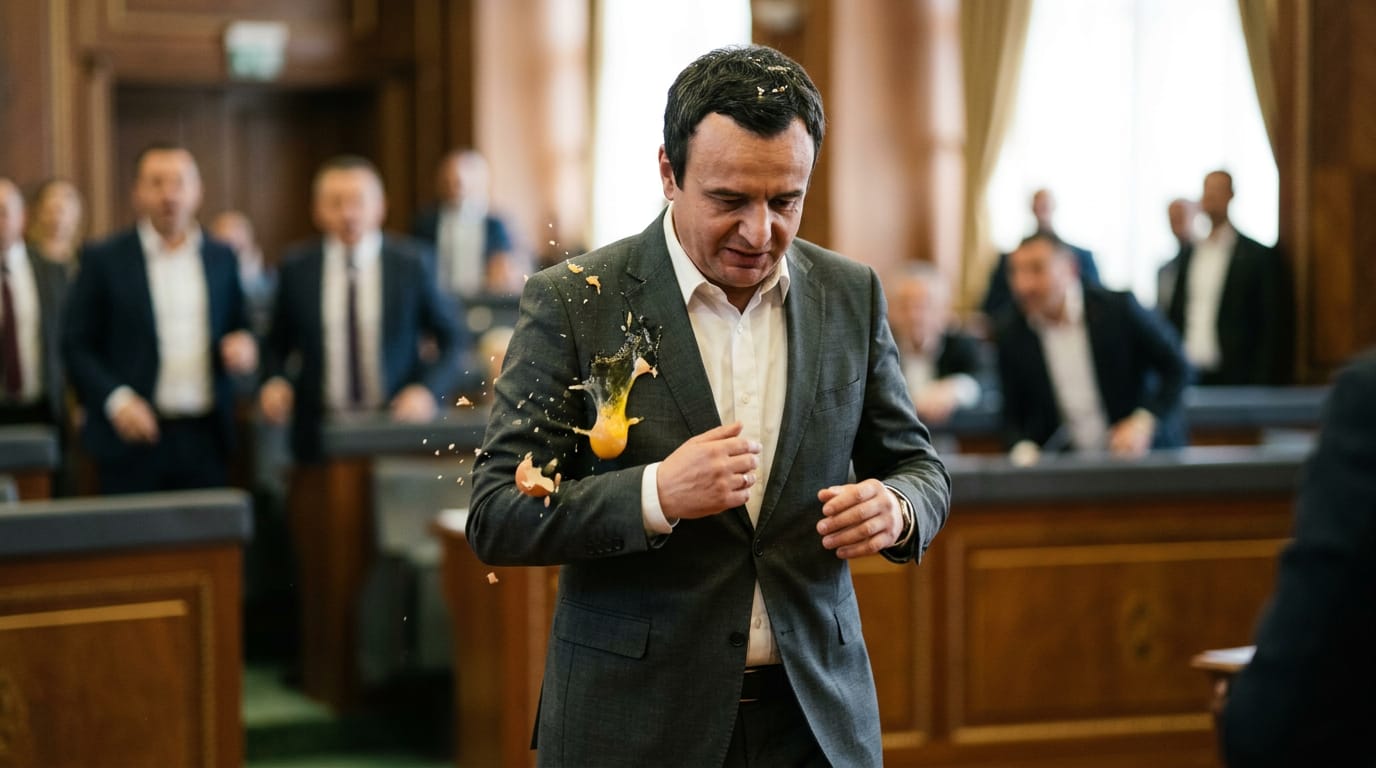
Pristina, Kosovo – The fragile political landscape of Kosovo was dramatically underscored Saturday as an opposition lawmaker pelted acting Prime Minister Albin Kurti with eggs inside the country's parliament, halting proceedings and highlighting a severe government formation deadlock. The audacious act of protest came as Kurti sought additional time to navigate stalled coalition talks, intensifying an already volatile political environment in the young Balkan nation.
The incident unfolded during a critical parliamentary session when Time Kadrijaj, a member of the opposition Alliance for the Future of Kosovo (AAK), approached Kurti and threw several eggs in his direction, reportedly shouting "Shame on you!" Security personnel and other lawmakers swiftly moved to intervene, and the parliamentary session was immediately suspended, with the live broadcast cut shortly after the confrontation. Appearing largely unfazed by the attack, Kurti later conveyed that if having eggs thrown at him was the necessary price for continuing political dialogue, he was "happy to pay this price." This dramatic protest lays bare the profound divisions and frustrations simmering within Kosovo's political class, threatening to push the nation toward yet another snap election.
A Nation in Prolonged Stalemate
The parliamentary fracas is a stark manifestation of a protracted political crisis gripping Kosovo since the snap parliamentary elections held on June 7. Albin Kurti's Vetëvendosje party emerged as the largest political force, securing between 53 and 58 of the 120 seats in the Assembly. Despite this significant win, the party fell short of the numbers required to govern alone, necessitating coalition agreements with opposition groups. Crucially, it also lacked the two-thirds majority in parliament needed to elect the country's president, a key factor in the current impasse.
For weeks, Kurti's party has been engaged in arduous negotiations, primarily with the Democratic League of Kosovo (LDK), which secured 18 seats in the June election. However, these talks have reportedly stalled, particularly over the contentious issue of the presidency. The LDK has reportedly insisted that the presidential post be part of any governing agreement, a demand Kurti has so far resisted. With a constitutional deadline to constitute parliament having expired on Friday, August 7, the pressure to form a stable government has reached a critical point. Kurti's request for more time to negotiate, aimed at preventing another round of elections, was met with strong opposition, culminating in Saturday's disruptive protest.
Roots of Recurrent Instability
Kosovo, Europe's youngest democracy, has been plagued by chronic political instability, having held three elections in less than two years. Successive parliaments have frequently collapsed under the weight of deep political divisions, reflecting a broader struggle to consolidate democratic institutions and achieve governmental stability. The inability to form functional governments often stems from the fragmented nature of its political landscape, where no single party typically secures an outright majority, making coalition-building a complex and often fraught process. This cycle of elections and political deadlock impedes policy implementation and delays much-needed reforms.
The current stalemate is particularly significant because of the constitutional requirement to elect a president. Without a two-thirds parliamentary majority, a consensus candidate is essential but often elusive, further prolonging the formation of a government and exacerbating tensions among political factions. This ongoing struggle highlights the delicate balance of power and the intense competition for key institutional positions in Kosovo's political system.
A Familiar Pattern of Parliamentary Protest
While Saturday's egging incident drew immediate international attention, it is not an isolated event in Kosovo's parliamentary history. The use of unconventional and disruptive protest methods by opposition parties has been a recurring feature of Kosovar politics. In 2015, then-Prime Minister Isa Mustafa was similarly pelted with eggs by opposition lawmakers while attempting to address parliament regarding agreements with Serbia. The very party now led by Kurti, Vetëvendosje, has itself resorted to extreme measures, including setting off tear gas in the parliamentary chamber, when they were in opposition to protest votes.
This historical context suggests that such acts are not merely spontaneous outbursts but rather an established, albeit controversial, tactic employed by opposition forces to express profound dissatisfaction and to disrupt legislative processes, especially when perceived as a last resort against unpopular government policies or prolonged political gridlock. Such protests reflect a deep-seated frustration with the parliamentary process and a willingness to escalate dissent to draw attention to critical issues.
Broader Implications for Kosovo's Future
The persistent domestic political instability has significant repercussions for Kosovo's standing on the international stage and its critical relationship with Serbia. The ongoing dialogue between Pristina and Belgrade, mediated by the European Union and the United States, aims to normalize relations between the two former adversaries. However, a lack of a stable and fully functional government in Kosovo can undermine its ability to engage effectively in these crucial talks, potentially delaying progress on agreements that are vital for regional stability and Kosovo's European integration ambitions.
International observers have frequently expressed concern over Kosovo's recurrent political crises, noting that prolonged stalemates can hinder economic development, deter foreign investment, and weaken the country's institutional capacity. The inability to quickly form a government after elections often leads to a period of uncertainty, making it challenging to address pressing socio-economic issues and advance critical reforms. The current impasse, underscored by the dramatic events in parliament, signals a challenging road ahead for Kosovo as it strives to overcome internal divisions and secure its long-term stability and prosperity.
The incident in parliament serves as a potent symbol of Kosovo's current political turbulence. With the constitutional deadline for government formation now passed and coalition talks at an impasse, the nation faces an uncertain future. The immediate challenge remains the formation of a stable and broadly supported government capable of navigating both domestic priorities and complex international relations. Without a breakthrough, the prospect of yet another election looms large, threatening to prolong the cycle of instability that has become a defining feature of Kosovo's post-independence political journey.


