China Achieves Landmark Reusable Rocket Booster Retrieval, Reshaping Global Space Landscape
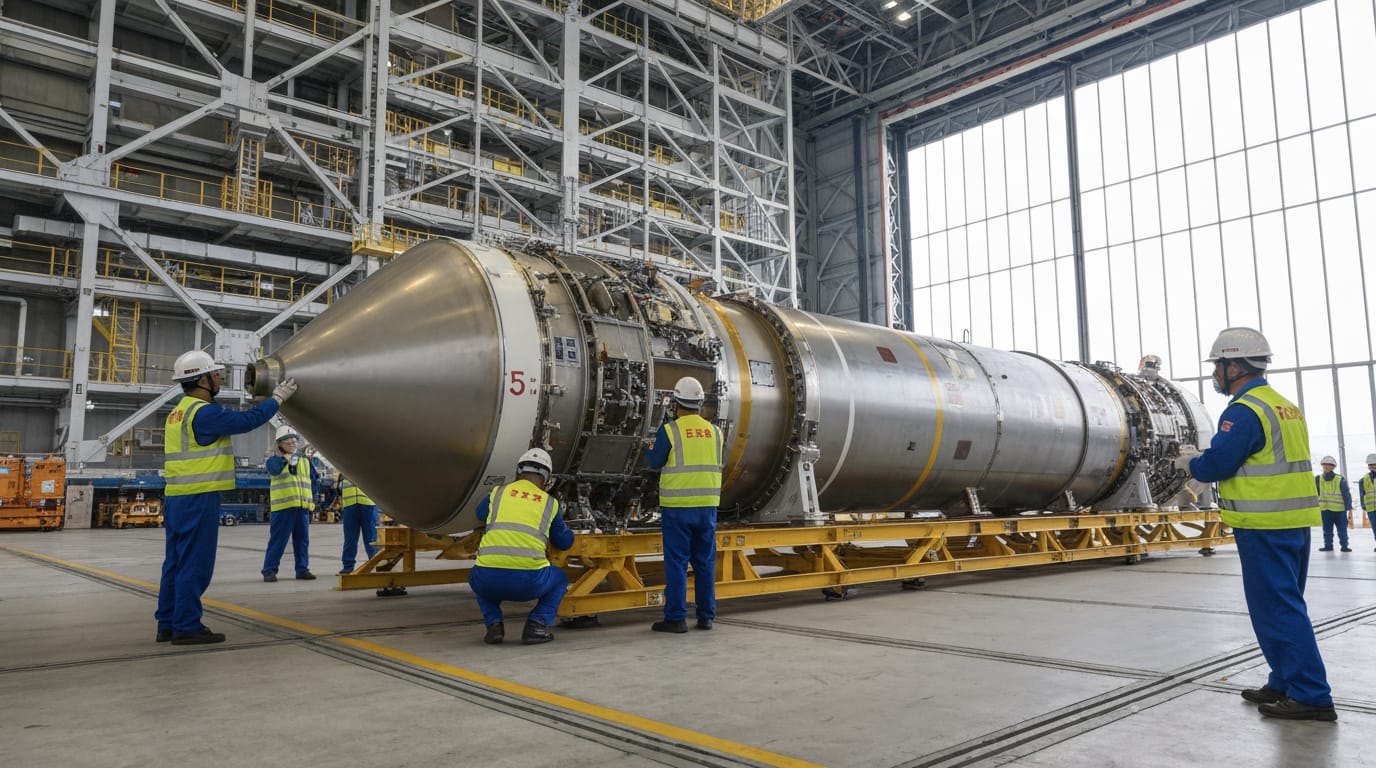
Wenchang, Hainan Province – In a significant leap forward for its ambitious space program, China successfully retrieved an orbital-class rocket booster on Friday, July 10, 2026, marking a historic breakthrough in its pursuit of reusable launch vehicle technology. The first stage of the Long March 10B rocket, a cargo-focused variant, was successfully captured by an innovative net system on an offshore platform in the South China Sea, approximately six minutes after its separation from the upper stage. This achievement positions China as the third nation globally to demonstrate such advanced capabilities, following the United States.
The successful recovery signals a pivotal moment for China, promising to dramatically reduce the cost of space launches and accelerate the country's extensive plans for commercial satellite networks and crewed lunar missions. State broadcaster CCTV lauded the event, emphasizing its role in narrowing the technological gap with established space powers.
A Historic Landing at Sea
The Long March 10B rocket embarked on its maiden flight from the Hainan commercial space launch site in southern China at 12:15 p.m. local time (0415 GMT). Carrying a payload—reportedly to support satellite constellation development—into its designated orbit, the mission garnered intense international attention. What truly distinguished this launch, however, was the controlled descent and recovery of its powerful first-stage booster. Unlike the conventional practice of discarding boosters into the ocean, this stage executed a vertical return before being precisely guided into a net suspended on an offshore platform.
This "net-capture system" stands in contrast to the deployable landing legs employed by companies like SpaceX, offering a unique engineering solution that simplifies the rocket's onboard structure, potentially reduces vehicle mass, and increases payload capacity. Chen Muye, an expert from the China Academy of Launch Vehicle Technology (CALT), highlighted that this method is also highly adaptable to landing-point deviations, as coordinated net systems can effectively expand the capture window. The China Aerospace Science and Technology Corporation (CASC), the primary contractor for China's space program, declared both the launch and the first-stage recovery a "complete success," hailing it as a "historic breakthrough."
The Reusability Revolution and Global Context
China's journey towards reusable rocket technology has spanned nearly a decade, involving a series of low-altitude hover tests and experimental orbital booster recoveries. This successful retrieval of the Long March 10B's booster marks the culmination of extensive research and development, following previous recovery attempts by other Chinese rockets that had failed to complete the final landing stage. The achievement now places China in an elite club of spacefaring nations capable of recovering and potentially reusing orbital-class rocket boosters.
Globally, the United States, through private companies like SpaceX and Blue Origin, pioneered this frontier. SpaceX achieved its first successful Falcon 9 booster landing after an orbital mission in December 2015, with Blue Origin's New Glenn following in November 2025. SpaceX's Falcon 9 rockets now conduct approximately 150 missions annually, with boosters often being reused dozens of times, fundamentally altering the economics of space launches. While China's achievement is monumental, it acknowledges that it still trails the United States in operational experience and launch frequency in the reusable rocket domain. The Long March 10B, with its ability to carry at least 16 metric tons to low-Earth orbit, has been frequently compared to SpaceX's Falcon 9, underscoring the direct competition and aspiration to challenge established dominance.
Strategic Implications for China's Space Ambitions
The successful recovery of the Long March 10B booster carries profound implications for China's ambitious space agenda. A successful reusable launch system is anticipated to significantly lower launch costs and enable a higher launch cadence. This cost-efficiency is crucial for supporting China's rapidly expanding commercial satellite networks, including mega-constellations designed to provide global internet services, mirroring projects like SpaceX's Starlink.
Moreover, the Long March 10B is part of the broader Long March 10 rocket family, which is central to China's planned crewed lunar missions before 2030. The ability to recover and reuse elements of these powerful rockets is expected to be a key enabler for China's lunar aspirations, including sending astronauts to the Moon. The Long March 10 itself is a heavy-lift carrier rocket designed to transport spacecraft for manned lunar missions, and its first-stage booster's reusability is a critical component of this overarching strategy. The successful test provides critical data and validates technologies relevant to the broader Chinese lunar program.
The Path Forward
Buoyed by this success, China has already indicated aggressive future plans. Officials within CASC have stated their intention to refly the recovered Long March 10B booster by the end of this year, a crucial step in validating its reusability and operational efficiency. This is part of a larger strategic vision to make all of China's Long March rockets reusable by 2035, encompassing a wide range of vehicles from medium-lift to super-heavy launchers.
The advancements are not limited to state-owned enterprises. Private Chinese aerospace firms are also accelerating their efforts to develop reusable rockets, supported by relaxed IPO regulations aimed at helping these companies raise capital. Companies like LandSpace, CAS Space, Galactic Energy, and Deep Blue Aerospace are developing their own reusable vehicles, aiming to compete in the burgeoning commercial space market with low-cost, rapid-turnaround missions. This intensified domestic competition, coupled with the state-backed efforts, signifies a robust and dynamic landscape for China's space future.
Conclusion
The successful retrieval of the Long March 10B booster marks a watershed moment for China's space program, underscoring its relentless pursuit of technological autonomy and leadership in the global space arena. This breakthrough demonstrates China's capacity to innovate and adapt, employing unique engineering solutions like the net-capture system to achieve reusability. By significantly lowering launch costs and increasing launch frequency, this development will undoubtedly fuel China's commercial satellite ambitions, bolster its crewed lunar exploration goals, and further intensify the global competition in space. As China prepares to refly its recovered booster and continues its aggressive development timeline, the world watches as a new chapter in space exploration unfolds, shaped by the imperative of reusability.


