Coast Guard Standoff Escalates Tensions Between Japan and China Near Disputed Islands
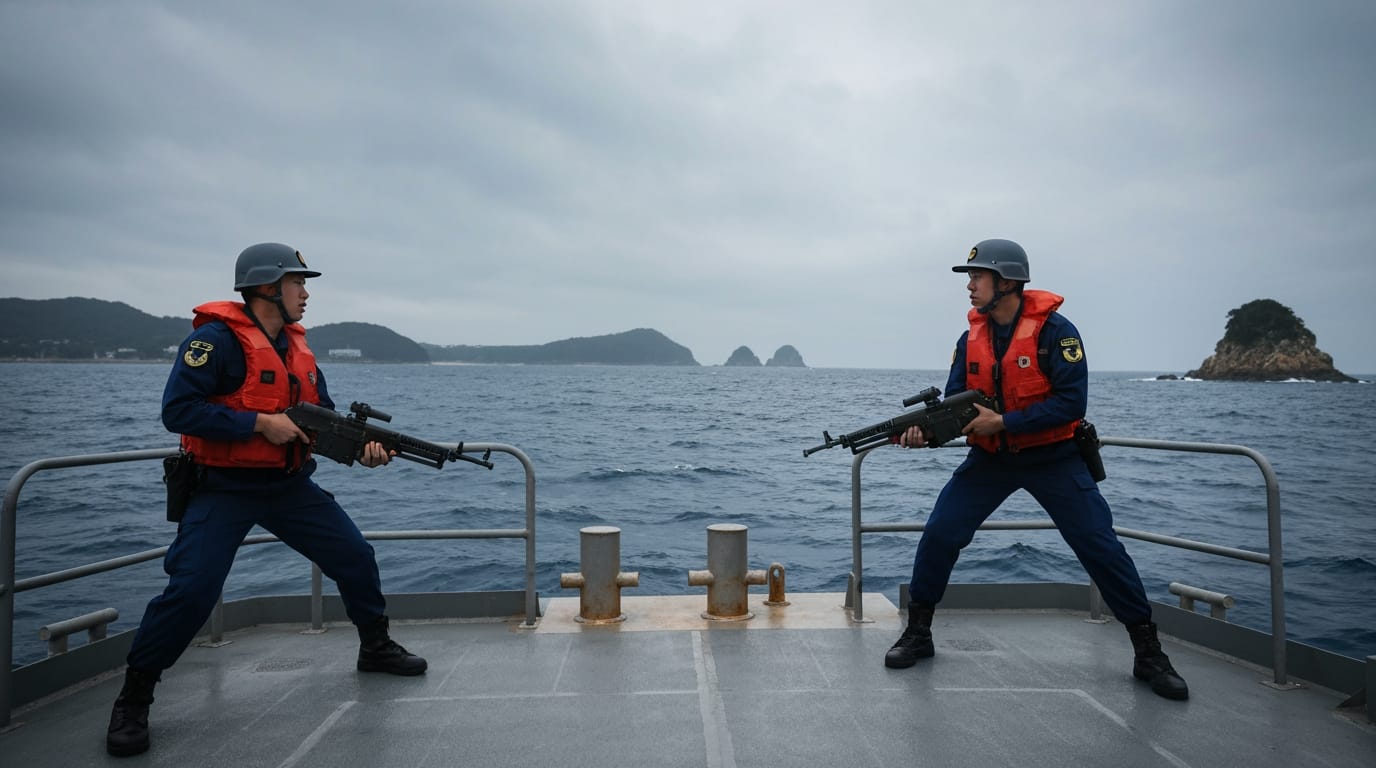
East China Sea, July 7, 2026 – A tense maritime confrontation unfolded today in the East China Sea, as coast guard vessels from Japan and China engaged in a standoff near a cluster of uninhabited islands claimed by both nations. Both sides accused the other of territorial incursions and claimed to have successfully repelled the opposing vessels from waters they assert as their own, further inflaming already fraught bilateral relations. The incident highlights the persistent and dangerous dispute over the strategically important archipelago, known as the Senkaku Islands in Japan and the Diaoyu Islands in China, which lies at the heart of competing historical claims and geopolitical ambitions.
Heightened Tensions in the East China Sea
The latest flashpoint occurred Tuesday morning when Japanese authorities reported that two Chinese coast guard ships entered what Tokyo considers its territorial waters after four Chinese vessels were observed operating in the vicinity. The Chinese ships reportedly approached a Japanese fishing vessel, the Zuihou Maru, operating near the islands. Japan’s Coast Guard promptly issued orders for the Chinese vessels to depart, successfully compelling them to leave Japanese territorial waters by approximately 9:20 a.m. local time. Japanese officials described the Chinese vessels' actions as a "violation of international law" and affirmed their commitment to "respond calmly and resolutely" to protect their maritime borders.
Conversely, China’s Coast Guard presented a starkly different account, asserting that its vessels had "taken necessary measures to warn and expel" the Japanese fishing boat, the Zuihou Maru, which it claimed had "intruded into" waters surrounding the disputed islands. This direct contradiction underscores the deep-seated disagreement over sovereignty and maritime rights in the region, where both nations regularly deploy government ships and fishing fleets, often leading to dangerous encounters.
Decades of Contention: The Senkaku/Diaoyu Dispute
The uninhabited islands, comprising five islands and three rocky outcrops, are situated between Taiwan and Japan’s Okinawa, approximately 120 nautical miles northeast of Taiwan and 200 nautical miles east of mainland China. Beyond their geographic location, the islands hold significant strategic value due to their proximity to vital shipping lanes, potential for rich fishing grounds, and the identification of possible oil and natural gas reserves in the surrounding seabed by the United Nations in 1969.
The sovereignty dispute is rooted in conflicting historical narratives and post-World War II settlements. Japan maintains that it incorporated the islands in 1895, claiming they were terra nullius, or land belonging to no state, prior to its administrative control. Following Japan's defeat in World War II, the United States administered the islands as part of the Ryukyu Islands, before transferring administrative control back to Japan in 1972. Tokyo asserts there is "no issue of territorial sovereignty" over the Senkakus, viewing them as an inherent part of Japanese territory.
China, however, disputes Japan's claims, arguing that the Diaoyu Islands have been an inherent part of Chinese territory since the Ming Dynasty and were illegally seized by Japan after the First Sino-Japanese War. Beijing and Taipei assert that the islands should have been returned to China under the 1943 Cairo Declaration and the 1945 Potsdam Declaration, which called for Japan to return all territories taken through aggression.
Escalation and International Ramifications
Tensions over the islands have periodically flared into major diplomatic crises. A significant escalation occurred in September 2012 when the Japanese government purchased three of the disputed islands from a private owner. This move, intended by Japan to maintain administrative stability, was met with strong diplomatic protests from China and Taiwan, triggering large-scale anti-Japanese demonstrations in China and a subsequent increase in Chinese maritime patrols around the islands. Beijing further asserted its claims by announcing territorial sea baselines around the islands and declaring an Air Defense Identification Zone (ADIZ) over the East China Sea, which includes the disputed territory.
The latest confrontation occurs amidst a backdrop of recently heightened diplomatic tensions. Japanese Prime Minister Sanae Takaichi’s comments in November, suggesting Japan could intervene militarily if China were to attack Taiwan, drew sharp condemnation from Beijing. These remarks have led to a further deterioration of bilateral relations, with China reportedly urging its citizens against traveling to Japan and tightening trade restrictions on some Japanese firms.
The United States, while maintaining a neutral stance on the ultimate sovereignty of the islands, has consistently affirmed that the 1960 U.S.-Japan Security Treaty applies to the Senkaku Islands. This commitment obligates the U.S. to defend territories under Japanese administration in the event of an armed attack, adding a critical international dimension to the dispute. The European Union has adopted a position of principled neutrality regarding legal title but acknowledges the significant risk of miscalculation.
The Perils of Miscalculation
The ongoing standoff in the East China Sea represents more than just a territorial disagreement; it embodies a broader contest over regional order, alliance politics, sea lane security, and the interpretation of international maritime law. The repeated dispatch of coast guard vessels by both nations into the disputed waters raises serious concerns about the potential for accidental collisions, miscommunication, or miscalculation that could rapidly escalate into a larger conflict.
The economic implications are also substantial, given the region’s importance for trade routes and energy resources. Any disruption to stability could have far-reaching consequences for global commerce and energy security. As both Japan and China demonstrate unwavering resolve in asserting their claims, the international community watches with apprehension, recognizing that a peaceful resolution remains elusive, with the risk of unintended incidents looming large over the East China Sea.


