'Cold Supermoon' Caps Off 2025 with Dazzling December Display
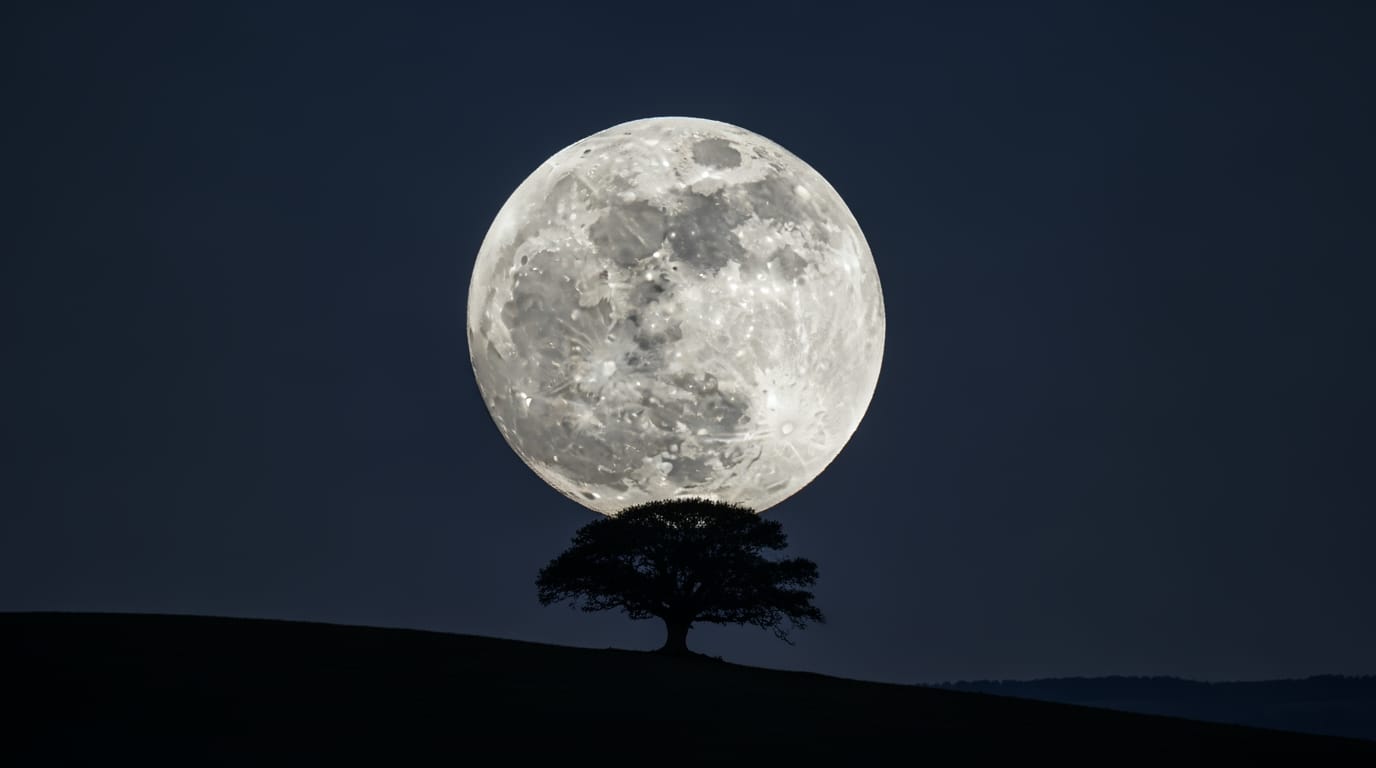
The night skies of December 4, 2025, played host to a magnificent celestial spectacle as the year's final "supermoon" graced observers across the globe. Known traditionally as the "Cold Moon," this luminous event marked the culmination of a series of supermoons, offering a captivating close-up of Earth's natural satellite that appeared notably larger and brighter than an average full moon. Stargazers who turned their eyes heavenward were treated to an extraordinary display, underscoring the moon's enduring power to inspire awe and curiosity.
The 'Cold Supermoon' Illuminates the Winter Sky
On Thursday, December 4, the full moon reached its peak illumination, casting a brilliant glow upon the deepening winter nights. This particular full moon carries the evocative moniker of the "Cold Moon," a name rooted in various Indigenous traditions reflecting the plummeting temperatures and the onset of winter in the Northern Hemisphere. It is also sometimes referred to as the "Long Night Moon," a nod to the lengthening nights surrounding the winter solstice. This celestial event was not merely a full moon; it was a "supermoon," signifying its close proximity to Earth, making it the third and final such occurrence in 2025. The earlier supermoons of the year delighted observers in October and November, setting the stage for December's grand finale.
Decoding the 'Supermoon' Phenomenon
The term "supermoon" has become widely popular, though its origins lie not in traditional astronomy but in astrology, coined by Richard Nolle in 1979. Scientifically, this phenomenon is more precisely known as a "perigee-syzygy moon". It occurs when a full moon coincides with the moon's closest approach to Earth in its elliptical orbit, a point known as "perigee". Conversely, when the moon is at its furthest point, it is called "apogee," leading to a "micromoon".
Due to this closer alignment, a supermoon can appear up to 14 percent larger and 30 percent brighter than a full moon at apogee. This perceptible difference, while significant to astronomers, can be subtle to the casual observer. The moon's orbit around Earth is not a perfect circle but an ellipse, meaning its distance from our planet constantly varies, ranging approximately between 360,000 and 400,000 kilometers. The December 2025 supermoon was situated approximately 221,965 miles (357,218 km) from Earth, contributing to its enhanced appearance. While the scientific distinction is clear, the public's engagement with the term "supermoon" has proven beneficial, encouraging more people to look up and appreciate the wonders of the night sky.
A Celestial Companion for the Longest Nights
Beyond its scientific intrigue, the Cold Supermoon carried cultural resonance, particularly given its timing. The name "Cold Moon" perfectly encapsulates the frigid conditions of early winter, while "Long Night Moon" highlights the extended darkness preceding the winter solstice. For those observing the supermoon near the horizon, an additional optical phenomenon likely enhanced its perceived size: the "Moon illusion". This well-known effect makes the moon appear dramatically larger when it is low in the sky, often framed by terrestrial objects like trees or buildings, providing a sense of scale that is absent when the moon is high overhead.
The December supermoon also shared the stage with other prominent celestial bodies. As it rose in the constellation Taurus, keen observers could spot the bright star Aldebaran, known as the "red eye of the bull," near the moon. Later in the evening, the constellation Orion, with its distinctive belt stars and the bright red supergiant Betelgeuse, became visible below the moon. Further to the left of Orion, the bright planet Jupiter was also a notable presence, offering additional points of interest for skywatchers.
Optimal Viewing and Future Spectacles
For those who seized the opportunity, optimal viewing conditions were paramount. The supermoon appeared essentially full for several nights, from December 3 through December 5, with peak illumination on December 4. Viewing the moon shortly after it rose over the eastern horizon provided the most striking visual experience, capitalizing on the moon illusion for an even grander appearance. Clear skies and a location with minimal light pollution were ideal, although the sheer brightness of the supermoon meant it was discernible even in urban areas. No special equipment was necessary, making it an accessible event for everyone.
While 2025's supermoon series has concluded, the celestial show continues. The December Cold Moon was the third in a sequence of four consecutive supermoons. The next opportunity to witness this phenomenon will be on January 3, 2026, when another supermoon, known as the "Wolf Moon," will illuminate the sky, offering another chance to connect with our nearest celestial neighbor.
The recent Cold Supermoon served as a powerful reminder of the dynamic cosmos above us. From its scientific definition to its traditional names and visual impact, the event offered a multifaceted experience that blended astronomical fact with human wonder. As the year draws to a close, this final supermoon leaves behind not just memories of a brilliant lunar disk, but a renewed appreciation for the celestial mechanics that orchestrate such breathtaking displays.