Comet 3I/ATLAS: An Interstellar Wanderer, Not an Alien Craft, Confirms NASA
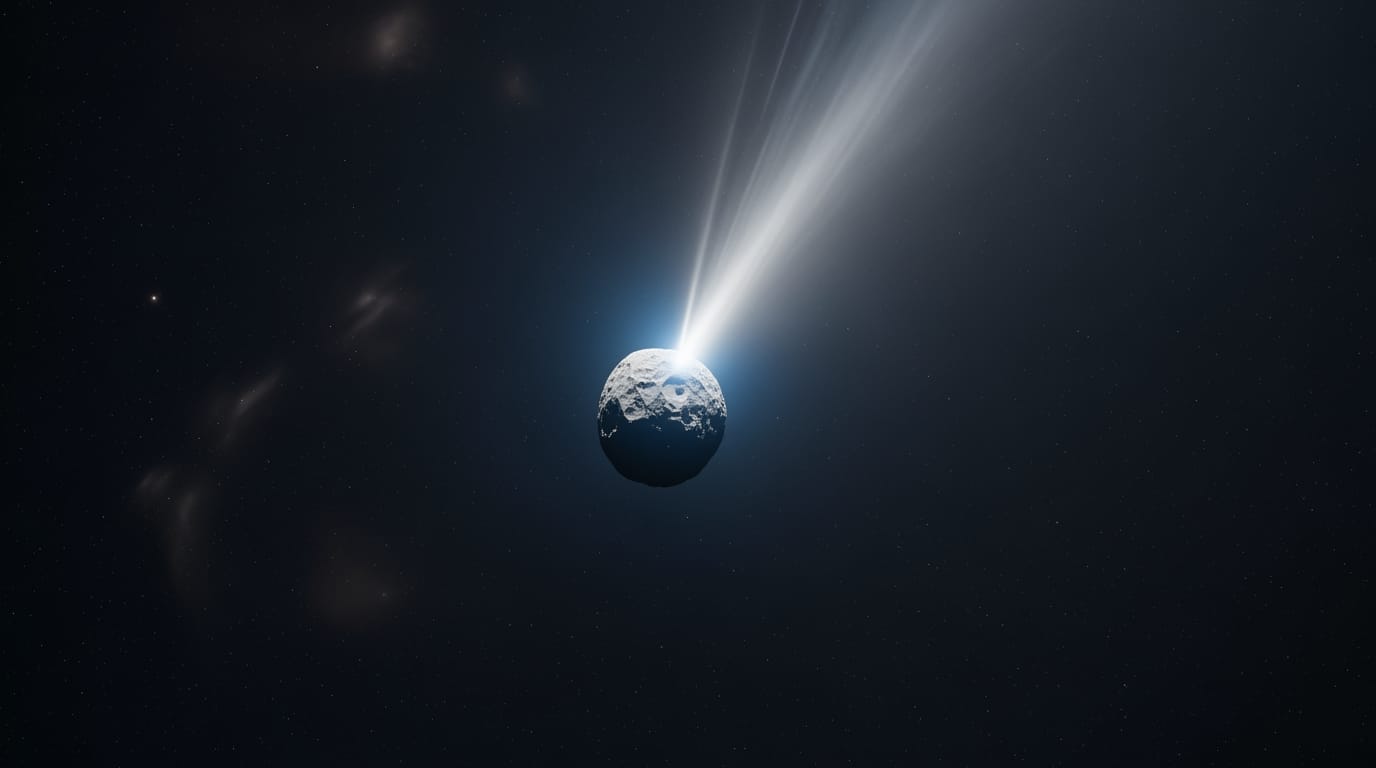
A celestial visitor from beyond our solar system, designated 3I/ATLAS, has captivated the scientific community and fueled widespread public speculation about extraterrestrial intelligence. However, NASA and a host of international astronomers have definitively concluded that the object is a natural interstellar comet, not an alien spacecraft, offering an unprecedented opportunity to study material from another star system.
The excitement began on July 1, 2025, when the NASA-funded ATLAS (Asteroid Terrestrial-impact Last Alert System) survey telescope in Río Hurtado, Chile, first detected the fast-moving object. Its unusual trajectory immediately signaled something extraordinary: 3I/ATLAS was not gravitationally bound to our Sun, indicating it originated from interstellar space. This makes it only the third confirmed interstellar object observed passing through our solar system, following 1I/ʻOumuamua in 2017 and 2I/Borisov in 2019. While its interstellar nature was quickly established, its true identity became a subject of intense scientific inquiry and public fascination.
An Interstellar Visitor: The Genesis of 3I/ATLAS
The journey of 3I/ATLAS began millions, perhaps even billions, of years ago in another star system, from which it was ejected into the vastness of interstellar space. Upon its discovery, it was traveling at approximately 61 kilometers per second (137,000 miles per hour) relative to the Sun, a speed characteristic of objects not gravitationally bound to our star. As it approached our Sun, its speed increased to about 68 kilometers per second (153,000 miles per hour) due to gravitational acceleration.
Designated 3I/ATLAS—the '3I' denoting its status as the third interstellar object and 'ATLAS' crediting its discoverer—the comet made its closest approach to the Sun on October 29, 2025, reaching a distance of about 1.36 to 1.4 astronomical units (AU), which places it between the orbits of Earth and Mars. Crucially, scientists have confirmed that 3I/ATLAS poses no threat to Earth, as it will pass no closer than 1.8 AU (approximately 270 million kilometers or 170 million miles) to our planet. The comet is expected to continue its hyperbolic trajectory, eventually departing our solar system at the same velocity it entered.
Initial observations from instruments like the Hubble Space Telescope estimated the comet's nucleus to be between 0.32 and 5.6 kilometers (1,050 feet and 3.5 miles) in diameter, likely less than 1 kilometer. This size, combined with its highly active state, which includes a visible coma—a cloud of gas and dust—and a distinct tail, aligns perfectly with the characteristics expected of a comet.
The Allure of the 'Alien' Hypothesis
Despite mounting scientific evidence, the arrival of 3I/ATLAS triggered a wave of popular speculation suggesting it might be an extraterrestrial craft. This discussion was significantly amplified by some voices within the scientific community, notably Harvard astrophysicist Avi Loeb, who had previously speculated about the artificial nature of 1I/ʻOumuamua.
Proponents of the 'alien' hypothesis pointed to several perceived "anomalies." Some early observations noted an absence of a clear dust tail, which can be atypical for comets. Others highlighted the object's high velocity and its specific trajectory through our solar system, particularly its path aligning closely with the ecliptic plane and making relatively close passes to Venus, Mars, and Jupiter. Loeb, for instance, suggested that such precise alignments are statistically improbable for a randomly arriving interstellar object, raising questions about potential intelligent manipulation or a deliberate "Grand Tour" of our solar system. Further fueling the speculation, there were unsubstantiated claims of anomalous acceleration and even possible radio signals. These discussions resonated with a public eager for discoveries that challenge our understanding of the universe.
Scientific Scrutiny Confirms Cometary Nature
In response to the burgeoning speculation, NASA and the broader astronomical community mobilized an unprecedented observation campaign, employing a vast array of telescopes and spacecraft. Missions including the Hubble Space Telescope, the James Webb Space Telescope, the Very Large Telescope, NASA’s Transiting Exoplanet Survey Satellite (TESS), and even Mars orbiters like Perseverance and MRO were tasked with studying 3I/ATLAS.
The comprehensive data collected rapidly reinforced the conclusion that 3I/ATLAS is indeed a comet. Images from Hubble captured a "teardrop-shaped cocoon of dust coming off of the comet's solid, icy nucleus," a classic signature of cometary activity. Scientists observed a clear coma and tail, definitive features of a comet formed by the sublimation of ices as the object approaches the Sun.
Spectroscopic analysis, a powerful tool for determining composition, revealed molecules familiar from comets originating within our own solar system. Observations showed 3I/ATLAS is rich in carbon dioxide and contains water ice, water vapor, carbon monoxide, carbonyl sulfide, cyanide gas, and atomic nickel vapor. While the chemical mix exhibited some variations compared to solar system comets, these differences are attributed to the unique environment of its home star system, not to artificial construction.
Furthermore, the perceived "anomalies" were systematically addressed. The initial lack of a pronounced tail was explained by its composition and activity being largely driven by highly volatile ices (like carbon dioxide) even at great distances, rather than water ice. The so-called "non-gravitational acceleration" is a common phenomenon in comets, caused by the asymmetric outgassing of material acting as tiny thrusters. NASA Associate Administrator Amit Kshatriya explicitly addressed the rumors, stating, "This object is a comet. It looks and behaves like a comet. And all evidence points to it being a comet." Elon Musk also weighed in, dismissing the alien speculation and reiterating its cometary nature.
A Window into Other Worlds
Beyond dispelling fanciful notions, 3I/ATLAS represents an extraordinary scientific bonanza. As an interstellar object, it carries pristine material from a distant star system, offering astronomers a rare direct glimpse into the chemistry and conditions beyond our cosmic neighborhood.
Its composition, particularly the suggested presence of "ice volcanoes" or cryovolcanoes, which erupt as the comet approaches the Sun, indicates similarities to trans-Neptunian objects in our own solar system. Researchers believe 3I/ATLAS could be billions of years old, potentially predating our own solar system by as much as 3 billion years. This makes it a "time capsule" that can provide invaluable insights into cosmic history and the processes of planet formation in ancient stellar environments. By comparing its characteristics to our native comets, scientists can test models of star system formation and determine whether our solar system is typical or unique.
The comprehensive study of 3I/ATLAS underscores the power of persistent, evidence-based scientific inquiry. While the allure of discovering alien technology remains a compelling dream, the actual scientific revelations from objects like 3I/ATLAS offer a deeper, more profound understanding of the universe's vast and diverse natural processes. This interstellar comet, though not a vessel from another civilization, is a messenger of cosmic proportions, carrying secrets from an unimaginably distant past and an alien star.


