Corruption Scandals Engulf Ukraine, Testing Zelenskyy's Wartime Leadership
KYIV, Ukraine – A series of high-profile corruption scandals is rocking Ukraine, casting a shadow over President Volodymyr Zelenskyy's administration and sparking widespread public discontent as the nation continues its grueling war against Russia. The investigations, reaching deep into Zelenskyy's inner circle, threaten to undermine crucial Western aid and complicate Ukraine's aspirations for European Union membership, pushing Kyiv to demonstrate unwavering commitment to accountability amidst existential threats.
The Widening Net: Scandals Reach Zelenskyy's Inner Circle
Recent weeks have seen a dramatic escalation in anti-corruption efforts, with Ukrainian authorities targeting figures once considered indispensable to President Zelenskyy. His former chief of staff, Andriy Yermak, was recently named an official suspect in an alleged $10.5 million money-laundering scheme tied to an elite housing development outside Kyiv. Yermak, widely regarded as Zelenskyy's "right-hand man" and an influential figure in Ukrainian politics, was subsequently arrested, with bail set at $3.2 million. He has denied the allegations. Authorities have clarified that President Zelenskyy himself is not currently under suspicion in this particular case.
This development follows closely on the heels of the "Operation Midas" investigation, which exposed an alleged $110 million corruption scheme within the state-owned nuclear energy company, Energoatom. The scheme reportedly involved contractors paying 10-15 percent kickbacks on infrastructure project contracts. At the center of this investigation is Timur Mindich, a film producer and former business partner of Zelenskyy, who co-founded the production company Kvartal 95. Mindich has reportedly fled Ukraine. Other prominent individuals implicated include former Minister of Energy Herman Halushchenko and former Deputy Prime Minister Oleksii Chernyshov.
Further underscoring the pervasive nature of graft, President Zelenskyy initiated an investigation into widespread bribery within military recruitment. He dismissed all regional military commissars, labeling "cynicism and bribery during war" as "high treason." These revelations highlight how wartime pressures, despite increased scrutiny, can paradoxically create new opportunities for illicit enrichment within public administration, procurement, and recruitment.
Public Outcry and Political Fallout
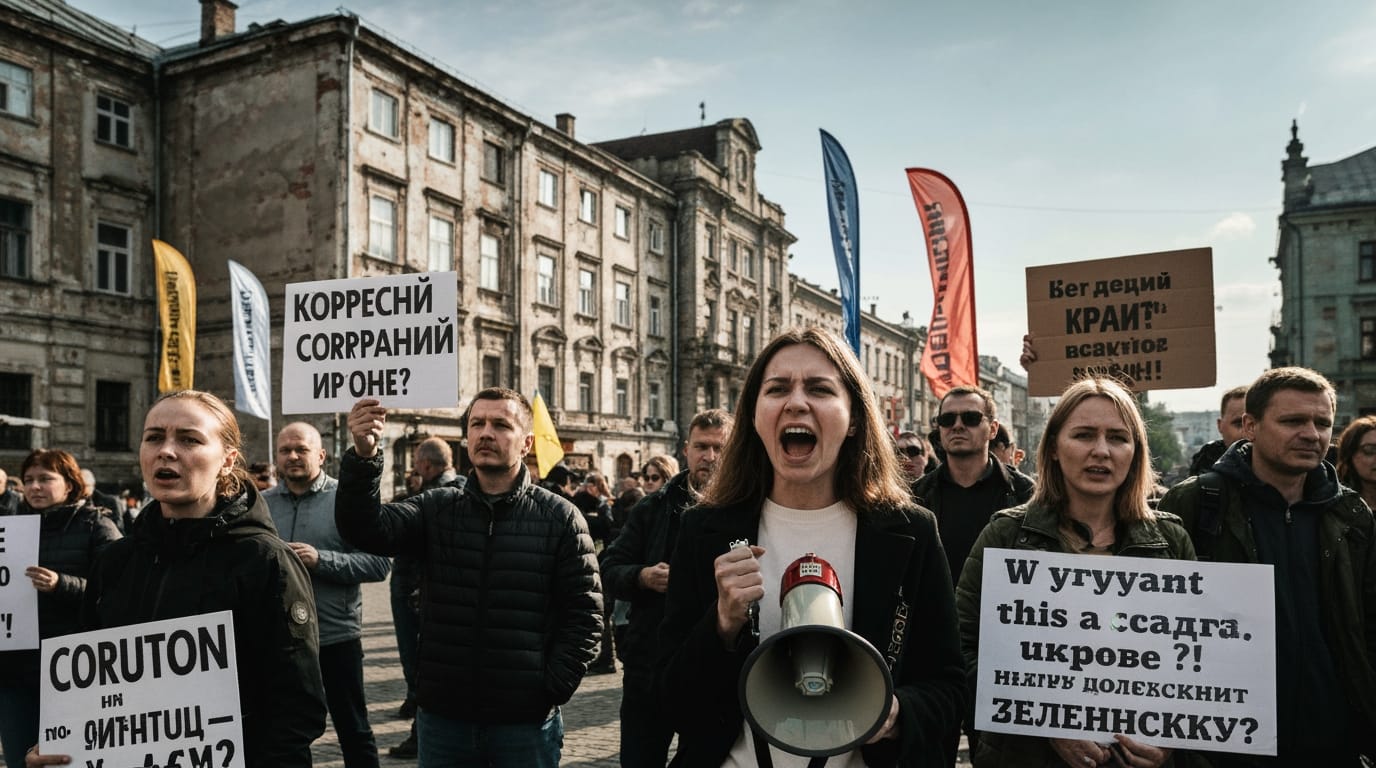
The drumbeat of corruption allegations has reverberated deeply within Ukrainian society, already strained by years of conflict. A 2023 survey indicated that 89% of Ukrainians perceive corruption as the nation's most serious problem, second only to the war itself. Compounding the pressure on Zelenskyy, polls suggest a significant portion of the population holds him responsible for corruption within government and military administrations. One survey reported 77.6% of Ukrainians believed the president was "directly responsible" for government corruption, while another indicated 59% believed him personally responsible for Timur Mindich's actions.
Such public sentiment places immense pressure on Zelenskyy to demonstrate greater accountability. His political opponents and concerned allies view these scandals as a severe test of his leadership, particularly given his 2019 presidential campaign promise to root out graft. The controversy is also testing the government's relationship with anti-corruption institutions. In July 2025, a law signed by Zelenskyy initially sought to curtail the independence of the National Anti-Corruption Bureau of Ukraine (NABU) and the Specialized Anti-Corruption Prosecutor's Office (SAPO), sparking widespread protests and international concern. Following public outcry, Zelenskyy reconsidered and signed a new law restoring their independence. This episode demonstrated the resilience of Ukrainian civil society and its critical role in safeguarding anti-corruption reforms, even during wartime.
A Persistent Shadow: Historical Context of Ukrainian Corruption
Corruption in Ukraine is not a novel phenomenon but a deeply entrenched societal issue with roots stretching back to the dissolution of the Soviet Union in 1991. Following independence, political figures, criminal organizations, and oligarchs exploited systemic weaknesses to consolidate power and wealth. Past leaders, such as Presidents Kuchma and Yushchenko, were characterized as "kleptocrats," a term describing those who abuse political power to plunder national resources. The era of Viktor Yanukovych, particularly before the 2014 Maidan Revolution, became synonymous with monumental embezzlement, with estimates reaching as high as $37 billion.
For decades, Ukraine has consistently been ranked among Europe's most corrupt nations, though it has shown steady progress since 2015. The persistence of corruption is attributed to a combination of factors, including a compromised justice system, a centralized and opaque government, strong ties between business and political elites, and a weakened civil society in earlier periods. Despite numerous reform efforts, particularly after the 2014 Revolution of Dignity, the perception of widespread corruption has remained high among Ukrainians.
The Wartime Dilemma: Aid, Integrity, and Survival
The ongoing war against Russia has amplified the stakes of Ukraine's fight against corruption. While Western assistance – including military, financial, and humanitarian aid – has exceeded €300 billion in commitments and been vital to Ukraine's defense, these funds also introduce new vulnerabilities. Repeated scandals in areas like defense procurement and military recruitment threaten to erode international confidence and the continued flow of critical support.
Western partners have made it increasingly clear that future aid will be conditional on demonstrable progress in combating judicial corruption, enforcing asset declarations for public officials, and ensuring transparency in all recovery funds. The argument is that corruption, if left unchecked, could become an "existential threat" by undermining both domestic and international support, ultimately jeopardizing Ukraine's ability to resist Russian aggression. Beyond financial implications, the scandals also foster public cynicism and undermine national unity, both crucial elements for a country at war. The battle for Ukraine's future is therefore being fought on two fronts: against external aggression and against internal corruption.
A Critical Juncture for Ukraine's Future
Ukraine finds itself at a pivotal moment, where the imperative to defend its sovereignty against an invading force converges with the urgent need to address deep-seated corruption. The current wave of high-profile investigations, while potentially embarrassing for the government, also signifies a strengthened capacity of independent anti-corruption institutions to pursue cases even against powerful figures. This renewed push for accountability is essential not only for maintaining domestic public trust but also for securing the sustained international backing that is vital for Ukraine's survival and its long-term integration into European structures. The ability of President Zelenskyy's administration to navigate these turbulent waters and deliver concrete results in the fight against corruption will undeniably shape Ukraine's trajectory in the years to come.