Damascus Residents Decry Alcohol Curbs, Citing Personal Freedom and Rising Conservatism
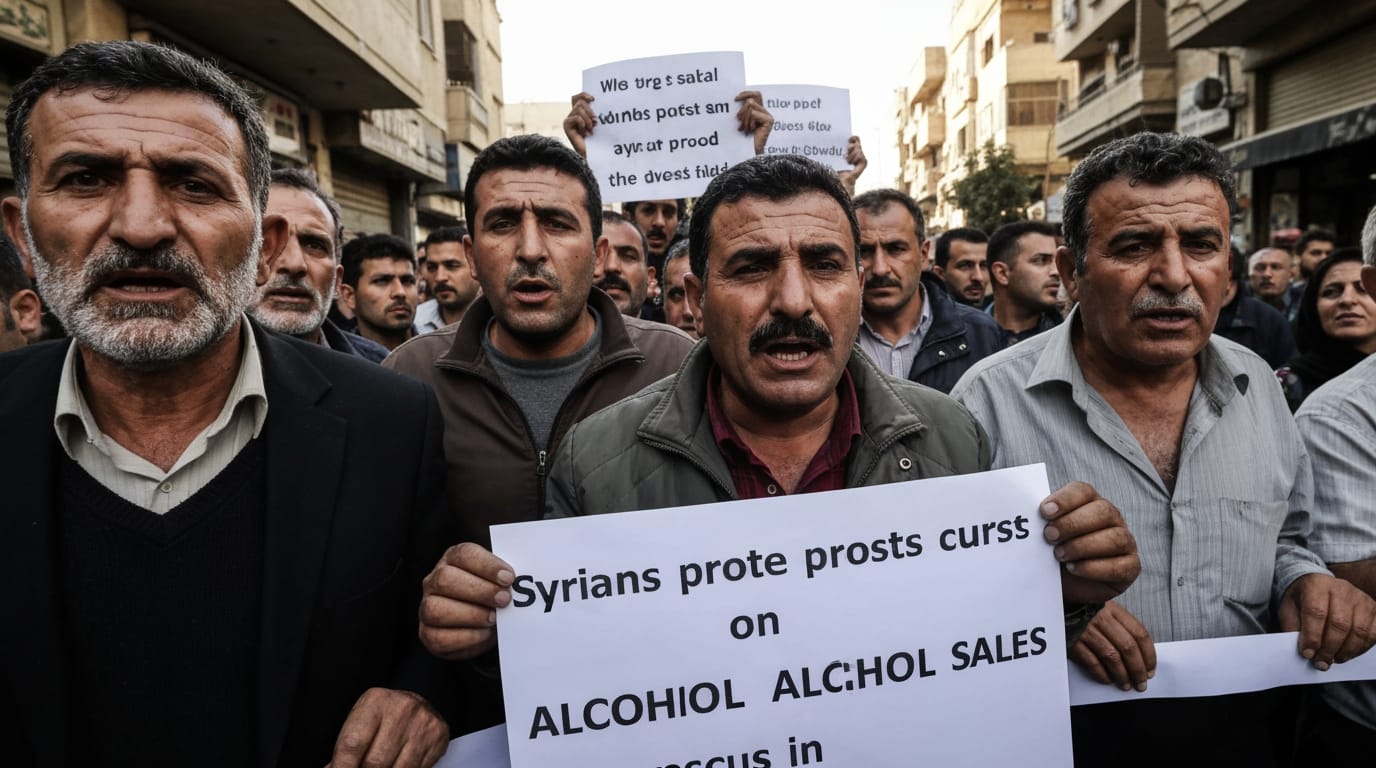
DAMASCUS, SYRIA – Hundreds of Syrians took to the streets of central Damascus on Sunday, March 22, 2026, to protest new restrictions on alcohol sales, an unusual public display of dissent in government-controlled areas that highlights growing anxieties over personal freedoms and increasing social conservatism under the new Islamist-led government. The demonstrations, primarily centered in the historic Bab Touma district, underscore a deepening societal divide as authorities, citing "public morals" and "community requests," enforce measures seen by many as an encroachment on long-held secular traditions.
The Curbs That Sparked Outcry
The controversy ignited last week following a decree issued by the Damascus governorate that drastically altered the landscape for alcohol sales in the capital. The new regulation banned the sale of alcoholic beverages in all restaurants and bars across Damascus, requiring these establishments to convert their licenses to café permits within three months. Retail sales of alcohol were subsequently restricted to sealed take-away bottles and limited exclusively to three predominantly Christian neighborhoods: Bab Touma, al-Qassaa, and Bab Sharqi. Even in these designated areas, establishments are prohibited from serving alcohol on-site, and retail outlets must maintain specific distances—at least 75 meters from mosques, churches, schools, and cemeteries, and 20 meters from police stations and government offices.
Authorities defended the decision, stating it was made "at the request of the local community" and aimed at "eliminating practices contrary to public morals." However, this explanation has done little to quell public discontent, with many interpreting the move as a clear step towards a more religiously conservative society. The decree has prompted outrage not only among secular Muslims but also within Christian communities who view the exemptions as a discriminatory measure that further isolates them and implies their association with what the decree labels "violations of public morals."
A Deeper Current of Conservatism
The restrictions on alcohol sales are not isolated but rather represent the latest in a series of measures indicative of a shift towards social conservatism since the Islamist authorities assumed control after the fall of long-time ruler Bashar al-Assad in December 2024. Since President Ahmed al-Sharaa's movement ousted Assad, the interim government has faced increasing pressure from hard-liners to impose more conservative religious values. Previous regulations have included requiring "modest" swimwear on public beaches nationwide and banning makeup for female public sector workers in Latakia province.
Under Bashar al-Assad's decades-long rule, a secular ideology was promoted, particularly to retain the support of minority groups in the Sunni-majority nation. While civic and political freedoms were limited, Syrians generally enjoyed personal liberties, including the ability to consume alcohol, frequent nightclubs, and dress as they pleased. This historical context makes the current restrictions a stark departure and fuels fears that the nation's new leadership is systematically eroding the secular fabric of Syrian society. Ahmed al-Sharaa, a former Islamist rebel, has publicly vowed to unite the country and protect pluralism, yet these recent policy decisions have raised concerns about the sincerity of such pledges.
Protests: A Stand for Personal Liberty
The protests on Sunday were a direct response to these burgeoning concerns, with hundreds gathering in a silent demonstration. Participants, representing a diverse cross-section of Damascus residents, held banners proclaiming "Personal freedom is a red line." Isa Qazah, a 45-year-old sculptor who participated in the rally, articulated the sentiment shared by many: "This is not about whether we want to drink alcohol; this is about personal freedom." Rami Koussa, a 37-year-old television writer, echoed this, stating, "this type of decision will not stand."
The demonstrators also voiced frustrations that the government was prioritizing what they viewed as trivial social engineering over the nation's myriad pressing issues. University professor Hanan Assi highlighted that Syrians face "thousands of forgotten issues, from poverty to the displaced, the homeless, and refugees" that should take precedence over such social restrictions. The protests, organized by civil society groups in the Bab Touma district, were monitored by heavily armed security forces but reportedly passed without incident, indicating a delicate balance in the state's response to public dissent.
Government's Measured Retreat and Legal Challenges
In the face of mounting criticism, Damascus authorities issued a statement the day before the main protest, attempting to assuage fears. They apologized to the city's Christian population for "any misunderstanding or misinterpretation of the decision" and clarified that hotels would be exempt from the alcohol restrictions. The statement asserted that the decision "does not interfere with citizens' personal freedoms" and that "the regulation of alcohol sales exists in all countries, with differences in how it's applied and enforced." This partial walk-back suggests the government's sensitivity to public opinion and the potential for civil society to influence policy, even in a post-conflict environment.
However, the legal basis of the restrictions has been challenged. Mohammad al-Abdullah, director of the Washington-based Syria Justice and Accountability Centre, argued that existing Syrian laws do not ban the consumption or sale of alcoholic beverages. He further noted that the decision contradicts Article 12 of Syria's Constitutional Declaration, approved by President Sharaa in 2025, which adopted human rights treaties protecting the right to consume alcohol. These legal arguments add another layer of complexity to the social and political ramifications of the new regulations.
Societal Ripples and Future Uncertainties
Syria remains a nation deeply scarred by 14 years of civil war and decades of authoritarian rule, struggling to define its future. The recent alcohol restrictions, and the subsequent public backlash, expose deeper societal tensions regarding religious freedom, personal autonomy, and the very identity of the post-Assad state. The decision to confine alcohol sales to predominantly Christian neighborhoods has been criticized for potentially deepening sectarian divisions at a time when the country is striving for unity amidst instances of sectarian violence.
As the new Islamist-led government navigates the complex path of reconstruction and governance, its approach to social policies like alcohol sales will be closely watched both domestically and internationally. The protests in Damascus serve as a potent reminder that even in a war-weary nation, citizens are willing to assert their fundamental rights and freedoms, signaling that the debate over Syria's future character is far from settled. The balance between conservative religious values and traditional secular liberties will continue to shape the social and political landscape of a nation still finding its footing.


