Dawn of a New Era: Chinese Robot 'Lightning' Shatters Usain Bolt's 100-Meter World Record
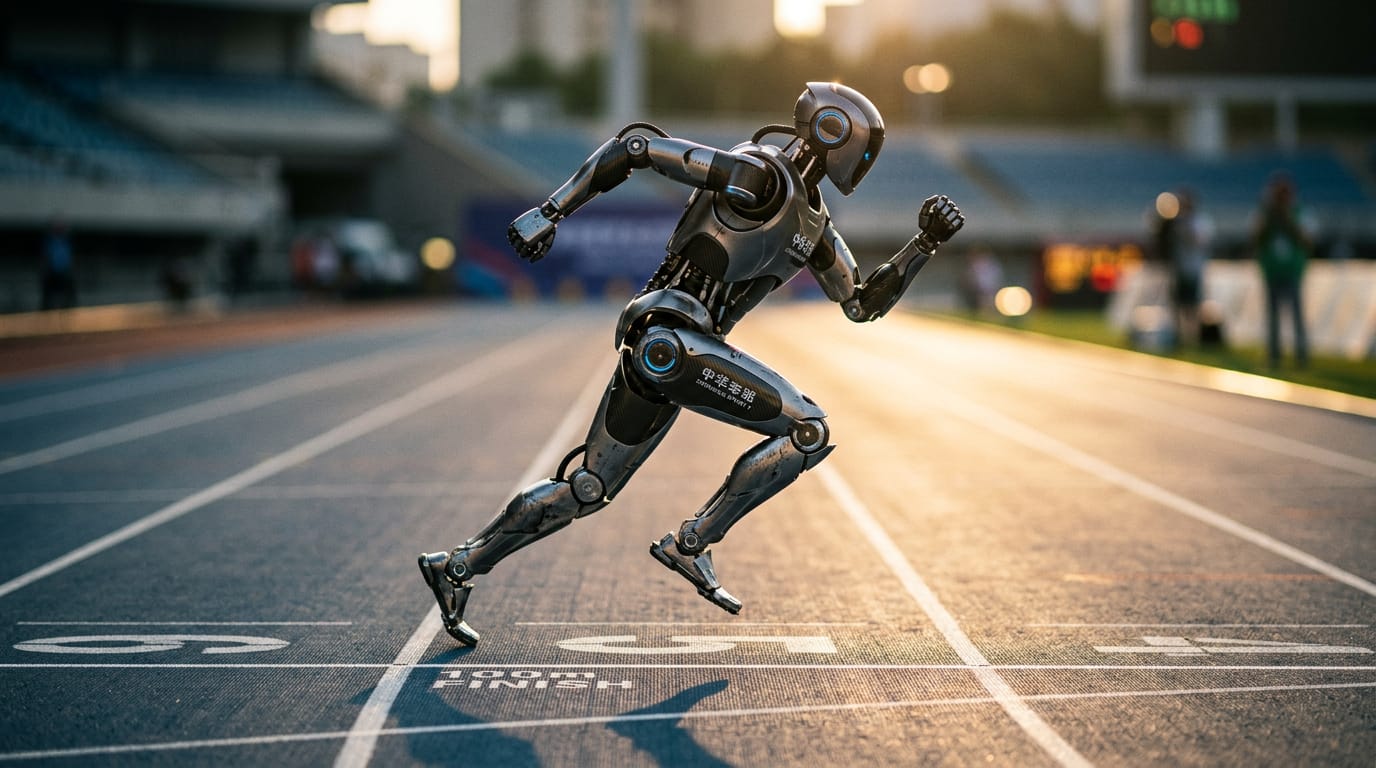
BEIJING – In a stunning display of technological prowess, a humanoid robot developed by Chinese smartphone manufacturer Honor has clocked a 9.32-second 100-meter sprint, surpassing Jamaican sprint legend Usain Bolt's long-standing human world record. The feat, achieved during a preparatory test event for the second World Humanoid Robot Games in Beijing, marks a significant milestone in the rapid advancement of robotics and has ignited discussions about the future of athletic performance.
The Record-Breaking Performance
Dubbed "Lightning," the agile automaton demonstrated its extraordinary speed on Saturday, August 22, 2026, registering a time that unequivocally beat Usain Bolt's 9.58-second record set at the 2009 World Athletics Championships in Berlin. The robot reached an impressive peak speed of 14.5 meters per second during its sprint, showcasing the sophisticated engineering and artificial intelligence underpinning its design. This groundbreaking performance was reported by China's state broadcaster and comes just as the second World Humanoid Robot Games commence, setting a high bar for robotic athletic capabilities.
The context of this achievement is crucial. While Bolt's record was set by a human athlete under competitive conditions, Lightning's sprint occurred during a test run. Nevertheless, the outright speed displayed by the humanoid machine signals a dramatic shift in what is physically possible for bipedal systems. The robot's fluid motion and controlled acceleration across the track underscore years of dedicated research and development in locomotion and balance algorithms. Its ability to maintain such high velocity over the 100-meter distance points to advanced motor control and power management systems.
Evolution of an Engineering Marvel
Lightning is a product of Honor, a prominent Chinese smartphone maker, signifying the growing diversification of technology companies into advanced robotics. The robot's development has been a journey of continuous refinement, with engineers constantly pushing the boundaries of its physical design and software. Originally, Lightning stood at 169 centimeters (approximately 5 feet 7 inches) with 95-centimeter legs. However, ahead of the World Humanoid Robot Games, researchers extended its legs by an additional 10 centimeters, bringing them to 1.05 meters. This modification likely played a pivotal role in achieving the enhanced speed and longer stride required to break the 100-meter record.
Beyond its recent sprint, Lightning has previously demonstrated remarkable endurance. In April of this year, the robot triumphed in the 21-kilometer Beijing half marathon, completing the course in a staggering 50 minutes and 26 seconds. This time was not only faster than the elite men's human world record pace for a half-marathon but also showcased the robot's capability for sustained high-performance locomotion over extended periods. These successive achievements underscore a significant leap in humanoid robotics, transitioning from controlled laboratory movements to complex, high-speed, and high-endurance athletic tasks in real-world or near-real-world environments.
China's Strategic Robotics Push
The success of "Lightning" is not an isolated incident but rather a testament to China's broader national strategy to promote humanoid robotics as a key emerging industry. Policymakers and technology companies across the nation are heavily investing in research and development, betting on the accelerating advancements in artificial intelligence and hardware to drive the widespread adoption of robots. These humanoid machines are envisioned to play transformative roles across various sectors, including manufacturing, logistics, and consumer applications. From streamlining assembly lines to automating delivery services and even assisting in daily household tasks, the potential uses are vast.
The World Humanoid Robot Games, where "Lightning" is a prominent participant, serve as a global platform to showcase these advancements and foster innovation through competitive challenges. Such events not only accelerate technological development but also help to capture public imagination and highlight the practical applications of robotics. The emphasis on athletic challenges like sprinting and marathons pushes the limits of robot design in areas critical for real-world functionality, such as dynamic balance, energy efficiency, and robust mechanical systems.
Other Chinese firms are also making significant strides. Unitree, another robotics company, recently unveiled a robot named "Superman," claiming it could outrun and outjump human athletes, reaching a top speed of 12.66 meters per second. While Unitree's claims for a full 100m sprint have yet to be independently verified, these developments collectively illustrate the intense competition and rapid innovation defining the Chinese robotics landscape.
The Shifting Landscape of Athleticism
The notion of a machine outpacing the fastest human on Earth inevitably sparks contemplation about the boundaries of human achievement and the evolving relationship between humans and technology. While "Lightning" currently operates in a controlled testing environment, its performance represents a tangible benchmark for robotic capabilities that few would have predicted just a decade ago. It opens up new avenues for exploring the biomechanics of speed and efficiency, potentially influencing athletic training and equipment design for human athletes.
The distinction between human and machine performance remains clear in terms of biological and cognitive elements. Robots do not experience fatigue, emotions, or the psychological pressures that define human competition. However, their physical capabilities are steadily approaching and, in some metrics, exceeding human limits. The World Humanoid Robot Games and similar initiatives signal a future where robots are not just tools but potentially competitors, partners, or even inspirations in various domains, pushing humanity to redefine its own potential. As robotics continues to advance, the achievements of machines like Lightning will undoubtedly fuel both fascination and profound questions about our technological future.