Deadly Drone Strike on Ukrainian Bus Signals Intensified Civilian Targeting Amid Broad Russian Assaults
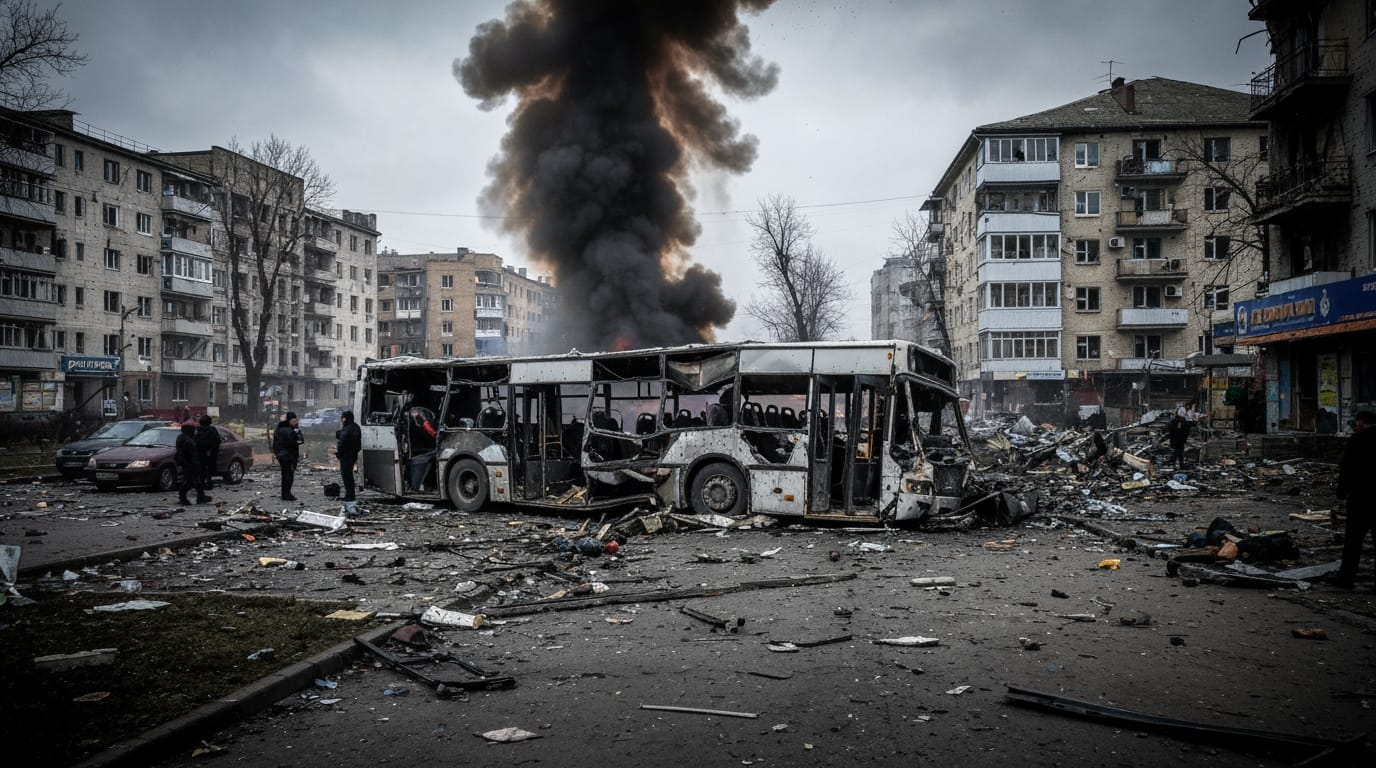
KYIV, UKRAINE – A Russian FPV drone struck a civilian passenger bus in Nikopol, Dnipropetrovsk Oblast, on Tuesday morning, killing four people and injuring 16 others during rush hour. This devastating attack was part of a broader wave of Russian assaults across multiple Ukrainian cities, resulting in at least nine civilian deaths and more than 50 injuries, and drawing strong condemnation from Ukrainian officials who labeled the acts as deliberate terror against peaceful populations. The incidents underscore a persistent and evolving pattern of Russian forces targeting civilian infrastructure and transport, inflicting severe human cost and humanitarian crisis as the conflict extends into its fifth year.
The strike in Nikopol occurred around 9 a.m. local time when the drone hit the bus as it approached a stop, impacting both passengers inside the vehicle and individuals waiting nearby. Initial reports detailed three fatalities and varying injury counts, but updated figures confirmed four civilians killed and 16 wounded, eight of whom required hospitalization. Images from the scene depicted the burnt-out bus with shattered windows and bodies on the pavement, as emergency services scrambled to assist the injured. Dnipropetrovsk Governor Oleksandr Hanzha explicitly stated that the bus strike was "not a random strike," but rather an act of "deliberate terror against civilians."
Widespread Carnage Across Ukrainian Cities
The Nikopol tragedy was not an isolated incident but rather one of several simultaneous attacks launched by Russian forces on April 7, 2026. In the southern port city of Odesa, an overnight assault claimed the lives of three people, including a child, and left at least 10 wounded. This attack targeted residential buildings, critical infrastructure, and administrative facilities, causing extensive damage to high-rise apartments and private homes, and sparking multiple fires. Deputy Prime Minister Oleksii Kuleba condemned these actions, stating, "This is deliberate Russian terror against peaceful cities and civilians."
Further south, in Kherson, a relentless half-hour Russian attack on a residential area resulted in the deaths of three elderly individuals and injuries to seven others. Ukrainian President Volodymyr Zelenskyy commented on the pervasive threat in Kherson, describing civilians there as being subjected to "constant so-called 'safaris'," highlighting the ongoing danger faced by residents in frontline regions.
Additional attacks unfolded in other parts of the country. In Chernihiv Oblast, administrative buildings in Pryluky and Novhorod-Siverskyi were set ablaze, with casualty figures yet to be fully determined. Kharkiv Oblast reported six injured individuals as the city of Kharkiv and 12 other settlements came under fire. Donetsk Oblast saw at least one person killed and 10 injured, while in Zaporizhzhia Oblast, five men were wounded, including a 73-year-old whose car was struck by an FPV drone. These coordinated strikes collectively pushed the day's civilian casualty toll to at least nine dead and 51 injured across Ukraine.
A Deliberate Strategy of Terror Against Civilians
Ukrainian officials were swift to condemn the day's assaults, particularly emphasizing the intentional nature of striking civilian targets like the bus in Nikopol during peak travel hours. Interior Minister Ihor Klymenko asserted, "This is not an accident, it's their (Russian) tactic: deliberate strikes on civilians." This sentiment echoes President Zelenskyy's earlier calls for tougher sanctions against Moscow, particularly after a similar drone attack in May 2025 on a minibus in the Sumy region, which killed nine people, mostly elderly women being evacuated. Zelenskyy had then stressed that Russians "could not have failed to understand what kind of vehicle they were targeting," labeling it a "deliberate killing of civilians."
These attacks align with a discernible pattern of Russian military operations throughout the conflict, which have increasingly focused on disrupting and destroying Ukraine's civilian transport infrastructure. Reports indicate that Ukraine's railway system alone has endured over 4,700 attacks since February 2022, with targets ranging from major passenger stations to freight and passenger trains. Deadly drone attacks on passenger buses have been documented repeatedly across the country, signifying that civilian transport remains a consistent target. The strategic goal behind these widespread strikes appears to be the destruction of "the basis of civilised life" and the paralysis of Ukrainian logistics, thereby inflicting both military and economic blows and causing severe hardship for the civilian population. Russia, however, consistently denies targeting civilians, despite the mounting evidence and casualty figures.
Humanitarian Crisis and International Condemnation
The continuous bombardment of civilian infrastructure has led to a profound humanitarian crisis within Ukraine. Millions of Ukrainians face daily hardships, with disruptions to transport meaning missed medical appointments, longer and more perilous journeys to work or school, and reduced opportunities to connect with family members displaced by the war. The widespread use of FPV drones in these attacks, while theoretically offering precision, has in practice placed "civilians at grave risk," leading to a significant rise in casualties. According to the UN and OSCE reports, these actions constitute escalating attacks on civilians, often with "blatant disregard of IHL, including the principles of distinction and proportionality." International human rights agencies and news organizations have consistently reported on Russia's "indiscriminate and disproportionate attacks" in Ukraine, which are widely considered violations of international humanitarian law. The Independent International Commission of Inquiry on Ukraine has repeatedly concluded that a majority of Russia's attacks, including the use of unguided bombs against civilians, have been indiscriminate.
The international community has broadly condemned Russia's invasion and its tactics. International organizations, including the United Nations and NATO, have voiced significant criticism over the unjustified nature of the conflict. Numerous countries, particularly in Europe, the Americas, and Southeast Asia, have imposed sanctions on Russia in response to its actions, aiming to undermine its ability to sustain the war effort. However, the ongoing attacks continue to highlight the severe challenges in enforcing international humanitarian law and protecting civilian populations in active conflict zones.
Ukraine's Resilience and Calls for Truce
Despite the relentless attacks, Ukraine continues to demonstrate remarkable resilience. Its transport operators, while struggling under the cumulative weight of Russian aggression, strive to maintain safe and reliable services. Ukrainian President Volodymyr Zelenskyy, while condemning the latest acts of terror, also extended a diplomatic overture, proposing a pause in attacks on energy infrastructure during the upcoming Orthodox Easter holiday. This offer, conveyed through the United States, suggested reciprocity: "If Russia is ready to stop strikes on our energy infrastructure, we will be ready to respond in kind."
The ongoing conflict, marked by such daily tragedies, continues to exact an immense toll on human lives and infrastructure. As the international community grapples with ways to foster peace and ensure accountability, the events of April 7, 2026, serve as a stark reminder of the devastating impact of the war on ordinary Ukrainians and the urgent need for a cessation of hostilities. The deliberate targeting of civilian transport and other non-military sites perpetuates a cycle of violence that undermines any prospects for lasting stability and peace in the region.


