Diplomacy in Motion: Secretary Rubio's India Visit Navigates Complex US-India Ties
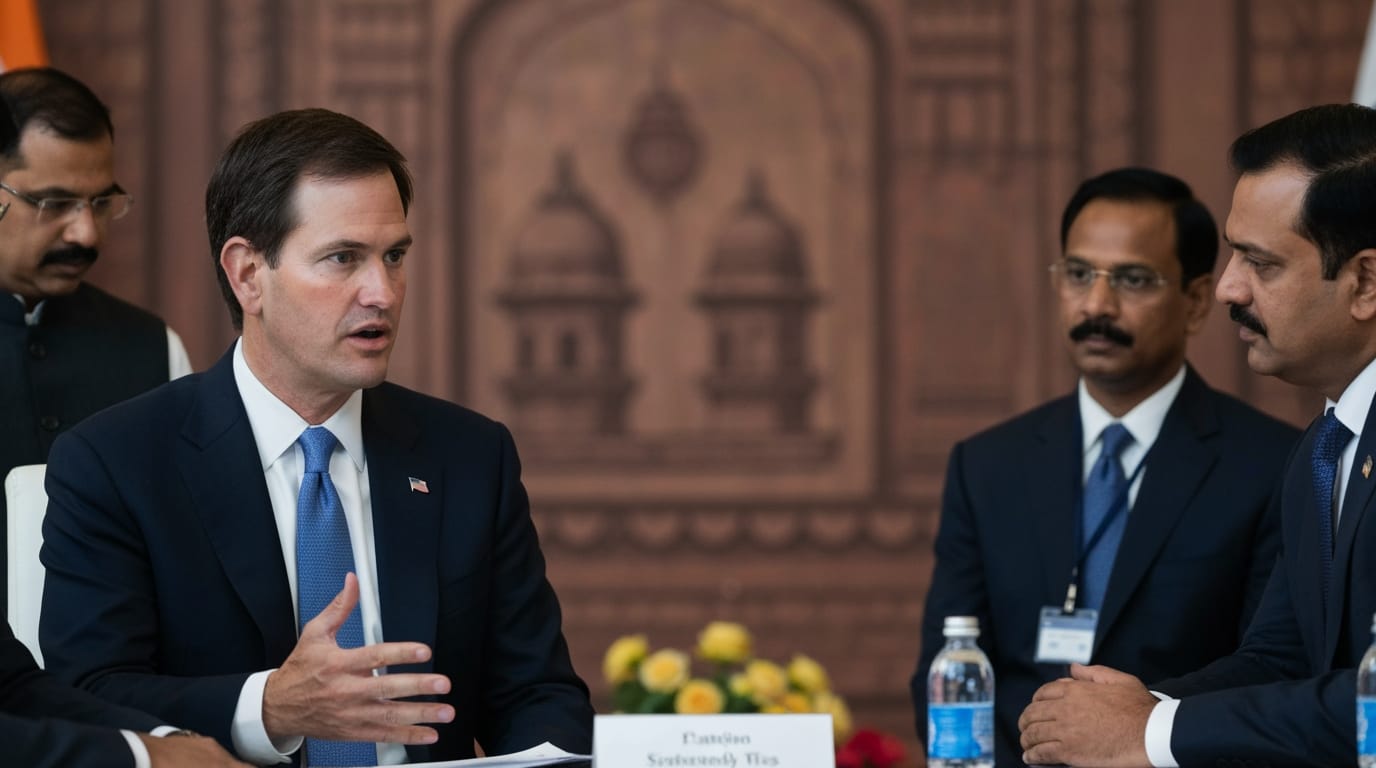
New Delhi, India – U.S. Secretary of State Marco Rubio concluded a critical four-day visit to India this week, signaling a concerted effort by Washington to stabilize and fortify its relationship with New Delhi amidst growing global uncertainties and bilateral frictions. The high-profile diplomatic engagement aimed to recalibrate strategic and economic ties that have experienced recent turbulence, underscoring India's pivotal role in Washington's Indo-Pacific strategy.
Rubio's itinerary, which spanned from Kolkata to Agra, Jaipur, and the capital, New Delhi, was designed to combine cultural outreach with pressing geopolitical discussions. His arrival in Kolkata on Saturday included a stop at a humanitarian organization founded by Mother Teresa, setting a tone for broader engagement. The core of the visit centered on intensive talks with Indian Prime Minister Narendra Modi and External Affairs Minister Subrahmanyam Jaishankar, focusing on a comprehensive agenda that included trade, energy security, defense collaboration, and the strengthening of the Quadrilateral Security Dialogue (Quad) alliance.
Navigating Recent Headwinds
The visit unfolded against a backdrop of visible strain in U.S.-India relations. Recent months have seen tensions emerge due to several factors, including the Trump administration's imposition of tariffs on Indian exports and New Delhi's continued procurement of Russian oil. These actions, coupled with Washington's renewed diplomatic engagements with Pakistan and China, have created friction and fueled concerns within the Indian government regarding the reliability of its strategic partner. Furthermore, the bilateral relationship has grappled with delays in finalizing a comprehensive trade agreement and consolidating Quad initiatives, contributing to a sense of unease.
Despite these challenges, an interim trade arrangement had previously eased some tariffs and expanded Indian purchases of U.S. goods, particularly energy products, indicating a willingness on both sides to mitigate disputes. Secretary Rubio consistently emphasized cooperation, articulating optimism about the prospect of a broader trade deal and reaffirming India's status as one of Washington's most important strategic partners. He described India as an "incredibly important partner" and a key ally, highlighting the ambition for continued collaboration across various sectors. Adding a personal touch to the diplomatic overtures, Rubio conveyed an invitation from U.S. President Donald Trump for Prime Minister Modi to visit Washington later in the year.
Strategic Convergence in the Indo-Pacific
A central pillar of Rubio's discussions was the shared strategic vision for the Indo-Pacific region. Both nations view India as an indispensable component of any durable Indo-Pacific framework, especially in countering the expanding military and economic influence of China. The Quad alliance, comprising the United States, India, Japan, and Australia, served as a key platform for these discussions. Secretary Rubio participated in a meeting with the foreign ministers of the Quad nations in New Delhi, underscoring the grouping's evolution into a critical mechanism for cooperation on maritime security, supply chain resilience, and regional strategy.
Discussions within the Quad framework specifically addressed Indo-Pacific coordination, defense cooperation, emerging technologies, and strategies to build resilient supply chains. While the Quad has repeatedly criticized Beijing's actions in the South China Sea, accusing it of militarizing disputed waters, China has, in turn, labeled the alliance as an attempt to contain its regional rise. This dynamic underscores the complex geopolitical environment that frames U.S.-India strategic alignment. For Washington, India remains crucial to its Indo-Pacific strategy, while for New Delhi, engagement with the United States is seen as vital for technological modernization, defense transformation, and economic growth.
Economic Imperatives and Unresolved Trade
The economic dimension of the U.S.-India relationship received considerable attention during Rubio's visit. A primary objective was to expand cooperation in trade and energy. Washington is actively seeking to increase its share of India's substantial energy market, a point Rubio specifically highlighted, stating, "We want to sell them as much energy as they'll buy." Officials from both countries are reportedly working toward finalizing a long-delayed comprehensive trade agreement, an issue that remains a significant point of contention and focus.
Despite the positive rhetoric from the U.S. side, the path to a broader trade deal has faced hurdles. Some observers and analysts have expressed skepticism, noting that the U.S. has been disappointed with India's perceived "foot-dragging" in trade negotiations. The lack of a finalized trade agreement, even months after an interim deal, has been cited as a factor that could overshadow other areas of engagement, making it challenging for the visit to significantly alter a "downward trajectory" in certain aspects of the relationship. India, for its part, aims to preserve strategic flexibility in an increasingly multipolar world, seeking to deepen engagement with both Western-led coalitions and non-Western platforms like BRICS, while carefully navigating its economic vulnerabilities and defense dependencies.
Conclusion: A Calibrated Path Forward
Secretary Rubio's visit to India represents a determined effort by the United States to mend and reinforce a strategically vital partnership. Despite lingering disagreements over trade tariffs and India's energy diplomacy, the shared imperative of regional stability, particularly in the face of China's growing influence, continues to bind the two democracies. The visit underscored that while challenges persist, both Washington and New Delhi remain committed to viewing each other as crucial partners in long-term strategic cooperation. The invitation for Prime Minister Modi to visit Washington later this year further indicates a mutual desire to sustain high-level dialogue and consolidate a relationship that is complex but ultimately indispensable for global order and regional security.


