"Double-Touching" Scandal Rocks Winter Olympics Curling Competition, Puts Canada at Center of Firestorm
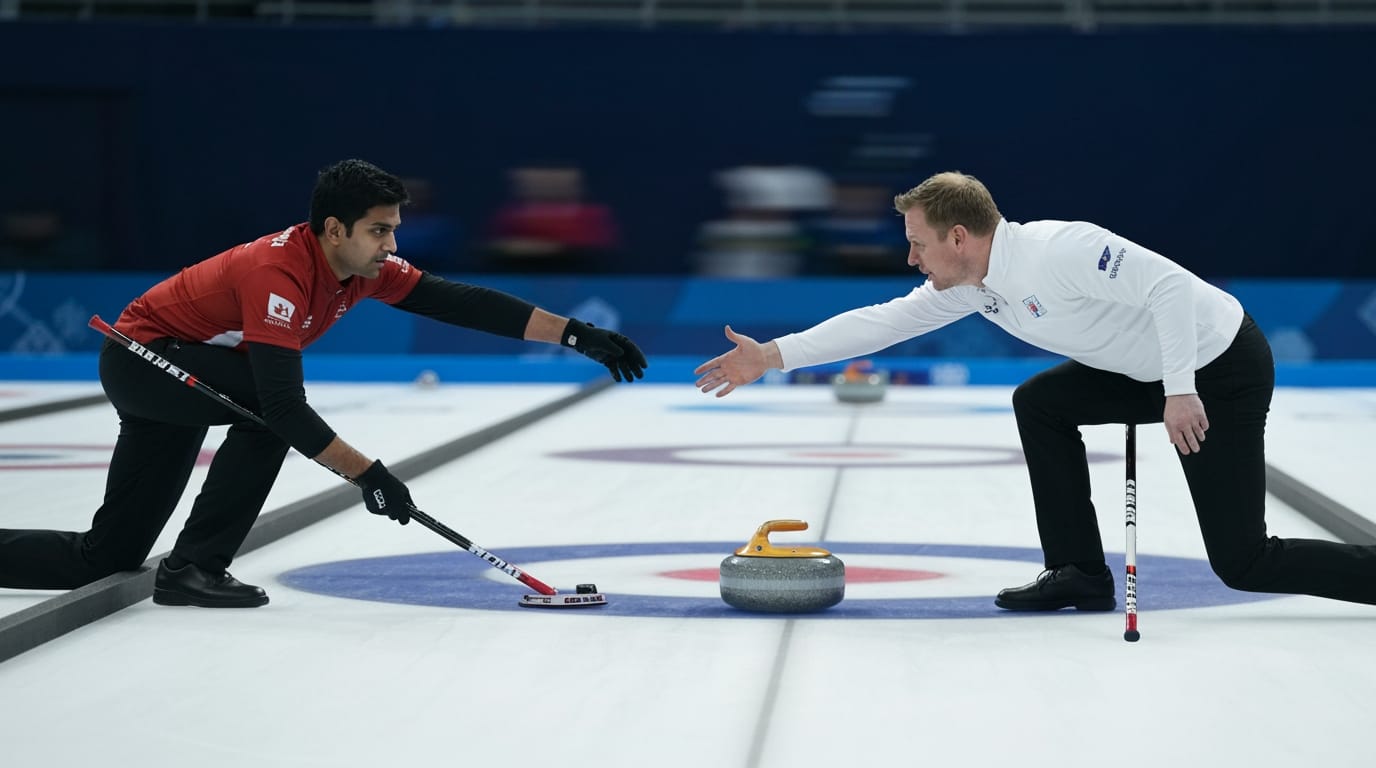
CORTINA D'AMPEZZO, Italy – A simmering controversy surrounding the seldom-enforced "double-touching" rule has erupted in the Winter Olympics curling arena, casting a shadow over the sport's traditional decorum and placing Canadian teams squarely in the crosshairs of international scrutiny. Accusations of players illegally nudging stones after release have triggered heated exchanges, official rule clarifications, and a burgeoning debate over the role of video technology in a sport long defined by sportsmanship and self-policing. The unfolding drama has not only impacted critical matches but also forced World Curling to address the integrity of the game mid-tournament, all while Canada, a curling powerhouse, finds its Olympic aspirations under intense pressure.
The Infraction at the Ice's Core: What is "Double-Touching"?
At the heart of the Olympic firestorm is a specific infraction known as "double-touching." According to World Curling rules, once a stone is in "forward motion" after release, touching its granite surface is strictly prohibited. Such an act can subtly alter the stone's trajectory or speed, providing an unfair advantage. If deemed to have occurred, the stone is to be immediately removed from play. This rule, while fundamental, is rarely called in live competition, relying heavily on the honor system among curlers. However, the current Winter Games have seen this principle challenged repeatedly, prompting World Curling to issue a clarification stating, "During forward motion, touching the granite of the stone is not allowed. This will result in the stone being removed from play."
The controversy ignited on Friday during the men's round-robin match between Canada and Sweden. Swedish curler Oskar Eriksson publicly accused Canadian veteran Marc Kennedy of double-touching a stone after his initial release. Video footage, reportedly from Swedish public broadcaster SVT, appeared to corroborate Eriksson's claim, showing Kennedy allegedly nudging the stone with his index finger. Despite the visual evidence, Kennedy reportedly maintained his innocence. Tensions flared during the match, with Canada's Ben Hebert also alleging that Eriksson himself had committed a similar violation. Although Canada ultimately won that match against Sweden with a score of 8-6, the incident set a contentious precedent for the remainder of the tournament.
The following day, the spotlight intensified when Canadian women's skip Rachel Homan faced a similar accusation in her team's match against Switzerland. An umpire halted play and removed Homan's stone due to an alleged double-touch. Homan expressed shock and denied the infraction, but once again, video evidence circulating on social media appeared to show the violation. This time, the outcome was less favorable for Canada, as the women's team lost to Switzerland 8-7.
Escalation and Official Scrutiny
The rapid succession of these high-profile incidents quickly escalated the "double-touching" issue from a minor point of contention to a full-blown Olympic scandal. The initial accusations led to a "heated clash between players and a subsequent media frenzy," according to reports. World Curling, the sport's governing body, was compelled to respond to the growing uproar. They not only clarified the specific rule but also announced increased surveillance of matches, deploying officials to monitor the hog line – the crucial point where curlers must release the stone. However, due to the number of concurrent matches, it was deemed "not possible" to have umpires stationed at each hog line for every game.
The heightened scrutiny soon extended beyond the Canadian teams. On Sunday, the British men's team also had a stone removed from play after Scottish curler Bobby Lammie was cited for an alleged double-touch during their match against Germany. Although Britain went on to win that game 9-4, the incident underscored that the issue was not isolated to a single team but rather highlighted a systemic challenge in officiating a nuanced rule. The absence of video replay for such in-game decisions, a long-standing practice in curling, became a central point of discussion. While electronic handles detect hog line violations upon release, they do not register physical contact with the stone's granite, which is at the core of the double-touching controversy.
Canada's Olympic Woes Amidst Controversy
The double-touching controversy strikes at a particularly vulnerable time for Canadian curling at the Winter Olympics. Historically a dominant force in the sport, Canada's performance in the current Games has been uncharacteristically subdued. The mixed doubles team failed to secure a medal, and the women's team, led by Rachel Homan, cannot afford additional losses if they hope to advance to the medal rounds. The accusations of rule-breaking against both the men's and women's teams have added an unwelcome layer of pressure and public debate to an already challenging Olympic campaign. This situation has reportedly bruised the ego of a nation that prides itself on its curling prowess. The integrity of the game, and by extension, the reputation of one of its most successful nations, now hangs in the balance as the tournament progresses.
The Debate: To VAR or Not to VAR?
In the wake of the controversy, a significant debate has emerged among athletes and officials regarding the implementation of video replay technology in curling. Many curlers have expressed openness to the prospect of introducing video reviews, similar to VAR (Video Assistant Referee) in soccer or Hawk-Eye in tennis, for resolving contentious calls like double-touching. United States men's team member Luc Violette acknowledged the difficulty for umpires to accurately spot split-second violations from the sidelines. He suggested that increased access to video could be a valuable tool for officials. Tara Peterson, second for the United States women's team, echoed this sentiment, noting that instant replay could also be beneficial for other scenarios in curling where visual evidence could clarify ambiguous situations.
However, not all curlers are enthusiastic about integrating advanced video technology. British women's skip Sophie Jackson voiced concerns that the introduction of VAR could significantly slow down the pace of play. Jackson emphasized the importance of maintaining the game's flow for viewers, suggesting that potential delays from video reviews might detract from the sport's appeal. For now, World Curling continues to rely on on-ice officials and the electronic handles for hog line detection, eschewing video replays for in-game decision-making.
The "double-touching" scandal at the current Winter Olympics has undeniably thrust a rarely seen infraction into the global spotlight, prompting immediate clarifications from World Curling and sparking an intense internal debate within the sport. The incidents, particularly those involving Canadian athletes Marc Kennedy and Rachel Homan, have highlighted the inherent challenges of officiating a sport with nuanced rules and a strong tradition of sportsmanship without the aid of advanced technology. As the Games continue, the resolution of this controversy, whether through stricter enforcement, technological integration, or a combination of both, will have lasting implications for the future of curling and its pursuit of both fair play and engaging competition on the international stage. The coming days will determine not only medal outcomes but potentially the very nature of how the "Roaring Game" is played and perceived.


