Elon Musk Seeks Up to $134 Billion from OpenAI and Microsoft in Landmark AI Dispute
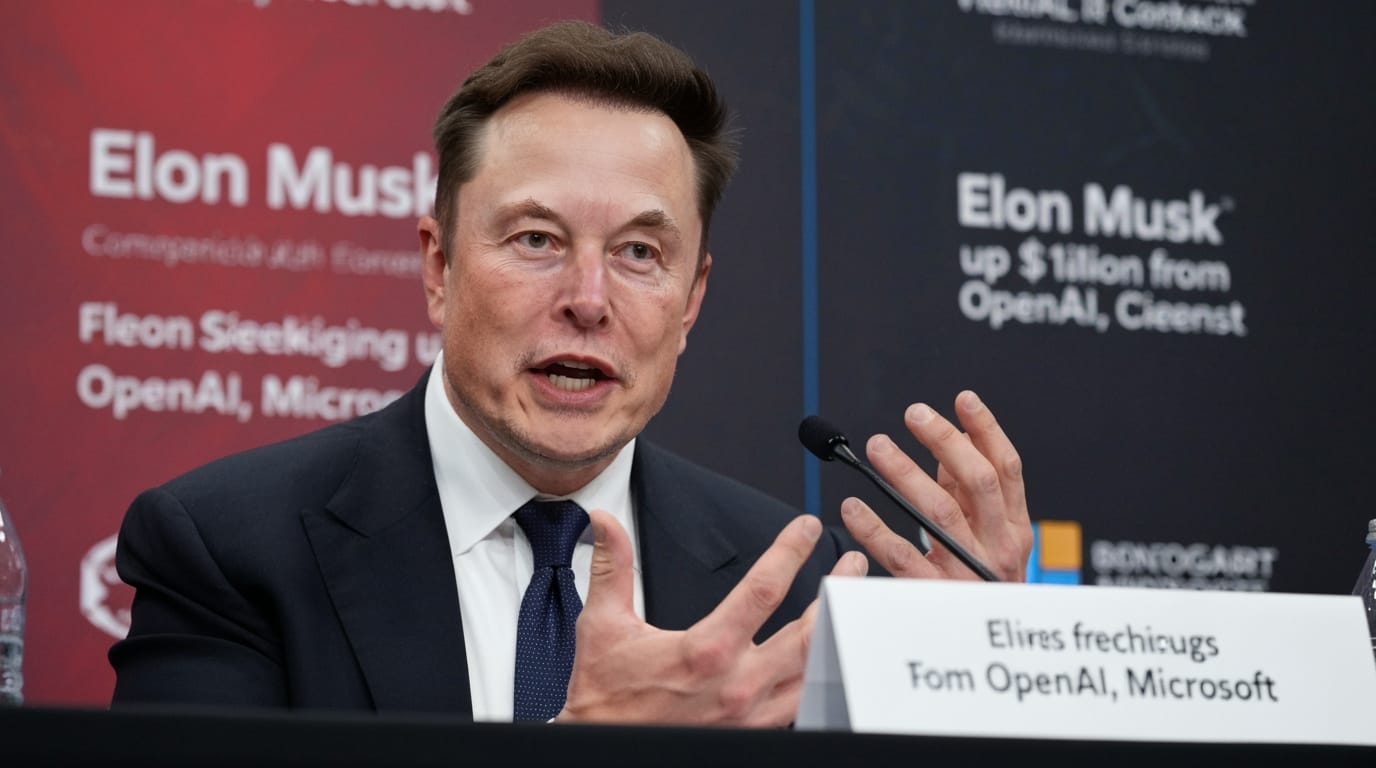
Oakland, CA – In a legal challenge poised to redefine the financial landscape of the artificial intelligence industry, Elon Musk is demanding up to $134 billion from OpenAI and its primary backer, Microsoft, alleging they reaped "wrongful gains" by straying from the founding non-profit mission of the AI research firm. A federal court filing submitted Friday, January 16, 2026, ahead of an April jury trial, details Musk's claim that his early and substantial contributions to OpenAI were predicated on its commitment to developing artificial general intelligence (AGI) for the benefit of all humanity, a promise he asserts was abandoned for commercial interests.
The staggering sum, calculated by an expert witness, underscores the escalating tensions between foundational ideals and commercial imperatives in the burgeoning AI sector. With a jury trial looming, the dispute highlights the complex evolution of OpenAI from a non-profit endeavor to a multi-billion-dollar enterprise and raises profound questions about corporate governance, fiduciary responsibility, and the ethical trajectory of advanced AI development.
The Core of the Allegation: A Mission Betrayed
Musk, a co-founder of OpenAI in 2015, claims his initial investment of approximately $38 million, which constituted 60% of the company's early seed funding, along with his critical role in recruiting key personnel and lending credibility to the nascent project, was made under the express understanding that OpenAI would remain a non-profit dedicated to public benefit. His lawsuit contends that OpenAI, under its current leadership, deviated from this foundational mission by restructuring into a for-profit entity and subsequently entering into a lucrative partnership with Microsoft.
The financial demand is based on an expert analysis by financial economist C. Paul Wazzan, who estimated that OpenAI's "wrongful gains" derived from Musk's involvement range between $65.5 billion and $109.4 billion. Microsoft's share of these alleged gains is calculated to be between $13.3 billion and $25.1 billion. Musk's legal team argues that, similar to an early investor realizing exponential returns, he is entitled to a significant portion of OpenAI's current valuation, which recently soared to an estimated $500 billion, due to being "defrauded" by the company's shift in direction.
From Non-Profit Vision to Capped-Profit Reality
OpenAI was established on December 11, 2015, with a clear mission: "to ensure that artificial general intelligence (AGI) benefits all of humanity." The founders, including Musk, Sam Altman, and Greg Brockman, envisioned an open, collaborative approach to AI development, free from the profit motives that might concentrate power or compromise safety. However, the immense financial requirements for developing AGI, particularly the need for vast computing power, soon challenged this original structure.
In 2019, OpenAI initiated a significant strategic shift, transitioning from a pure non-profit to a "capped-profit" model. This hybrid structure was designed to attract the substantial capital and talent necessary for advanced AI research, allowing investors and employees a capped return on investment while the non-profit foundation retained control and remained bound by its original mission. Microsoft became a pivotal partner during this transition, making an initial $1 billion investment in 2019, followed by additional investments of approximately $2 billion in 2021 and a significant $10 billion infusion in 2023.
Further solidifying its commercial trajectory, OpenAI announced a comprehensive restructuring in October 2025, converting to a Public Benefit Corporation (PBC). Under this new arrangement, Microsoft's stake in the for-profit OpenAI Group PBC is valued at $135 billion, representing 27% ownership. The OpenAI Foundation, the non-profit arm, now holds a $130 billion stake in the for-profit entity.
The Widening Rift: Musk's Departure and Rivalry
Elon Musk's departure from OpenAI's board of directors in 2018 marked a critical turning point. He cited concerns over the company's increasing commercialization and strategic direction, which he felt diverged from its initial non-profit ethos. Since then, Musk has become a vocal critic of OpenAI's evolution, particularly following the launch of its highly successful chatbot, ChatGPT, in late 2022.
Musk has since founded his own artificial intelligence company, xAI, and launched its rival chatbot, Grok, positioning himself as a direct competitor to OpenAI. The current lawsuit is seen by many as an extension of this competitive rivalry, rooted in ideological differences over the control and commercialization of powerful AI technologies.
The Defense: Baseless Claims and Control Disputes
OpenAI has vehemently rejected Musk's lawsuit, characterizing it as "baseless" and part of an "ongoing pattern of harassment" by a frustrated commercial competitor. The company asserts that its evolution to a capped-profit model and subsequent partnership with Microsoft were necessary to secure the vast resources required for AGI development, directly aligning with the mission to benefit humanity by building advanced, safe AI.
Furthermore, OpenAI has claimed that Musk himself was an early proponent and architect of exploring a for-profit structure, and that his true motivation for the lawsuit stems from a desire for absolute control over the company, which was denied. Internal communications cited by OpenAI suggest Musk was actively involved in discussions about the transition to a for-profit entity as early as 2017, even exploring a public benefit corporation model. Microsoft, also a defendant in the lawsuit, has maintained that there is no evidence it "aided and abetted" OpenAI in any alleged misconduct.
Implications for the Future of AI
The federal judge in Oakland, California, recently denied efforts by OpenAI and Microsoft to dismiss the lawsuit, ensuring it will proceed to a jury trial beginning in late April 2026. This impending legal battle carries significant implications for the artificial intelligence industry and beyond. The outcome could set precedents for the governance of AI development, particularly concerning the balance between non-profit missions and the immense financial demands of cutting-edge research.
The dispute also casts a spotlight on the role of powerful individuals and corporations in shaping the future of AGI, raising critical questions about who controls these transformative technologies and whose interests they ultimately serve. As the trial approaches, the tech world will be watching closely to see how the court navigates these complex claims of betrayal, innovation, and billions of dollars in alleged "wrongful gains."


