EU-Jordan Summit: Brussels Bolsters Influence in Volatile Middle East
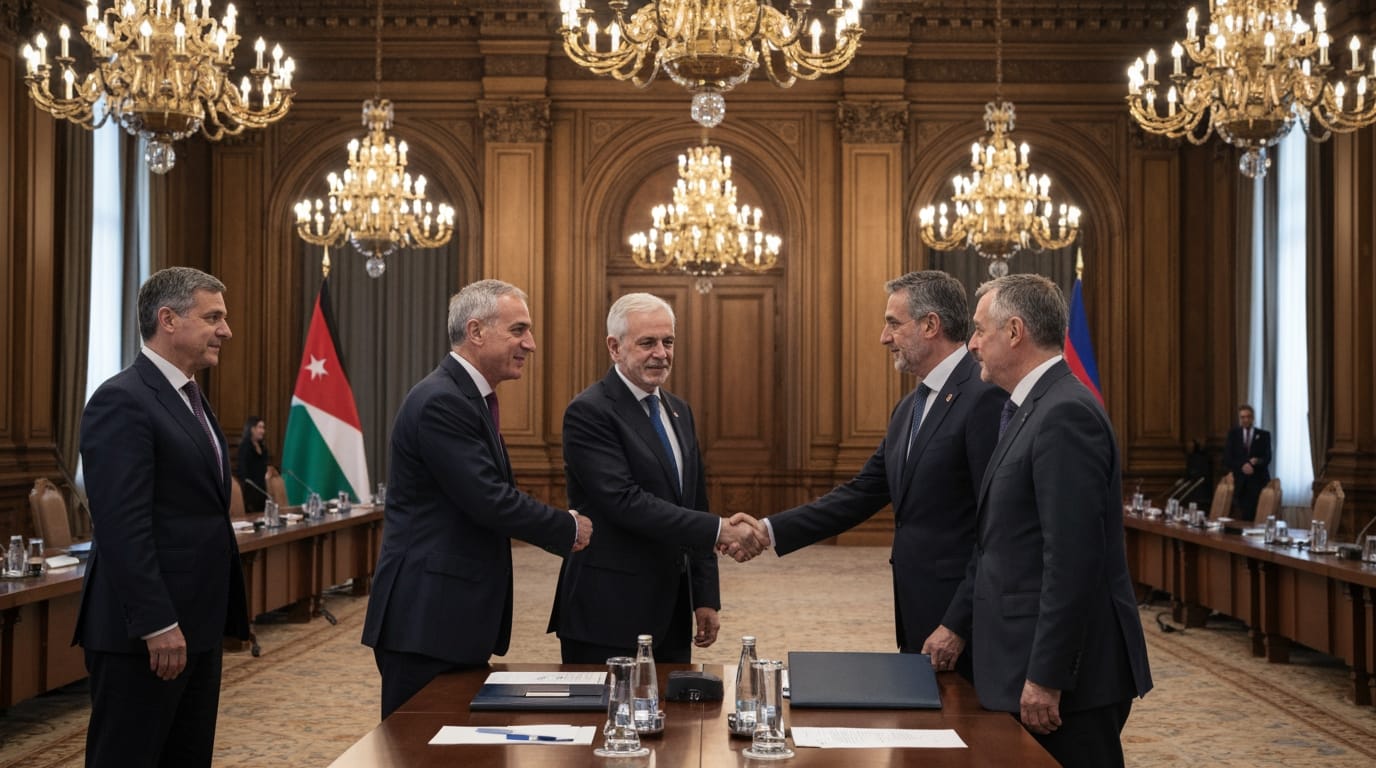
Amman, Jordan – In a significant diplomatic maneuver aimed at solidifying its standing in a turbulent region, the European Union convened its first-ever bilateral summit with Jordan in Amman on January 8, 2026. The high-level gathering, featuring King Abdullah II of Jordan alongside European Council President António Costa and European Commission President Ursula von der Leyen, underscored Brussels' strategic commitment to fostering stability, economic resilience, and deeper political ties within the Middle East. This pivotal meeting comes one year after the signing of the EU-Jordan Strategic and Comprehensive Partnership (SCP), signaling an elevated chapter in a relationship that has become increasingly vital for both parties amidst escalating regional crises and shifting global dynamics.
A Strategic Imperative in a Volatile Landscape
The timing and location of this inaugural summit highlight the pressing need for robust partnerships in a Middle East grappling with multifaceted challenges, including ongoing conflicts, humanitarian crises, and economic uncertainties. For the European Union, the summit represents a clear effort to project influence and safeguard its interests in a region geographically proximate and strategically critical. European leaders have frequently expressed a desire to move beyond a fragmented approach and cultivate a more unified, effective foreign policy in the Middle East, one that strengthens economic, technological, and intelligence cooperation while promoting human rights and sustainable development. Jordan, recognized by the EU since 2010 with "advanced status" partnership, is perceived as a crucial cornerstone for regional stability, making it an indispensable partner in this broader strategic vision.
The discussions in Amman focused on deepening the political and economic partnership, which was formally established through the Strategic and Comprehensive Partnership in January 2025. This partnership builds upon decades of cooperation, dating back to the 2002 Association Agreement and the Jordan-EU Partnership Priorities for 2021-2027. The summit served as an opportunity to review the implementation of the SCP and set future priorities, aiming to translate commitments into tangible actions for shared prosperity and resilience.
Pillars of Enhanced Partnership: Security, Economy, and Human Capital
The Strategic and Comprehensive Partnership between the EU and Jordan is structured around five key pillars, all of which were central to the summit's agenda. The first involves political relations and regional cooperation, emphasizing peace and stability across the Middle East and Mediterranean, promoting good governance, democracy, and human rights. Regular high-level engagements, including these summits and coordination within the Union for the Mediterranean, are integral to this pillar.
The second pillar focuses on security and defense, addressing common threats such as terrorism, extremism, organized crime, and drug trafficking. Cooperation in this area includes supporting Jordan's armed forces, enhancing cybersecurity, and improving border management. The recent launch of the first EU-Jordan Security and Defense Dialogue in Amman further solidifies this commitment, with discussions around EU support under the European Peace Facility and potential Jordanian engagement in the EU's Common Security and Defence Policy.
Economic resilience, trade, and investment form the third critical pillar. The partnership aims to bolster Jordan's economy through reforms that foster growth and job creation, fully leveraging the potential of the EU-Jordan Free Trade Area. Significant European investments are targeted towards key sectors like digital technology, green energy, sustainable tourism, and pharmaceuticals. A substantial financial and investment package of approximately 3 billion euros for 2025-2027 underpins this effort, comprising 640 million euros in grants, 1 billion euros in macro-financial assistance (soft loans), and 1.4 billion euros in public and private investments. This financial support also aims to attract additional private sector investments, with a high-level EU-Jordan Investment Conference slated for April 2026.
The fourth pillar centers on human capital, with initiatives designed to improve education and skills training, enhance labor market inclusivity, and foster entrepreneurship and job creation, particularly for youth and women. Finally, the fifth pillar addresses migration, protection, and refugee support. Given Jordan's role as a major host for Syrian and Palestinian refugees, cooperation in this area is paramount. Efforts include managing refugee issues, supporting host communities, improving border management, combating human trafficking, and working towards long-term solutions for refugees, including voluntary and dignified returns. The EU reiterated its commitment to supporting the United Nations Relief and Works Agency for Palestine Refugees in the Near East (UNRWA) and its vital services.
Jordan's Enduring Role in Regional Stability
Jordan's consistent commitment to peace and security, coupled with its strategic geographical location, positions it as an indispensable partner for the European Union. The Kingdom's role as a regional hub for humanitarian assistance, especially in the context of the Gaza conflict, and its efforts to consolidate ceasefires, were acknowledged and appreciated by the EU leadership. Jordan's diplomacy also plays a significant role in advocating for a two-state solution to the Israeli-Palestinian conflict, emphasizing the urgent need for humanitarian aid in Gaza, and raising concerns about the deteriorating situation in the West Bank. The summit's joint statement called for urgent measures to address the catastrophic humanitarian conditions in the Gaza Strip, advocating for rapid and unhindered delivery of aid and unrestricted access for humanitarian organizations. It also urged the release of Palestinian clearance revenues and strongly rejected any attempts at land annexation or forced displacement of Palestinians.
Historically, Jordan has relied on Western alliances to navigate regional pressures, and in return, the West has valued Jordan's role in maintaining peace and de-escalating crises. This mutual understanding continues to form the bedrock of the EU-Jordan relationship, with the EU recognizing the immense generosity of Jordan in hosting millions of refugees over the years.
Broader EU Aspirations in the Middle East
The EU-Jordan summit is not an isolated event but rather a significant component of Brussels' evolving and increasingly assertive foreign policy in the Middle East. Faced with growing regional instability and a desire to avoid a "marginal role" in global politics, the EU is striving to overcome internal divisions and articulate a coherent, unified strategy. This includes strengthening economic ties through projects such as the India-Middle East-Europe Economic Corridor (IMEC) – a geostrategic response to China's Belt and Road Initiative – and energy infrastructure projects like the EuroAsia and EuroAfrica Interconnectors. Jordan's importance in the development of the IMEC was specifically highlighted during the summit, with commitments to support energy and digital connectivity.
Despite past challenges in achieving a unified stance on Middle Eastern issues, the EU's renewed focus aims to combine its role as a key economic partner with a more robust strategic influence. The partnership with Jordan serves as a model for this broader engagement, demonstrating how the EU seeks to support political and economic modernization, enhance resilience, and contribute to stability through substantial financial aid and comprehensive cooperation frameworks.
Conclusion
The inaugural EU-Jordan summit on January 8, 2026, marks a pivotal moment in the relationship between the European Union and the Hashemite Kingdom. By elevating their ties to a Strategic and Comprehensive Partnership and committing a substantial 3 billion euro financial package, the EU has underscored Jordan's critical role as a pillar of stability in a volatile Middle East. This comprehensive cooperation, spanning political, security, economic, human capital, and migration domains, reflects a concerted effort by Brussels to assert its influence, safeguard its interests, and contribute actively to regional peace and prosperity. The summit not only reinforced an enduring alliance but also signaled the EU's determination to be a more impactful and unified geopolitical actor in one of the world's most complex regions. The outcomes lay the groundwork for a new phase of constructive collaboration, serving mutual interests and strengthening the Jordanian-European partnership at all levels.


