EU-Mercosur Trade Deal Faces Mounting European Resistance Amid German Push
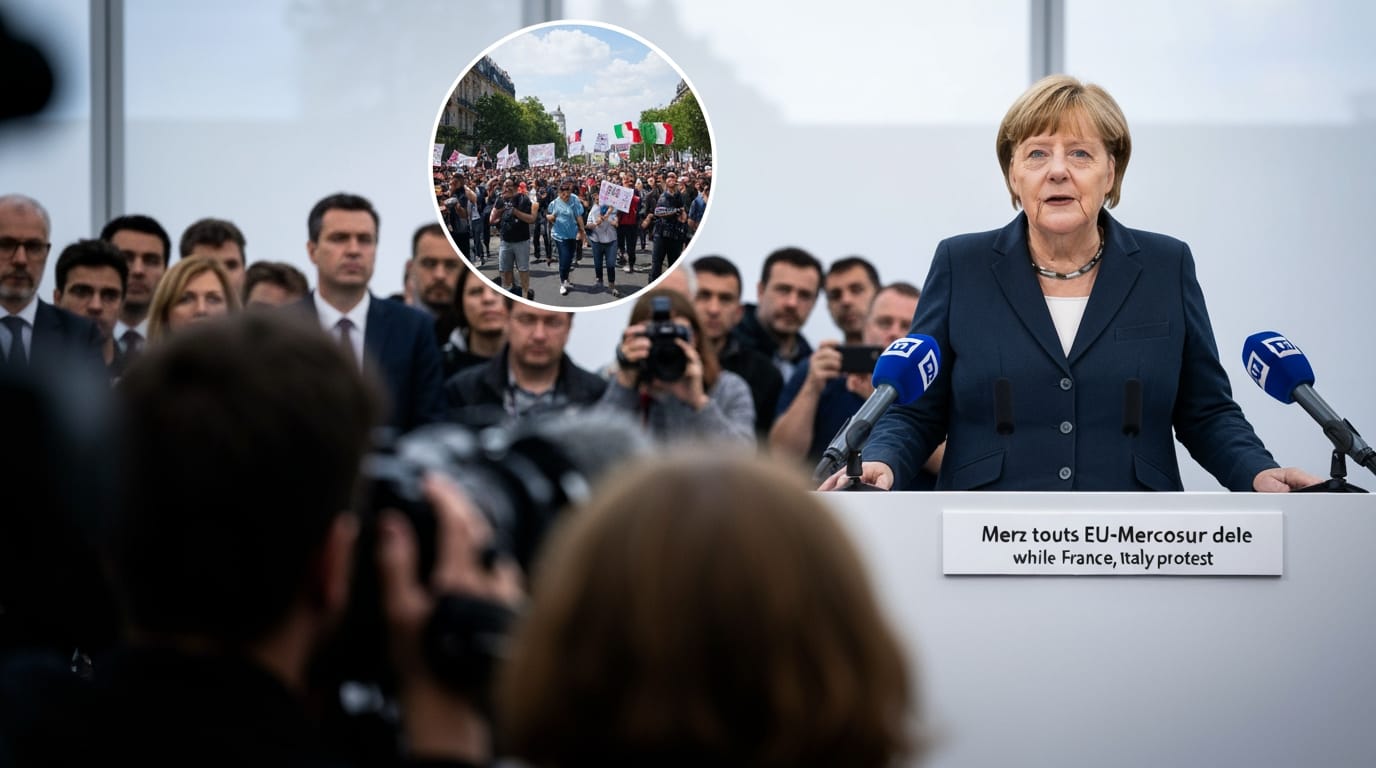
Brussels, Belgium – December 17, 2025 – A quarter-century in the making, the ambitious trade agreement between the European Union and the South American Mercosur bloc finds itself at a critical juncture, championed by Germany's Chancellor Friedrich Merz as vital for economic prosperity and global influence, yet increasingly challenged by staunch opposition from France and a newly vocal Italy. The long-anticipated pact, poised to create one of the world’s largest free-trade zones, now hangs in the balance as European leaders convene, grappling with deep-seated concerns over agricultural competitiveness, environmental standards, and the very unity of the bloc.
The EU-Mercosur Association Agreement, which saw a political agreement reached on December 6, 2024, and subsequent proposals adopted by the European Commission on September 3, 2025, aims to eliminate over 90% of tariffs on bilateral trade, impacting a market of nearly 800 million people. Proponents highlight projected annual savings of €4.5 billion in duties for European exporters, opening Mercosur markets for EU-made vehicles, machinery, chemicals, and textiles, while Mercosur agricultural goods like beef, poultry, sugar, and ethanol would gain increased access to the European market. However, this economic calculus is overshadowed by a fierce debate that lays bare the complex priorities within the European Union.
German Chancellor Merz Champions Economic Imperative
German Chancellor Friedrich Merz has emerged as a leading advocate for the swift conclusion and ratification of the EU-Mercosur deal, emphasizing its strategic importance for European economic strength and global positioning. Speaking after recent EU summits, Merz expressed confidence in a "great willingness" among EU leaders to finalize the agreement. He underscored the principle that "Free, fair trade ensures our prosperity," arguing that the deal would significantly strengthen both the German and broader European economies.
Merz views the agreement not only through an economic lens but also as a crucial geopolitical signal. He suggested that a rapid conclusion would demonstrate the EU's ability to act decisively in international trade, potentially influencing ongoing negotiations in other regions, such as the Indo-Pacific. German industrial sectors, including steel and automotive, which currently face high tariffs in some markets, are seen as significant beneficiaries of the reduced trade barriers promised by the Mercosur agreement. Despite Merz's optimistic pronouncements, including a reported (and later refuted) claim of unanimous EU approval, the path to ratification remains anything but smooth.
French Farmers Lead Charge Against "Unfair Competition"
Opposition to the EU-Mercosur agreement has been most vocal and sustained from France, where farmers have staged numerous protests, citing existential threats to their livelihoods. French agricultural unions and the government contend that the deal would expose European farmers to unfair competition from South American imports produced under less stringent environmental, social, and food safety regulations. Concerns specifically target a potential influx of duty-free beef, poultry, and sugar, which, according to critics, often involve production methods, such as the use of hormones or certain pesticides, banned within the EU.
French Agriculture Minister Annie Genevard has publicly stated her opposition, arguing that the deal, "as it stands," is "harmful" and risks importing products linked to deforestation. French President Emmanuel Macron has also consistently voiced his skepticism, pushing for robust safeguard clauses, "mirror clauses" to ensure Mercosur products meet EU standards, and increased border inspections for agricultural imports. France has actively sought to delay a final EU vote on the agreement and to rally a blocking minority among member states, requiring at least four nations representing over 35% of the EU's population to derail the pact.
Italy Joins Opposition, Raising Hurdles
In a significant recent development, Italy has formally joined France in expressing reservations about the deal, casting further doubt on its imminent approval. On Wednesday, December 17, 2025, Italian Prime Minister Giorgia Meloni informed the Italian parliament that signing the agreement "would be premature." Meloni emphasized that Italy would only approve the deal if it included a package of measures to adequately protect Italian farmers and ensure "reciprocal guarantees" for its agricultural sector.
This late-stage opposition from Italy, a key agricultural producer within the EU, significantly strengthens the hand of France and other skeptical member states like Poland, Austria, and the Netherlands, who share similar concerns about the competitive disadvantage European farmers might face. Italian farmers have also been actively protesting EU agricultural policies, including the Mercosur agreement, citing rising production costs and unfair competition from non-EU imports. The combined resistance from two of the EU's largest economies signals a formidable obstacle to the European Commission's desire to finalize the pact.
Environmental and Geopolitical Crosscurrents
Beyond agricultural concerns, the agreement faces substantial criticism regarding its potential environmental impact. Opponents argue that increased trade, particularly in commodities like beef and soy, could accelerate deforestation in Mercosur countries, notably in the Amazon, despite the agreement's inclusion of sustainability clauses and commitments to the Paris Agreement. Studies suggest that increased beef imports alone could lead to the destruction of hundreds of thousands of hectares of forests annually. While the deal includes provisions allowing for its suspension if Paris Agreement commitments are breached, critics argue these are insufficient and lack enforceability.
Conversely, supporters of the deal also highlight its geopolitical implications, arguing that it could strengthen democratic ties between Europe and South America and serve as a counterbalance to the growing economic influence of other global powers, particularly China, in the region. The European Commission views the deal as crucial for the EU's geopolitical credibility and ability to forge new alliances in a volatile global landscape.
An Uncertain Path Forward
With European Commission President Ursula von der Leyen and European Council President António Costa having initially planned to sign the agreement in Brazil around December 20, 2025, the recent objections from France and Italy have thrown that timeline into considerable doubt. The requirement for ratification by EU member states and the European Parliament means that a significant consensus must be achieved, a task made increasingly difficult by the vocal opposition from key players.
The ongoing debate surrounding the EU-Mercosur deal encapsulates the broader challenges facing the European Union in balancing economic ambition with environmental protection and the livelihoods of its diverse agricultural sector. The coming weeks will determine whether the bloc can reconcile these competing interests or if the 25-year-long negotiation will remain stalled, signaling a potential shift in the EU's approach to global trade agreements.


