Former Georgian President Saakashvili Sentenced to Additional Nine Years in Prison
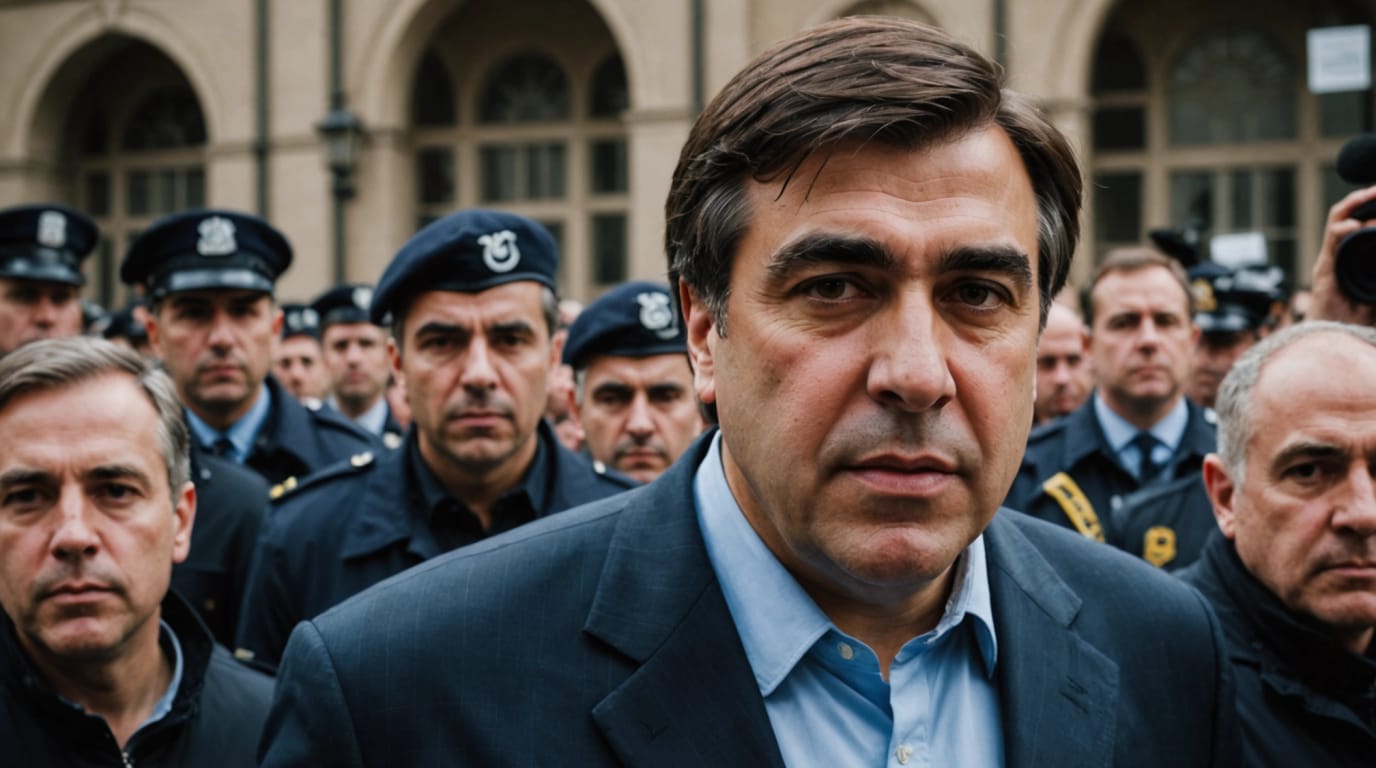
Mikheil Saakashvili, the former president of Georgia, was sentenced to an additional nine years in prison Wednesday on embezzlement charges, further deepening the political turmoil surrounding the already imprisoned leader. The ruling, delivered by the Tbilisi City Court, marks another chapter in the tumultuous saga of a figure who once steered Georgia towards a pro-Western path but now finds himself embroiled in a series of legal battles and health concerns.
The court found Saakashvili guilty of misappropriating approximately 9 million lari (around $5.4 million at the time) from the state budget between May 2009 and February 2013. The funds were allegedly used for personal expenses, including stays in luxury hotels, cosmetic procedures, and designer clothing. Teimuraz Janashia, the former head of the Special Guard Service, was also convicted in the case and fined 300,000 Georgian lari ($108,000) for abuse of office.
Saakashvili, who served as Georgia's president from 2004 to 2013, has consistently denied the charges, claiming they are politically motivated. He alleges that his prosecution is orchestrated by Bidzina Ivanishvili, the honorary chairman of the ruling Georgian Dream party, at the behest of Moscow.
This latest sentence adds to Saakashvili's existing prison terms. He was previously sentenced to six years for ordering the beating of an opposition lawmaker in 2005 and three years for abuse of power related to pardoning police officers convicted of murder in 2008. He was detained upon returning to Georgia in 2021.
A Polarizing Figure's Rise and Fall
Saakashvili's presidency was marked by significant reforms aimed at modernizing Georgia and aligning it with Western institutions. He spearheaded efforts to combat corruption, streamline the bureaucracy, and attract foreign investment. His pro-Western stance, however, strained relations with Russia, culminating in the brief but devastating Russia-Georgia war in 2008.
Following his departure from office, Saakashvili served as the governor of Ukraine's Odesa Oblast from 2015 to 2016, further solidifying his image as a reformer and a staunch critic of Russian President Vladimir Putin. However, his political career in Ukraine was also marred by controversy, and he eventually fell out of favor with the Ukrainian government.
Saakashvili's return to Georgia in 2021 was a surprise move that immediately triggered his arrest. His imprisonment has become a focal point of political tension within Georgia and has drawn international concern.
Concerns Over Saakashvili's Health
Since his imprisonment, concerns have grown regarding Saakashvili's deteriorating health. Reports and images have surfaced showing significant weight loss and other health issues. Ukrainian President Volodymyr Zelensky has accused the Georgian government of "killing" Saakashvili, highlighting the severity of the situation.
Saakashvili's supporters and international observers have called for his release on humanitarian grounds, citing his declining health and the potential for irreversible damage. The Georgian government, however, has maintained that Saakashvili is receiving adequate medical care and that his imprisonment is justified under the law.
The European Court of Human Rights (ECHR) ruled in May 2023 that there were no grounds to believe that Saakashvili's criminal proceedings were unfair. However, the ECHR has also urged the Georgian government to ensure Saakashvili's safety and provide him with appropriate medical treatment.
Implications for Georgia's Political Landscape
Saakashvili's imprisonment and the recent additional sentence have further polarized Georgia's political landscape. The opposition accuses the ruling Georgian Dream party of using the legal system to silence political opponents and consolidate power. The government, in turn, accuses Saakashvili of undermining Georgia's stability and attempting to destabilize the country.
The situation has also complicated Georgia's relationship with the European Union. The EU has repeatedly called on the Georgian government to ensure that Saakashvili's rights are protected and that he receives appropriate medical care. The ongoing political turmoil surrounding Saakashvili's case could potentially hinder Georgia's aspirations for closer integration with the EU.
The conviction of Saakashvili and the fining of Janashia raise questions about the fairness and impartiality of the Georgian judicial system. Critics argue that the charges against Saakashvili are politically motivated and that the trial was conducted in a biased manner. The government maintains that the judicial process was fair and transparent and that Saakashvili was convicted based on solid evidence.
A Nation Divided
The case of Mikheil Saakashvili has become a symbol of the deep divisions within Georgian society. He remains a popular figure among some segments of the population, who view him as a reformer and a champion of democracy. Others, however, see him as an authoritarian leader who abused his power and led the country into a disastrous war with Russia.
The ongoing legal battles and the concerns over Saakashvili's health have created a volatile political climate in Georgia. It remains to be seen how this situation will unfold and what impact it will have on the country's future. The coming months will be critical in determining whether Georgia can overcome its political divisions and move forward on a path of stability and progress. The international community will likely continue to monitor the situation closely, urging all parties to uphold the rule of law and ensure that Saakashvili's rights are protected.


