Francis Halzen Wins Nobel Physics Prize for South Pole Neutrino Observatory
The award recognizes research that opened an observational pathway into deep space by detecting elusive cosmic particles trapped within Antarctic ice.
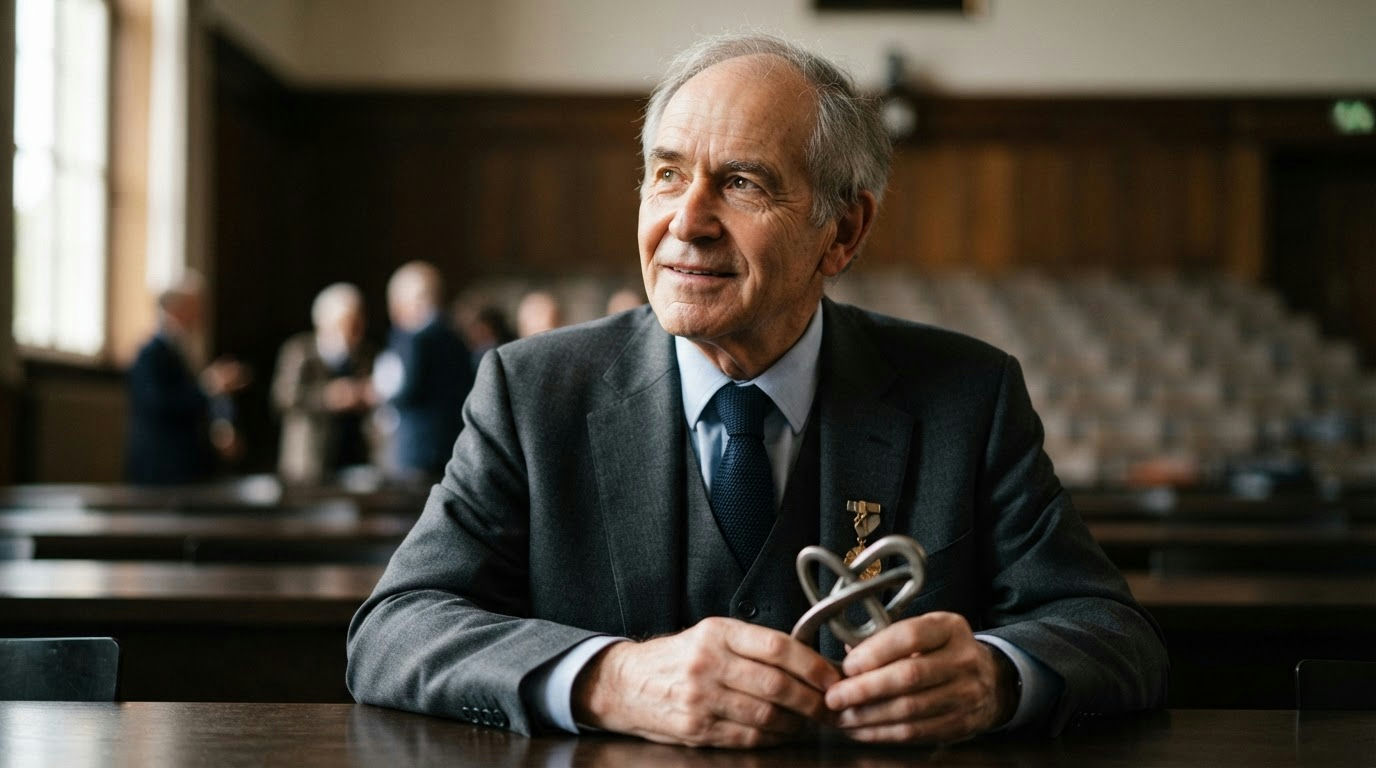
The Royal Swedish Academy of Sciences awarded the 2026 Nobel Prize in Physics to Francis Halzen on Tuesday in Stockholm. The Belgian-born physicist won for his contributions to the IceCube Neutrino Observatory. His work led to the detection of high-energy neutrinos originating outside the solar system.
Halzen will receive the full cash award of 12 million Swedish kronor, equal to about 1.2 million dollars. He serves as a physics professor at the University of Wisconsin–Madison. The university leads the international collaboration that operates the Antarctic observatory.
Neutrinos are subatomic particles with virtually no mass and no electrical charge. Trillions pass through human bodies every second without touching anything. Scientists cannot track them directly and must wait until a particle hits an atomic nucleus to create a faint flash of light.
Unlike light and charged particles, neutrinos travel through space without deflection by magnetic fields and without losing energy. This behavior allows researchers to trace high-energy particles directly back to extreme cosmic events across the universe.
Halzen first proposed using the deep Antarctic ice cap as a neutrino detector in 1988. The South Pole offered clear ice free from earthquakes and surface interference. The environment enabled scientists to monitor immense volumes of ice for rare particle collisions.
Teams finished building the IceCube observatory in 2011. They drilled into the ice sheet and placed thousands of optical sensors up to 2,500 meters deep. In 2013, the facility confirmed the first high-energy neutrinos originating beyond our galaxy.
Mark Pearce, the chair of the Nobel Committee for Physics, said Halzen guided the project with tenacity and scientific vision. Pearce noted that the instrument established a new method of astronomical observation.
Michael Moloney, chief executive of the American Institute of Physics, called the Antarctic detector a revolutionary tool for cosmic research. Belgian Prime Minister Bart De Wever noted on social media that Halzen is the eleventh Belgian to win a Nobel prize.
Halzen was born in 1944 in Tienen, Belgium, and completed his doctorate at KU Leuven in 1969. He worked at the CERN physics center in Europe before joining the faculty at the University of Wisconsin–Madison in 1972.
Halzen spoke to the Nobel committee by phone from Italy after the announcement. He said he was preparing a research proposal and hoped the prize would help it gain approval. The Royal Swedish Academy of Sciences will announce the chemistry prize on Wednesday.