French High School Protests Spark Fierce Political Clashes Nationwide
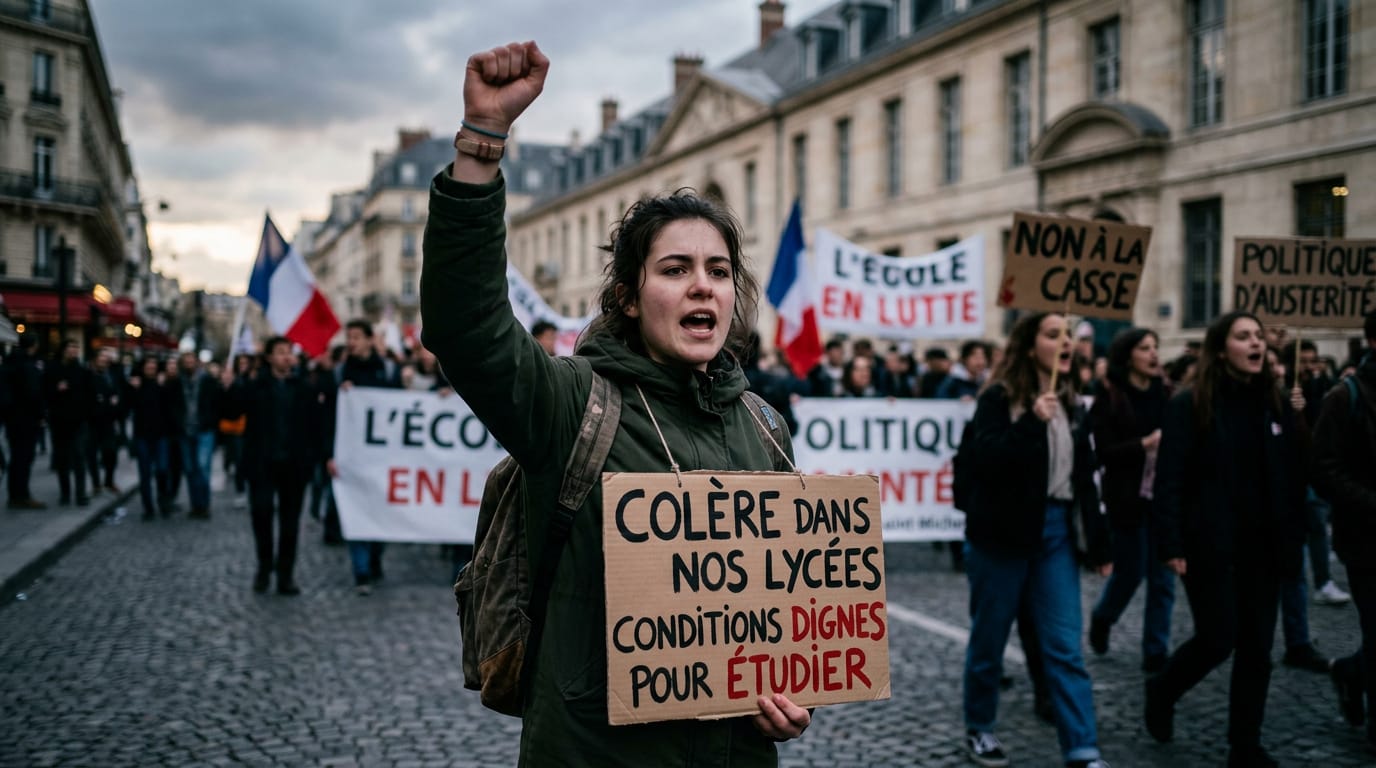
PARIS — A wave of high school blockades over deteriorating classroom conditions has escalated into confrontations with law enforcement and triggered sharp political clashes across France.
The unrest, driven by complaints over chronic underfunding and severe staffing shortages, has disrupted education in roughly 180 institutions nationwide. Tensions reached a flashpoint outside school entrances in major urban hubs, resulting in 164 arrests and dozens of injuries. The demonstrations have rapidly broadened beyond academic complaints, emerging as a major political dispute between the government and left-wing opposition leaders as both sides maneuver ahead of national elections.
Schoolhouse Grievances Spill Into the Streets
The protests began in the Île-de-France region before expanding to cities including Lille, Marseille, and Sedan. Demonstrations quickly disrupted the morning routine at campuses nationwide, where teenagers dragged garbage dumpsters, barricades, and metal fencing to blockade school gates.
Students cite persistent classroom overcrowding, heavy weekly schedules, shortages of essential educational materials, and unfilled teaching vacancies as primary grievances. Pressure associated with Parcoursup, France’s competitive national university admissions portal, has also fueled frustration.
Student labor unions have declared the blockades a necessary measure to draw attention to failing infrastructure, noting that poor heating and inadequate maintenance have compromised learning environments. The movement quickly garnered backing from public-sector workers and several teachers' unions, whose members walked out in solidarity to demand emergency budget allocations for the public education system.
Escalation and Police Confrontations
While many pickets began peacefully, events outside dozens of campuses turned volatile as security forces mobilized to clear barricades and restore access. Law enforcement officers deployed tear gas in several districts after small factions of masked demonstrators launched commercial fireworks and other projectiles toward perimeter lines.
Small street fires erupted near school entrances, and several facilities reported exterior property damage. Interior Ministry records state that 12 police officers, 12 students, and three school staff members sustained injuries during the clashes.
Authorities have also opened an inquiry into an incident in which a student was reportedly struck by a police-deployed crowd-control round. The scale of the unrest prompted 164 arrests in a single day, drawing condemnation from civil liberties monitors and student organizations over the use of aggressive crowd-control tactics near adolescent school sites.
Government Denounces Radical Agitation
The central government moved swiftly to condemn the unrest while drawing a boundary between genuine academic grievances and acts of civil disorder.
Prime Minister Sébastien Lecornu emphasized that student safety and public order cannot be compromised by radical factions. While acknowledging that high schools face structural difficulties requiring policy attention, the prime minister insisted that street violence, the lighting of fires, and the use of pyrotechnics near school grounds remain entirely unacceptable.
Interior Minister Laurent Nuñez echoed those concerns, stating that while the government respects the right to voice concerns regarding school resources, organized agitators had infiltrated student groups specifically to provoke physical clashes with security forces. Education officials went further, arguing that the traditional student movement had been co-opted by radical outside networks aiming to undermine municipal stability.
Opposition Defends Youth Mobilization
Left-wing leaders rejected the government's rhetoric, contending that ministers are attempting to deflect from years of austerity measures and educational spending cuts.
Opposition figures from the La France Insoumise party rallied to defend the pupils, arguing that the youth are simply responding to a decaying public service framework that fails to provide basic educational standards. Political party leader Jean-Luc Mélenchon accused the administration of orchestrating heavy-handed police actions against young citizens exercising democratic rights.
The sharp divide reflects broader political tensions, as both the ruling centrist coalition and rival legislative factions seek to position themselves ahead of the upcoming presidential vote. Education has become a central battleground, with the parliamentary left framing the unrest as the inevitable outcome of broader fiscal constraints.
Standoff Deepens Amid Budgetary Pressures
The dispute arrives at an inopportune moment for the French treasury, which faces strict European Union fiscal rules and mounting pressure to reduce the state deficit. Meeting the teachers' and students' demands for smaller class sizes and higher compensation would require multi-billion-euro funding injections that state budget planners are reluctant to authorize.
Student unions have pledged to continue campus actions until concrete negotiations over school staffing and resource distribution begin. With public-sector labor groups coordinating parallel protests, the unrest highlights a persistent domestic challenge: balancing national fiscal discipline with public demands to safeguard France's traditional social safety net and educational institutions.