German High Court Rejects Landmark Climate Case Against BMW and Mercedes-Benz
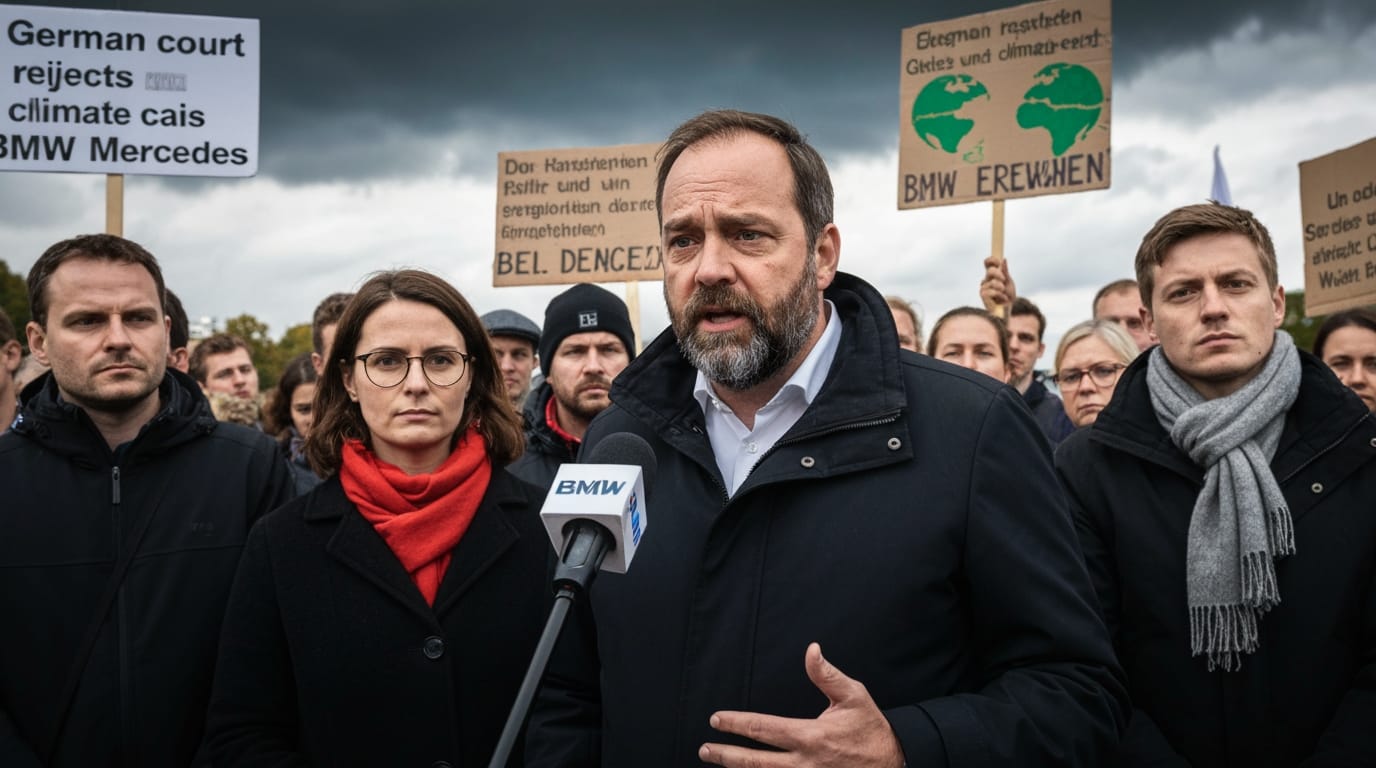
KARLSRUHE, Germany – In a significant legal development for corporate climate responsibility, Germany's Federal Court of Justice (BGH) on Monday rejected a landmark climate lawsuit aimed at forcing automotive giants BMW and Mercedes-Benz to cease sales of internal combustion engine (ICE) vehicles by 2030. The ruling, which upheld decisions by lower courts, reinforces the judiciary's stance that setting specific climate targets for private companies primarily falls within the purview of the legislative branch, not the courts.
The case, brought by the environmental advocacy group Environmental Action Germany (DUH) and its executive directors, sought to compel the automakers to dramatically accelerate their transition away from fossil fuel-powered cars. The decision is a setback for environmental campaigners who have increasingly turned to legal channels to pressure corporations into aligning their business practices with global climate goals.
The Environmentalists' Ambitious Legal Challenge
The lawsuit by Deutsche Umwelthilfe (DUH) represented a pioneering attempt in Germany to hold private companies directly accountable for their contributions to climate change. The core demand was for BMW and Mercedes-Benz to stop selling new combustion-engine cars by October 31, 2030. This deadline was five years earlier than the European Union's original phase-out target for fossil fuel-powered vehicles, a target that was subsequently "watered down" after intense lobbying by automakers.
DUH's legal strategy was predicated on a groundbreaking 2021 ruling by Germany's Federal Constitutional Court. That landmark decision, often referred to as the Neubauer case, established that the state has a constitutional duty to protect future generations from the severe impacts of climate change, mandating a tightening of national emission reduction targets. The environmental group argued that this constitutional principle should extend to corporations, particularly those like BMW and Mercedes-Benz, whose extensive vehicle fleets are significant contributors to greenhouse gas emissions.
The plaintiffs asserted that the continued sale of ICE vehicles by these manufacturers would consume a disproportionate share of Germany's "remaining carbon budget" – the maximum amount of CO2 that can be emitted globally to limit warming to a specified level. They contended that this would infringe upon the personal rights and freedoms of younger generations by necessitating more drastic emission reduction measures in the future. Three DUH managing directors invoked their fundamental right to personality, enshrined in the German Basic Law, arguing it was being violated by the automakers' business activities.
The Automakers' Defense and the Court's Reasoning
BMW and Mercedes-Benz consistently maintained that decisions regarding climate targets and the phase-out of combustion engines should be addressed through democratic political processes and legislation, rather than through judicial rulings. Both companies pointed to their substantial investments in the development and production of electric and hybrid vehicles, highlighting their commitment to meeting future climate targets set by regulatory bodies.
In its ruling, the Federal Court of Justice sided with the automakers, finding that the personal rights of citizens were "not affected... by the business activities of the defendant." The court explicitly stated that "private individuals cannot demand that automobile manufacturers refrain from placing passenger cars with internal combustion engines on the market" ahead of existing European Union deadlines.
A central tenet of the court's reasoning was the absence of legally defined, individual CO2 budgets for private companies under current German law. While Germany adheres to a national carbon budget as part of its commitments under the Paris Agreement and the Federal Climate Protection Act, the court determined that this budget does not translate into specific, enforceable emission allowances for individual corporations. Therefore, the court concluded there was no legal basis to compel BMW and Mercedes to comply with a company-specific emissions cap calculated by the environmental group. Ultimately, the BGH emphasized that the question of when to phase out combustion engines is a "political question" that belongs to elected legislators in parliament, not to judges.
Broader Landscape of Climate Litigation
The lawsuit against BMW and Mercedes-Benz is part of a growing global trend of climate activism extending into the courtroom, seeking to impose climate action on governments and corporations alike. The initial success of environmental groups in suing the German government in 2021, which resulted in a mandate to strengthen national climate protection laws, inspired similar legal challenges against private entities.
However, the outcomes of these cases have been mixed. While the Milieudefensie et al. v. Royal Dutch Shell case in the Netherlands successfully ordered the oil giant to significantly reduce its CO2 emissions by 2030, German courts have generally been more hesitant to apply such direct obligations to private companies in the absence of specific legislation. This distinction highlights varying legal interpretations and judicial activism across different jurisdictions.
Other similar climate lawsuits targeting German automakers continue. For instance, Greenpeace Germany has pursued a parallel case against Volkswagen with similar demands, which also faced rejection at lower court levels. These ongoing legal battles underscore the persistent efforts by environmental groups to expand the scope of climate accountability beyond state actors.
Implications and Future Outlook
The Federal Court of Justice's ruling provides a degree of "legal certainty for companies operating in Germany," a point welcomed by both BMW and Mercedes-Benz. It clarifies that, under current legal frameworks, the judiciary views itself as having a limited role in dictating specific operational timelines for industries based on climate protection arguments, preferring such decisions to emerge from legislative processes.
Despite the setback, DUH Executive Director Barbara Metz emphasized that the decision does not "absolve Mercedes-Benz and BMW of their responsibility for the climate crisis" and reiterated that the obligation for climate action now falls squarely on the federal government. The environmental group has indicated it is considering an appeal to the German Constitutional Court, a path that remains open if fundamental rights are perceived to be affected.
The case highlights the complex interplay between legal interpretation, corporate responsibility, and political governance in the fight against climate change. While this specific legal avenue for forcing a rapid phase-out of combustion engines through judicial decree has been closed, the broader pressure on automakers to transition to sustainable mobility remains. With the European Union's own evolving regulatory landscape and increasing consumer demand for electric vehicles, the automotive industry continues to navigate a challenging path towards a lower-carbon future, albeit one shaped more by policy and market forces than by direct court mandates in Germany.


