German High Schoolers Mobilize Nationwide Against Military Service Amid Conscription Fears
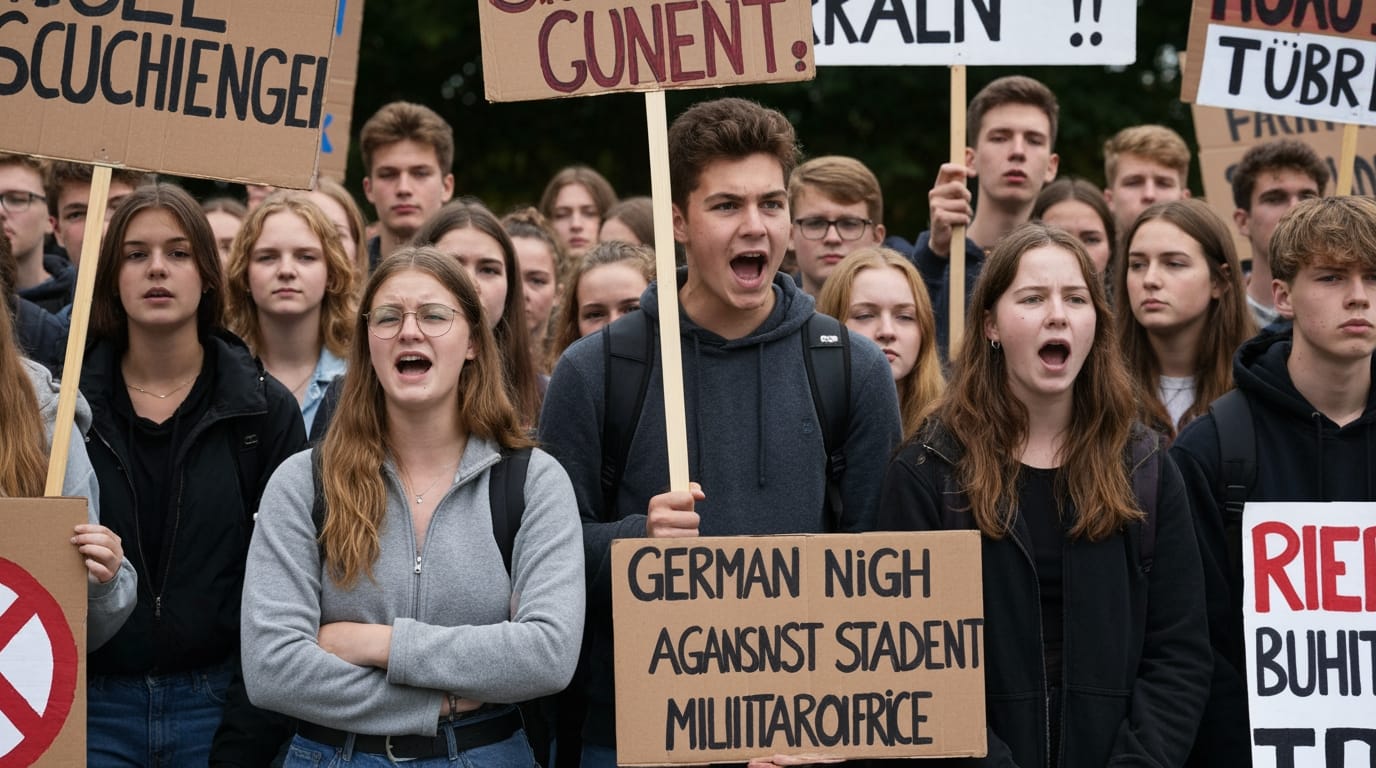
Berlin, Germany – Thousands of high school students across Germany took to the streets today, March 5, 2026, in a widespread "school strike" to protest a new military service law that they fear is a precursor to the reintroduction of mandatory conscription. Demonstrations, organized under the banner "Schulstreik gegen Wehrpflicht" (School Strike Against Conscription), drew tens of thousands of young people in over 90 cities, challenging the government's efforts to bolster its armed forces in response to escalating European security concerns.
The protests mark a significant mobilization of German youth, echoing sentiments of being overlooked in policy decisions that directly impact their futures. Chants of "Dying is not on the timetable" and "Nie, nie, nie wieder Wehrpflicht" (Never, never, never again conscription) resonated through city centers, signaling a strong rejection of potential military obligations.
The New Law: A Step Towards Compulsory Service?
At the heart of the students' discontent is a new military service law that came into effect on January 1, 2026. This legislation mandates that all 18-year-old men complete a questionnaire designed to assess their suitability and interest in military service. While women are also encouraged to fill out the forms, their participation remains voluntary under current German law.
The government, led by Chancellor Friedrich Merz, has stated that the initial phase aims to increase voluntary recruitment for the Bundeswehr, Germany's armed forces. However, a critical provision within the new law stipulates that if the voluntary recruitment targets are not met, the government reserves the right to introduce a "Bedarfswehrpflicht," or needs-based conscription. This clause has fueled widespread apprehension among young people and their advocates, who view the current questionnaire system as a "backdoor" to reintroducing the draft, which was suspended in 2011.
Bela Breitner, a spokesperson for the "School Strike Against Conscription" initiative, articulated this concern, stating that despite being presented as voluntary, the new system represents a clear step toward compulsory military service. This sentiment is widely shared among the protesting students, many of whom are in the age group directly affected by these measures.
Voices of a Generation: "We Are Not Cannon Fodder"
The motivations behind the student protests are multifaceted, extending beyond a simple aversion to military service. Many young Germans express deep-seated pacifist convictions and a fundamental opposition to war and the militarization of society. Signs displayed during the demonstrations, such as "We are not cannon fodder" and "Friedrich Merz an die Front" (Send Friedrich Merz to the front line), underscore a generational rejection of what they perceive as political rhetoric pushing for increased military engagement.
Students voiced concerns that a return to conscription would disrupt their life plans, including education, travel, and career development. Alex Krzeszka, a 15-year-old student at the Berlin rally, told reporters, "I don't see why anyone should have to go to the front lines for politicians. I don't see it as morally right, and I think war should never be the solution. Problems should be solved diplomatically." Tillmann, a 19-year-old, emphasized a staunchly pacifist stance, stating, "I'm against conscription and against war propaganda. And I think murdering someone is always wrong, even if the state says that someone should be murdered. There's nothing more important than human life."
Beyond individual concerns, a collective feeling of being unheard by the political establishment resonates strongly. Amy Kirchhoff, Secretary-General of the Bundesschülerkonferenz (Federal Student Conference), criticized the decision-making process, stating that the policy was "made from above" without prior consultation with young people. This perceived lack of dialogue has galvanized student activists, many of whom are demanding greater investment in education and social projects rather than military expenditure.
Germany's Shifting Defense Policy and Geopolitical Realities
The debate over military service in Germany is inextricably linked to broader shifts in European security policy, largely driven by Russia's full-scale invasion of Ukraine in 2022. Like other European nations, Germany has committed to strengthening its armed forces, the Bundeswehr, to address evolving geopolitical threats and fulfill NATO obligations.
Chancellor Merz has publicly vowed to transform the Bundeswehr into Europe's largest conventional army. Current plans aim to increase active-duty troops from approximately 185,000 to 260,000 by 2030 and quadruple the size of reserves to 200,000. This ambitious expansion necessitates a significant boost in recruitment, which the new military service law seeks to facilitate. Defense Minister Boris Pistorius has indicated that the reintroduction of conscription would be discussed if the voluntary model fails to attract enough personnel.
However, the students' protests highlight the tension between these national security imperatives and the values and aspirations of a generation that has grown up without compulsory military service. Conscription was suspended in Germany in 2011, following decades of a system that saw all young men liable for service or alternative civilian duty. For many of today's high school students, the concept of mandatory military service is alien, prompting deep questions about its relevance and fairness in the 21st century.
Broader Support and Political Repercussions
The student-led demonstrations have garnered support from various segments of society, including parent groups, teachers' unions, and left-leaning political parties. The GEW teachers' union, for instance, encouraged teachers to view student participation as "learning in a different place" rather than unexcused absence, although education authorities in some states have warned that truancy could impact grades. Political parties like Die Linke and Bündnis Sahra Wagenknecht (BSW) have also expressed solidarity, with BSW's youth organization criticizing the new law as "conscription through the back door."
Despite the widespread nature of the protests, political figures from the ruling coalition have pushed back against what they term "populist" messaging. Siemtje Möller of the SPD, a junior coalition partner, emphasized that the new law does not immediately mandate service or send youth to conflict zones, dismissing such fears as "pure populism, or simply nonsense." Nonetheless, the substantial turnout and impassioned arguments of the students underscore a significant societal debate. In Berlin alone, police estimated 3,000 participants, while organizers claimed figures closer to 6,000 to 10,000. Nationwide, organizers estimated over 50,000 participants.
A Generation Mobilized
The nationwide protests today underscore a profound generational divide in Germany regarding national defense and military service. While the government navigates complex geopolitical realities and seeks to strengthen its armed forces, a significant portion of its youth is actively resisting policies that they perceive as jeopardizing their personal freedoms and future aspirations.
The student movement, characterized by its grassroots organization and clear articulation of demands, poses a considerable challenge to policymakers. It forces a critical re-evaluation of how Germany balances national security needs with the democratic values and individual liberties cherished by its citizens, particularly its youngest generation. The ongoing debate surrounding the new military service law and the potential for conscription will undoubtedly continue to shape Germany's social and political landscape in the years to come, with the voices of its high school students playing an increasingly prominent role.


