Germany's Left Party Grapples with Deepening Antisemitism Crisis
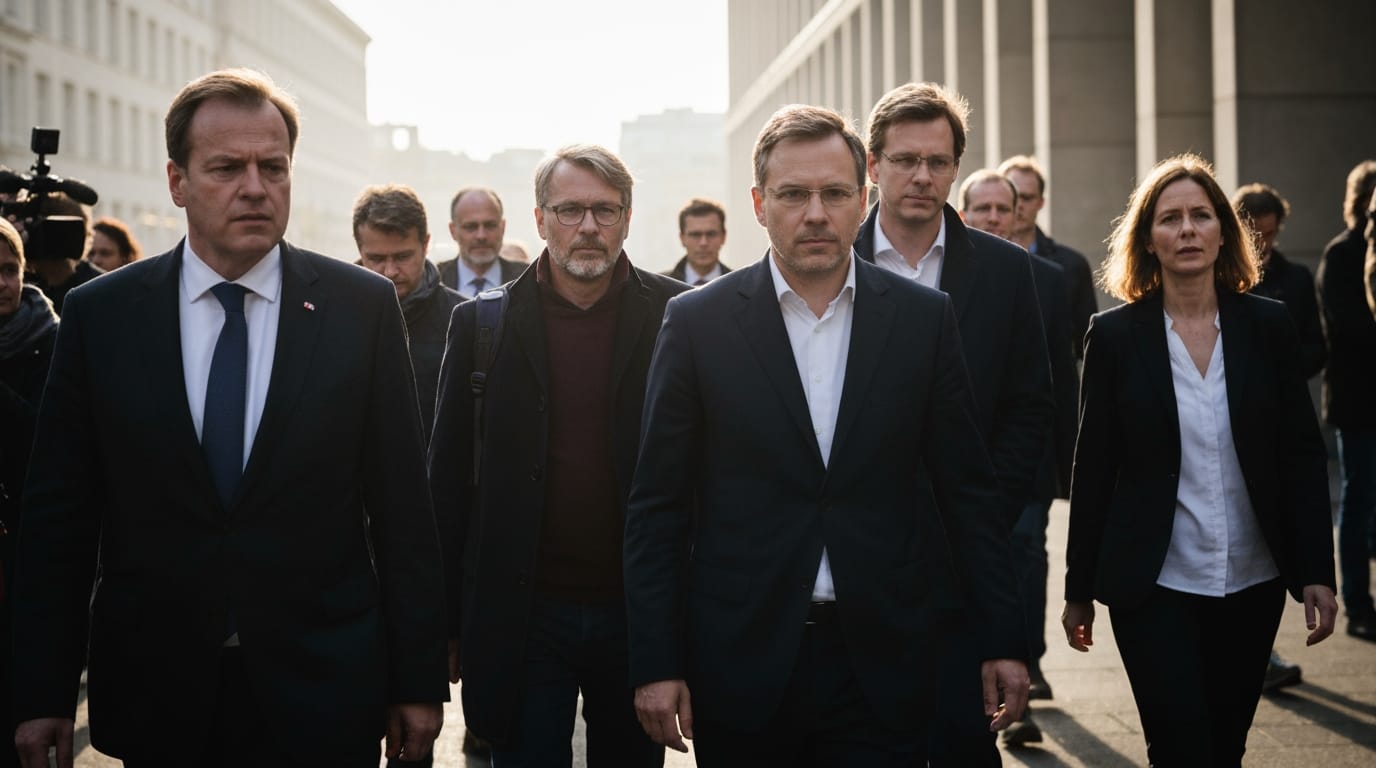
Germany's Die Linke (The Left Party) finds itself embroiled in a deepening crisis marked by escalating antisemitism allegations, internal discord, and high-profile resignations. The controversy, intensified by the ongoing conflict in the Middle East, challenges the party's foundational principles and casts a long shadow over its political future. Accusations range from condoning anti-Israel sentiments to failing to adequately address antisemitic tendencies within its ranks, leading to significant departures and a questioning of the party's ability to combat all forms of hatred.
The Escalation of Allegations and Departures
The recent wave of antisemitism allegations has triggered a series of events that underscore the profound divisions within Die Linke. In October 2024, five prominent members of the Berlin branch, including former senators Elke Breitenbach and Klaus Lederer, resigned from their leadership positions after a proposed motion on opposing antisemitism failed to pass at a party conference. The motion, which sought to condemn celebrations of October 7 and accuse Hamas and Hezbollah of "eliminatory antisemitism," was heavily opposed, leading to a walkout by delegates and ultimately its failure to secure the necessary two-thirds majority. The resigning leaders cited their struggle to advocate for the party's policies, particularly regarding antisemitism, as a key reason for their departure.
Further igniting the debate, in March 2026, Andreas Büttner, the antisemitism commissioner for the state of Brandenburg, announced his resignation from Die Linke. His decision followed a resolution passed by the party's Lower Saxony branch, which explicitly rejected "Zionism in its current form." Büttner, who has long supported the International Holocaust Remembrance Alliance (IHRA) definition of antisemitism, viewed the resolution as dangerously close to questioning Israel's right to exist. He described years of harassment within the party over his pro-Israel stance and stated he could no longer continue without betraying his convictions.
The party's youth wing, Linksjugend, also drew severe criticism in November 2025 for adopting a resolution titled "Never again remain silent in the face of genocide," which explicitly described the Israeli military actions in Gaza as genocide and criticized the "colonial and racist structure" of the Israeli state. This resolution was deemed by many within the party leadership as incompatible with Die Linke's adopted positions, which generally limit criticism of Israel and prohibit delegitimizing its existence. Earlier, in August 2025, Linksjugend Frankfurt faced accusations of antisemitism for a controversial tweet regarding Jewish teenagers expelled from a flight, though the local chapter later distanced itself and expelled the responsible member.
Adding another layer of complexity, senior party figure Gregor Gysi, a former parliamentary group leader, stirred controversy in March 2026 with remarks linking rising anti-Israel sentiment within the party to members with migrant backgrounds. Gysi's comments, made in an interview discussing antisemitism, suggested that new members from certain backgrounds bring "incorrect views about Israel," triggering sharp internal backlash and accusations of reproducing racist narratives from the Federal Working Group of Migrant Left (BAG Migrantische Linke).
The Battle Over Defining Antisemitism
At the heart of Die Linke's internal struggle lies a fundamental disagreement over the definition of antisemitism, particularly as it relates to criticism of Israel. In May 2025, during its party congress in Chemnitz, Die Linke adopted the Jerusalem Declaration on Antisemitism (JDA), explicitly distancing itself from the more widely recognized IHRA working definition. The party argued that the IHRA definition often conflated legitimate criticism of Israeli government policy with antisemitism and was being misused to silence dissent and political protest.
However, this decision was met with significant condemnation from Jewish organizations and figures in Germany. Josef Schuster, President of the Central Council of Jews in Germany, expressed dismay, asserting that the party's adoption of the JDA signaled a lack of support for Jewish communities and indicated where Die Linke truly stands – not alongside Jews in Germany. Critics argue that while the JDA states it is antisemitic to hold all Jews accountable for Israeli actions, it critically refuses to categorize boycotts against Israel as inherently antisemitic, potentially offering a "fig leaf of legitimacy" to movements like BDS (Boycott, Divestment, Sanctions).
This shift in definition reflects a long-standing tension within the party regarding anti-Zionism. Benjamin-Christopher Krueger, a founding member of BAK Shalom, a working group within Die Linke dedicated to fighting antisemitism, anti-Zionism, and anti-Americanism, has noted an increase in antisemitic incidents within the party in recent years. He suggests that while the leadership outwardly distances itself from antisemitism, it has not done enough to actively combat it.
Historical Context and Ideological Roots
Die Linke's challenges with antisemitism are not new and are rooted in its historical and ideological lineage. As a partial successor to the East German communists, the party has an "anti-imperialist tradition" that, according to some observers, has historically translated into strong anti-Israel sentiment. Instances of controversial actions date back over a decade, including some parliamentarians remaining seated during an address by Israeli President Shimon Peres in the Bundestag in 2009, and others refusing to support resolutions against antisemitism in 2008.
Prominent party members participated in the Gaza flotilla in 2010, which sought to break the Israeli blockade, and some factions have advocated for boycotts of Israeli products. The party has consistently defended its right to criticize Israeli government policy, arguing that such criticism should not be automatically equated with antisemitism. However, critics, including social scientists Samuel Salzborn and Sebastian Voigt, argue that "anti-Zionist antisemitism" has become a consensus position within Die Linke, gaining force from this anti-imperialist tradition.
The party's stance on the Israeli-Palestinian conflict has consistently been a polarizing issue, often creating internal conflict. While party programs, such as the Erfurt Programme of 2011, have committed to defending Israel's "right to exist" and supporting a two-state solution, the failure to achieve this solution has led to ongoing criticism of Israeli policies.
Political Ramifications and Future Uncertainty
The ongoing antisemitism allegations and internal turmoil pose significant challenges to Die Linke's political viability. The party has struggled to maintain its electoral standing, with polls indicating difficulty in reaching the 5% threshold required to enter the Bundestag. In October 2024, the party experienced a split where several city councilors left after the party adopted a resolution against antisemitism, claiming it would stifle pro-Palestinian protest.
The broader German political landscape observes these developments with concern. Given Germany's historical responsibility concerning antisemitism, any perception of a political party not taking a firm stand against it is met with severe scrutiny. There is a growing sentiment among some German voters that the political "left" has lost its moral compass, leading to a shift in support towards center-right parties and even the far-right Alternative for Germany (AfD), which paradoxically often maintains a staunchly pro-Israel stance despite its own internal issues with extremism.
The crisis within Die Linke highlights a broader debate in Germany about the boundaries of free speech, criticism of Israel, and the imperative to combat antisemitism. For the party, reconciling its diverse factions and articulating a unified, unambiguous position on these sensitive issues will be crucial for its survival and relevance in German politics.
Conclusion
Germany's Die Linke finds itself at a critical juncture, navigating a complex web of antisemitism allegations, ideological divisions, and political pressures. The party's decision to adopt the Jerusalem Declaration on Antisemitism, the resignations of prominent members, and the controversial statements from its youth wing and senior figures all point to a profound internal struggle. As the party attempts to reconcile its commitment to anti-imperialism and Palestinian solidarity with its stated opposition to antisemitism, its ability to project a coherent and principled stance is increasingly questioned. The outcome of this ongoing crisis will not only shape the future of Die Linke but also contribute to the evolving discourse on antisemitism and foreign policy within Germany's political landscape.