Gerry Adams in High Court Battle, Adamantly Denies IRA Membership Amid Bombing Claims
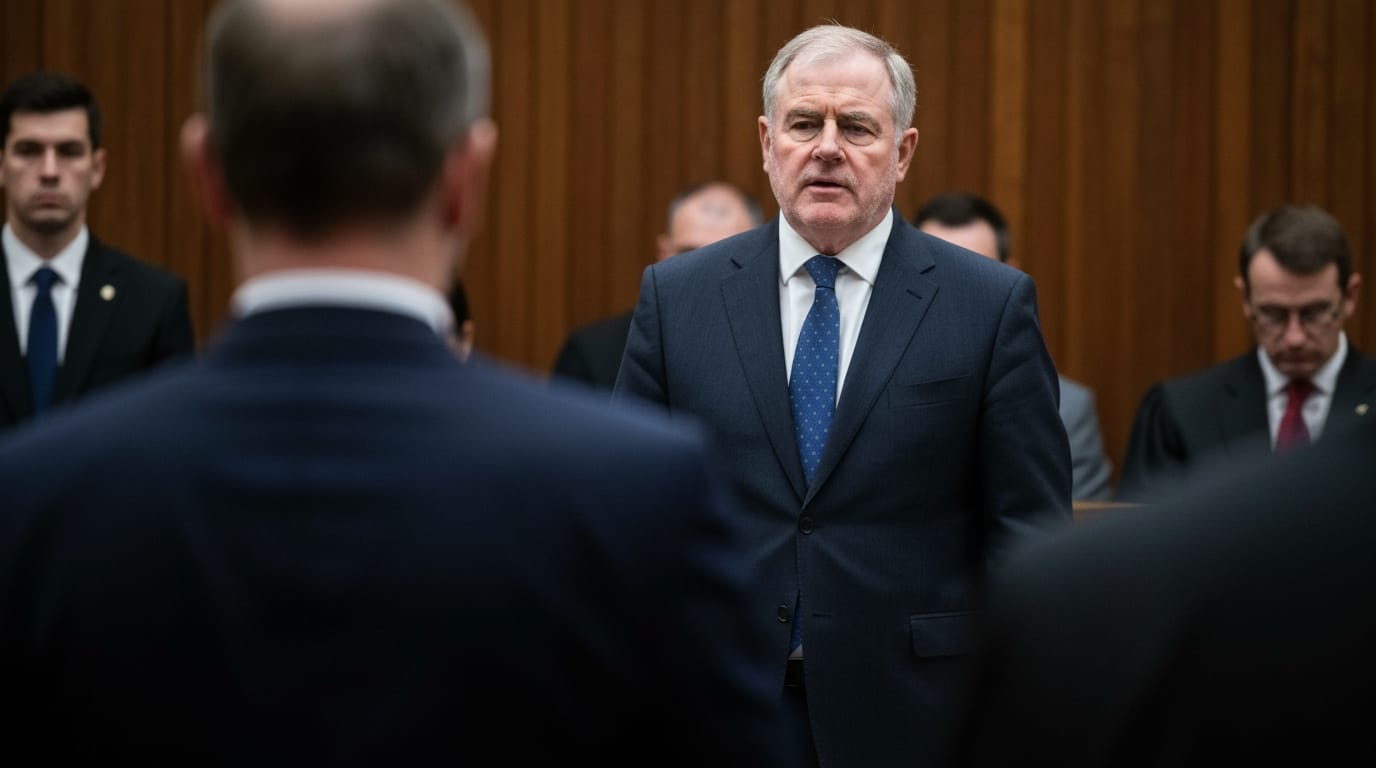
London, UK – Former Sinn Féin leader Gerry Adams is currently embroiled in a high-stakes civil trial at the Royal Courts of Justice in London, where he is emphatically denying allegations of his past membership and leadership within the Provisional Irish Republican Army (IRA). The 77-year-old, a pivotal figure in Northern Ireland's peace process, is being sued for symbolic damages of £1 by three victims of IRA bombings in England, who assert he was directly responsible for their injuries due to his alleged role in the paramilitary organization's Army Council.
The long-standing debate over Adams's involvement with the IRA has once again taken center stage, nearly three decades after the Good Friday Agreement. This civil action, unlike a criminal prosecution, will be decided on the "balance of probabilities," a lower legal threshold, which could profoundly impact how his historical role is perceived. Adams has consistently rejected claims of IRA membership for decades, maintaining his innocence in the face of persistent accusations from former security forces and victims.
The Heart of the Allegations: Victims' Claims
The case has been brought forward by Jonathan Ganesh, injured in the 1996 London Docklands bombing; John Clark, a victim of the 1973 Old Bailey bombing; and Barry Laycock, who suffered injuries in the 1996 Arndale shopping center bombing in Manchester. Their legal team alleges that Adams was not only a leading member of the Provisional IRA at the time of these attacks but also an integral part of its decision-making body, the Army Council. This claim positions him as instrumental in authorizing and orchestrating the very bombings that caused the claimants their lasting physical and emotional scars.
The legal action, seeking a nominal £1 in damages, is primarily for "vindicatory purposes," aiming to establish a judicial finding of Adams's alleged responsibility. For the victims, the trial represents a pursuit of accountability and recognition of what they believe was Adams's "command-and-control role" within the IRA.
Adams's Resolute Denial
Gerry Adams, who served as Sinn Féin president from 1983 to 2018, has met these accusations with an unwavering denial. In his witness statement, he "categorically" denied any involvement in the bombings central to the claim, expressing deep consciousness of the claimants' suffering but reiterating his lack of participation in the authorization, planning, or conduct of the attacks. He stated he was a member of Sinn Féin since 1964, which was a proscribed organization until 1974, but asserted he was "never a member of the IRA or its Army Council," nor did he hold any rank or role within the paramilitary group.
During his testimony, Adams also critiqued what he described as a "shocking ignorance" of Irish history in Britain. His barrister, Edward Craven KC, has argued that Adams "emphatically, unequivocally and categorically denies" any involvement and that suggestions to the contrary often emanate from individuals with "an axe to grind." Adams has never been charged, prosecuted, or convicted of any offense related to the bombings or IRA membership, despite multiple arrests and interrogations over the years. He highlighted that he was released without charge in 2014 after four days of questioning in connection with the 1972 abduction and murder of Jean McConville.
Conflicting Narratives from Key Witnesses
The court has heard testimony from a series of witnesses, painting a starkly different picture from Adams's account. Veteran journalist John Ware suggested that Adams might have "spectacularly deluded" himself into believing he was not an IRA member, given the significant leadership role he reportedly held. Ware testified that his extensive reporting on the Troubles included interviews with former and serving IRA members, as well as Royal Ulster Constabulary (RUC) Special Branch officers, who consistently alleged Adams's involvement in the IRA from its inception.
Further corroboration came from retired Brigadier Ian Liles, who alleged that Adams personally authorized IRA operations in the mid to late 1990s, including the 1996 Manchester truck bombs. Liles claimed that all attacks on the British mainland during that period would have required authorization from the IRA Army Council, of which he asserted Adams was an active member. Two former RUC officers, Tim Hanley and an anonymized "Witness B," also provided evidence. Witness B categorically stated that Adams was the "de facto leader" of the IRA and "undoubtedly a member of the Army Council," a belief shared across RUC Special Branch. They suggested that if Adams were not a senior IRA figure, he achieved a "remarkable coup" in convincing British, Irish, and U.S. governments of his authority. Former British army commander Richard Kemp echoed these sentiments, finding it "inconceivable" that Adams was not involved in authorizing IRA bombings, based on two decades of intelligence.
However, Adams's legal team has challenged the reliability and objectivity of some of these testimonies. During cross-examination, it was suggested to Kemp that he lacked direct evidence of Adams's role in the bombings and that intelligence could be "wrong and unreliable." Similarly, the defense questioned why Adams was not arrested earlier if such intelligence regarding his IRA membership existed.
A Legacy Under Scrutiny
The ongoing civil trial underscores the complex and often contentious legacy of the Troubles and the individuals who shaped that era. Gerry Adams, a key architect of the peace process that largely ended the conflict, now faces a renewed public and legal examination of his past. The outcome of this trial, decided on a balance of probabilities, holds significant implications not only for Adams personally but also for the historical narrative of the Northern Ireland conflict.
As the proceedings continue in London, with Adams taking the witness stand, the court is tasked with sifting through decades of intelligence, testimony, and denials to render a judgment on a figure whose public persona has long been defined by his political leadership and his consistent disavowal of direct involvement in paramilitary activities. The judgment will inevitably add another layer to the enduring and often painful process of confronting the past in Northern Ireland.


