Global Oil Markets Brace for Turbulence as Iran Conflict Threatens $100-a-Barrel Threshold
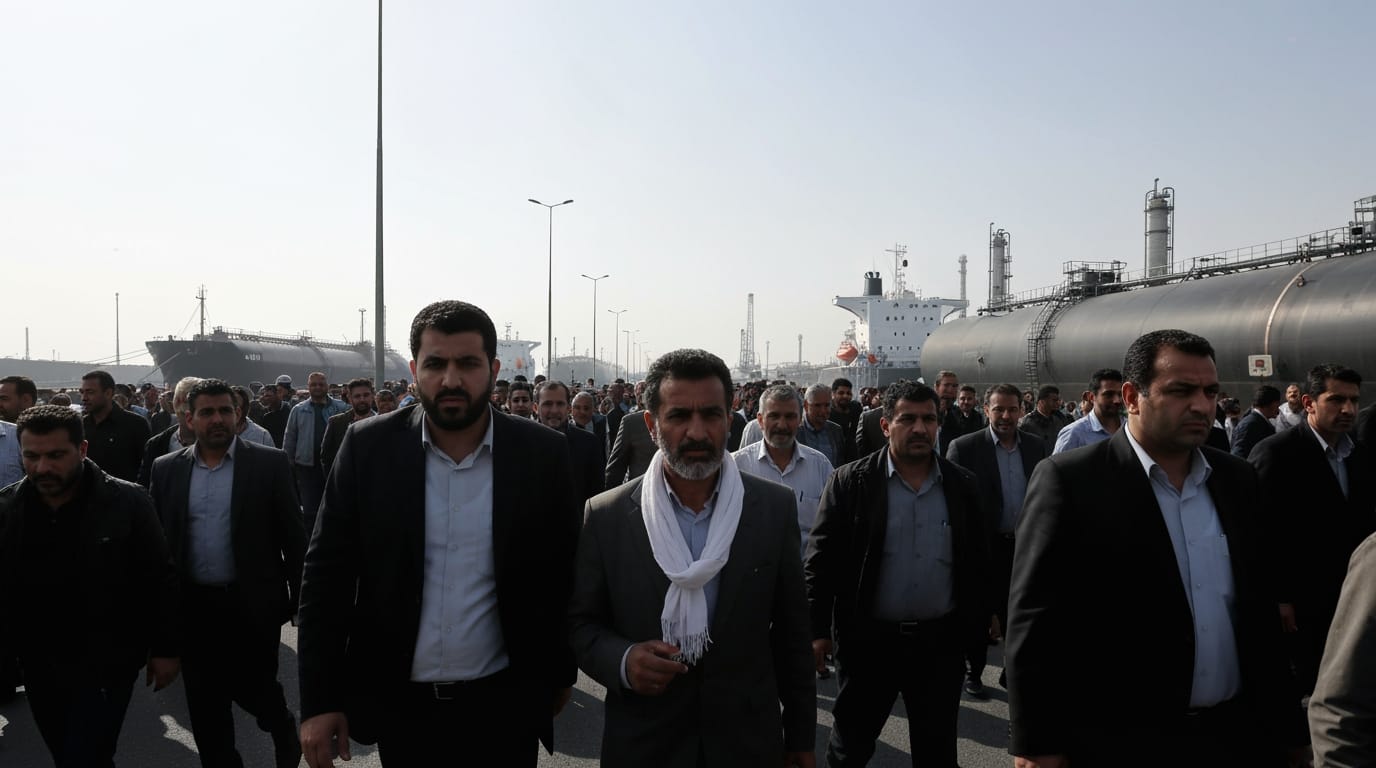
LONDON - Global oil markets are teetering on the brink of significant upheaval following recent escalations in the Middle East, raising concerns that crude prices could surge past $100 per barrel. The immediate aftermath of reported US-Israeli strikes on Iran and subsequent retaliatory actions by Tehran has already sent shockwaves through energy trading, with analysts warning that prolonged conflict, particularly any disruption to the vital Strait of Hormuz, could trigger a substantial and sustained price rally, impacting economies worldwide.
On Friday, Brent crude futures were trading around $72.48 to $73 per barrel, while West Texas Intermediate (WTI) crude oil prices stood at approximately $67 per barrel. However, over-the-counter trading saw Brent crude jump 10% to around $80 per barrel following the initial reports of conflict, indicating the market's immediate apprehension. Experts are now closely monitoring the situation, with a consensus emerging that the duration and intensity of the current tensions will be critical in determining whether the coveted $100 mark becomes a reality.
Escalation Ignites Market Volatility
The recent military actions, including reported US-Israeli strikes and Iranian reprisals, have thrust geopolitical risk to the forefront of oil market considerations. Washington has issued warnings about navigation safety in the Gulf, while Iranian media indicated the country's Revolutionary Guards had warned ships that the Strait of Hormuz was unsafe. These developments have rattled traders, who were already pricing in some level of risk. The initial surge in oil prices reflects the market's sensitivity to supply stability in the Middle East, a region central to global energy production.
Economists and energy analysts suggest that even limited strikes could push Brent crude to $80 per barrel. However, a more prolonged conflict that directly impacts oil supply or blocks key shipping routes could easily drive prices much higher, potentially reaching and surpassing $100 per barrel. A Kremlin economic adviser has already suggested that "$100+ oil per barrel" could be seen soon. Energy analytics firm Wood Mackenzie projected that a prolonged regional conflict could lead to a decrease of approximately 1.5 million barrels per day (b/d) in Iran's oil production, which would in turn raise oil prices by $10 to $15 per barrel. The firm also identified disruption to the Strait of Hormuz as "the most severe risk," which could push prices to $90 or even $100 a barrel.
The Strait of Hormuz: A Global Chokepoint Under Threat
At the heart of the escalating concerns is the Strait of Hormuz, recognized globally as the most crucial oil transit chokepoint. This narrow waterway, situated between Oman and Iran, connects the Persian Gulf with the Gulf of Oman and the Arabian Sea. In 2022, an average of 21 million barrels of oil per day flowed through the strait, representing about 21% of global petroleum liquids consumption. More recently, in 2024, this figure stood at approximately 20 million b/d, equivalent to about 20% of global petroleum liquids consumption and roughly 20-30% of the world's seaborne oil trade. Additionally, around one-fifth of global liquefied natural gas (LNG) shipments also transit this strait.
The strait's narrowest point is approximately 33 kilometers wide, with designated shipping lanes only about 3 kilometers wide in each direction, making it highly vulnerable during periods of military tension. Gulf producers, including Saudi Arabia, Iraq, Iran, Kuwait, Qatar, and the UAE, rely heavily on this route to transport their crude oil and LNG to international markets. Even short-term disruptions could severely tighten global supply and cause oil prices to spike almost immediately. Shipping data suggests that at least 150 tankers, including crude and LNG carriers, have already paused their movements due to security concerns, highlighting the immediate impact of heightened tensions.
While some alternative pipeline infrastructure exists to bypass the Strait of Hormuz, such as routes in Saudi Arabia and the United Arab Emirates, their capacity is limited and cannot fully compensate for a major closure. Analysts estimate that a complete closure could result in a net loss of 8 to 10 million b/d of crude oil supply, even after accounting for diversions. Ed Hirs, an energy fellow at the University of Houston, suggested that if even half of the oil supply through the strait were cut off for an extended period, crude oil prices could more than double, potentially reaching $150 a barrel.
Iran's Strategic Oil Position and Historical Context
Iran plays a significant role in global oil markets, ranking as the third-largest oil producer within OPEC. The nation possesses the world's third-largest proven crude oil reserves, estimated at 208.6 billion barrels as of 2025. Despite decades of sanctions that have constrained its output, Iran's production capacity remains substantial. In 2024, Iran produced approximately 4.6 million b/d, positioning it as the sixth-largest producer globally. Recent reports indicate that Iran's oil industry has seen records in production, exports, and capacity building despite ongoing sanctions, with crude oil production reaching around 3.3 million b/d in January 2026. The country exported nearly 820,000 b/d in 2025. Should sanctions be lifted, Iran's crude oil production could potentially increase to 3.8 million b/d.
The history of oil markets is replete with examples of geopolitical events causing significant price volatility. The 1979 Iranian Revolution, for instance, led to oil prices more than doubling and triggered a global economic recession. More recently, the conflict in Ukraine caused oil prices to surge above $110 per barrel. While the relationship between geopolitical developments and oil prices is not always straightforward, and not every event leads to sustained high prices, the potential for supply disruptions from a major oil-producing region like the Middle East consistently introduces a significant risk premium.
Economic Repercussions of Elevated Oil Prices
A sustained period of high oil prices, particularly above $100 a barrel, would have profound economic implications globally. A commonly cited rule of thumb suggests that every $10 increase in the price of a barrel of oil can reduce global Gross Domestic Product (GDP) growth by half a percentage point within two years. Such a surge would inevitably fuel inflation, increase production costs across various industries, and slow economic growth worldwide.
Oil-importing nations, particularly in Asia, would bear the brunt of such a price shock. Countries like China, India, Japan, and South Korea are heavily dependent on oil imports from the Persian Gulf, with Asian markets being the primary destination for crude oil flowing through the Strait of Hormuz. For these economies, a sudden supply shock would lead to higher fuel prices, increased manufacturing costs, and a significant deceleration of economic expansion. India, one of the world's largest crude oil importers, would immediately feel the impact, facing a higher import bill, a weaker rupee, and a widening current account deficit.
The United States, while less dependent on Persian Gulf oil imports due to increased domestic production, would still face economic headwinds through higher gasoline prices for consumers and increased costs for businesses. The overall impact on the global economy will largely hinge on how long any conflict persists and the extent of actual disruptions to oil supplies and shipping routes.
The current situation underscores the inherent fragility of the global energy supply chain when confronted with geopolitical instability. As the conflict unfolds, the world watches anxiously to see whether the critical $100 per barrel threshold will be breached, ushering in a new era of economic uncertainty.