Henri Kagan and Kenso Soai Win 2026 Nobel Prize in Chemistry
Their discoveries explain how life selects single mirror-image molecules, providing fundamental tools to improve the safety and effectiveness of modern medicines.
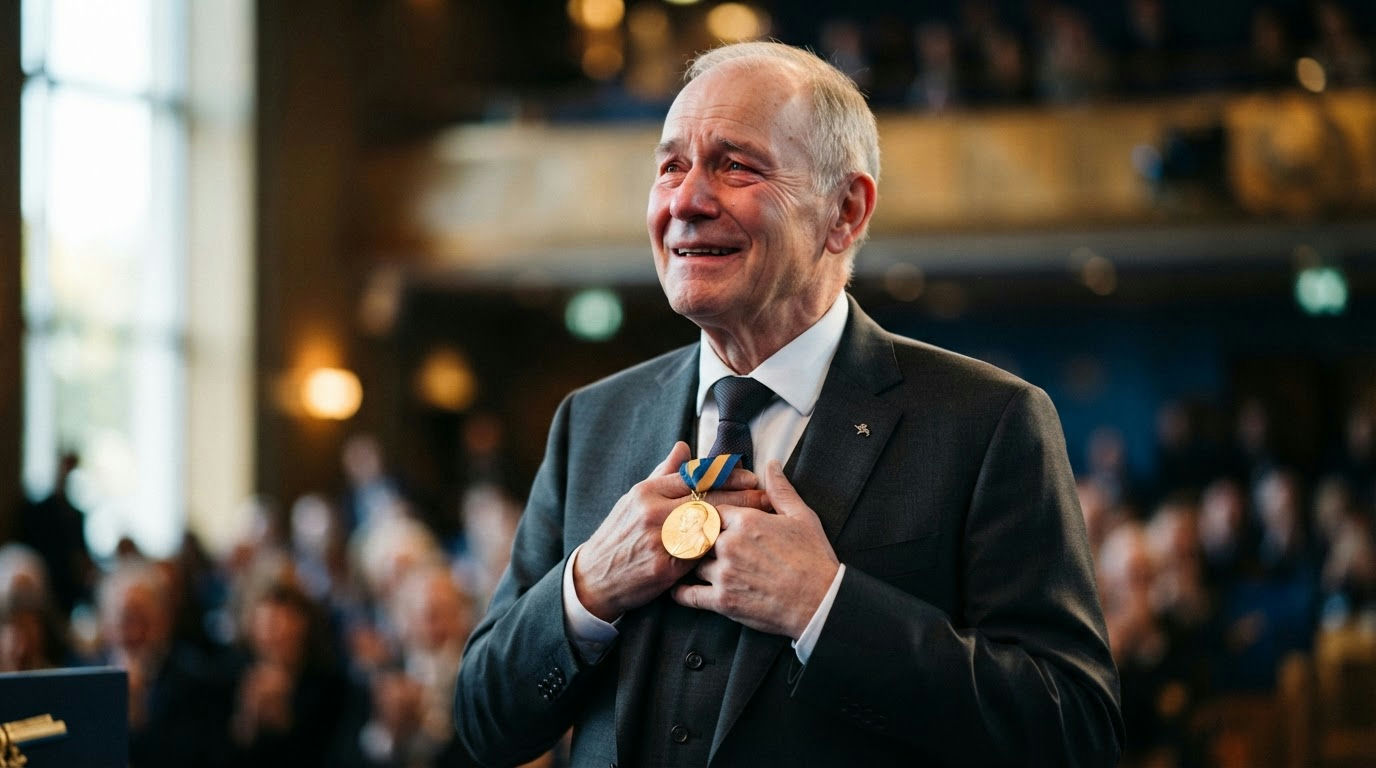
The Royal Swedish Academy of Sciences awarded the 2026 Nobel Prize in Chemistry to Henri B. Kagan and Kenso Soai on Wednesday in Stockholm. The scientists received the prize for discovering non-linear effects and autocatalysis in asymmetric organic synthesis. They will split the prize money of 12 million Swedish kronor, worth about $1.2 million.
Kagan discovered non-linear effects in asymmetric synthesis in 1986. His work demonstrated how to manipulate chemical reactions to produce a much higher excess of one mirror-image molecule than classical theory predicted.
Soai published findings on asymmetric autocatalysis in 1995. By 2003, he developed the Soai reaction, which creates a single mirror-image form from an initial mixture lacking significant chirality.
Many biological molecules, including sugars and amino acids, exist in two mirror-image configurations known as enantiomers. Living organisms naturally use only one set of enantiomers. Scientists had spent decades trying to understand how nature initially broke this symmetry without existing biological tools.
Heiner Linke, chair of the Nobel Committee for Chemistry, stated that Kagan and Soai resolved a century-old mystery about how homochirality emerges spontaneously. Linke described their reactions as spectacular. Committee member Peter Somfai called Soai’s experiment one of the finest in organic chemistry.
Ellen Moons, permanent secretary of the academy, explained that the prize recognizes methods for selecting specific mirror-image molecules. The findings apply to manufacturing pharmaceuticals, fragrances, flavors, and advanced materials, where opposite mirror forms can have distinct biological effects.
American Chemical Society President Rigoberto Hernandez stated that modern pharmaceuticals would not exist without this underlying chemistry. Royal Society of Chemistry President Robert Mokaya stated that asymmetric synthesis shows how basic research addresses drug safety and efficacy. In medicine, one molecular form may heal while its opposite causes harm.
Kagan, born in France in 1930, is professor emeritus at Université Paris-Sud. Soai, born in Japan in 1950, is professor emeritus at the Tokyo University of Science. Their honor follows the 2001 chemistry prize for asymmetric synthesis and the 2025 prize awarded for metal-organic frameworks.
The Nobel Prize in Literature will be announced on Thursday, followed by the Peace Prize on Friday and the Economic Sciences prize on Monday. Kagan and Soai will receive their medals and diplomas from King Carl XVI Gustaf of Sweden in Stockholm on December 10, 2026.