High-Stakes Diplomacy: Kushner Meets Netanyahu in Jerusalem Amid Push for Gaza Peace Plan
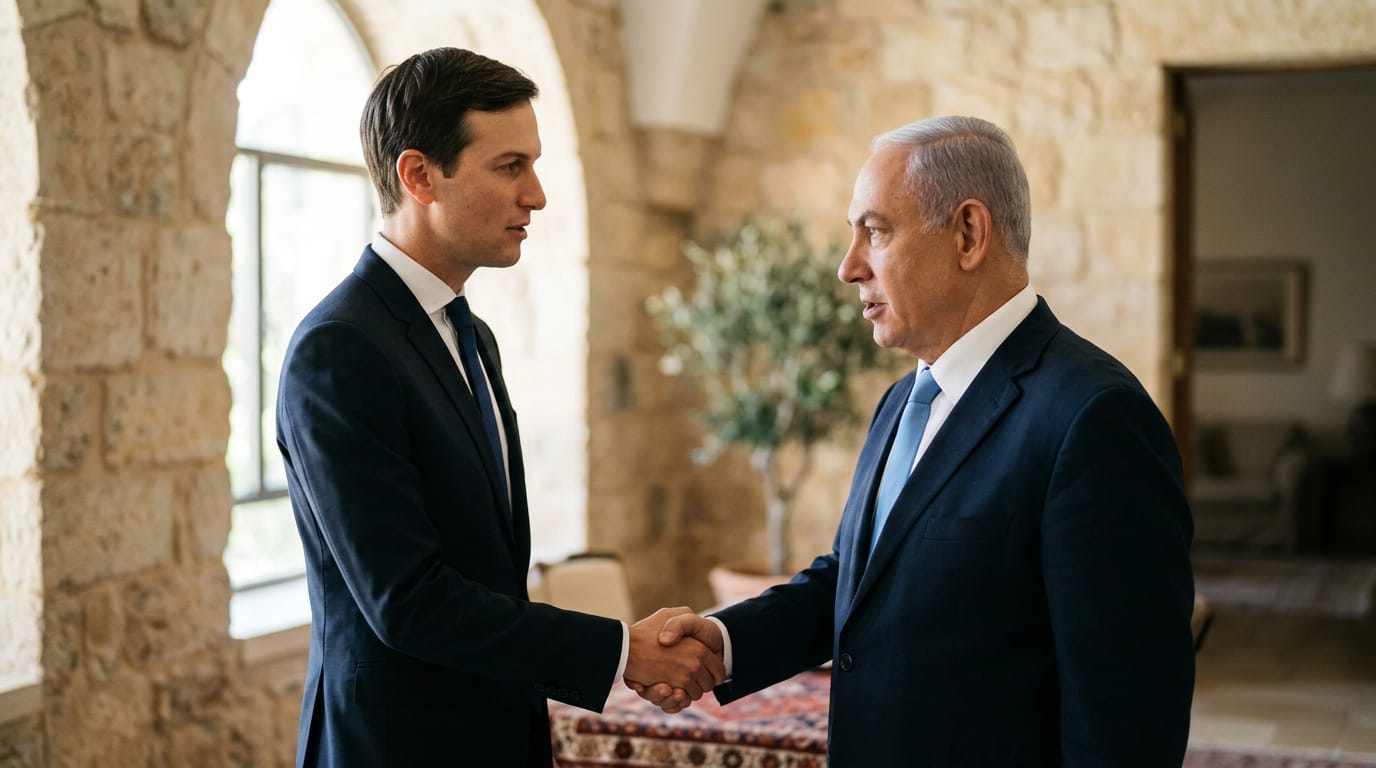
JERUSALEM – U.S. envoy Jared Kushner convened a pivotal meeting with Israeli Prime Minister Benjamin Netanyahu in Jerusalem on Monday, August 17, 2026, marking a critical juncture in the ongoing efforts to advance a U.S.-backed peace plan for the Gaza Strip. The discussions in the Israeli capital followed rare and sensitive talks held by Kushner with leaders of Hamas in Egypt over the weekend, underscoring the complex and often contradictory diplomatic pathways being pursued to stabilize the volatile region. The central aim of these high-level engagements is to move forward with "Trump's Gaza plan," a multi-point proposal that seeks the disarmament of Hamas and a subsequent Israeli withdrawal from the territory, a vision fraught with significant obstacles from both sides of the conflict.
Diplomatic Blitz for a Stalled Peace
The meeting in Jerusalem saw Kushner, son-in-law and senior advisor to U.S. President Donald Trump, joined by Nickolay Mladenov, the director of the Trump-created "Board of Peace" and High Representative for Gaza, and former British Prime Minister Tony Blair, a member of the Board's executive board. Their presence signaled a concerted international push to operationalize elements of the comprehensive peace framework. The discussions focused on accelerating the implementation of President Trump's broader 20-point plan, specifically its 15-point component addressing the disarmament of Hamas. Ahead of the Jerusalem talks, Kushner, Mladenov, and Blair had reportedly met with senior Egyptian officials and other mediators in El Alamein, Egypt, to strategize on transforming the roadmap's next steps into concrete measures. Crucially, the U.S. delegation had engaged with a Hamas delegation, led by its new chief, Khalil al-Hayya, in Cairo on Sunday, a highly unusual direct engagement with the Islamist group.
Deep Divisions on Disarmament and Withdrawal
Despite the intensive diplomatic activity, significant chasms remain between the parties regarding the core tenets of the peace plan. The 15-point proposal, initially lauded by President Trump in late July as a breakthrough, outlines a reciprocal, gradual process: Hamas would disarm, and Israel would withdraw from the Gaza Strip. Reports indicate that Hamas has expressed its acceptance of this 15-point plan. However, Israeli Prime Minister Netanyahu has publicly voiced strong reservations, particularly rejecting the prospect of an Israeli withdrawal before Hamas fully disarms. Israel's position maintains that complete disarmament of Hamas and the removal of all weapons from Gaza are non-negotiable prerequisites for any withdrawal. During his engagement with Hamas, Kushner reportedly demanded that the group verify its abandonment of weapons and renounce any future role in governing Palestinian territory, a key sticking point for the Israeli side. This fundamental disagreement highlights the arduous nature of securing concessions from both entrenched adversaries.
The Role of the Board of Peace and Regional Architects
The "Board of Peace," established in the aftermath of a 2025 deal to secure the release of hostages captured during the October 7, 2023, attack on Israel, serves as the primary mechanism for implementing the U.S. peace plan. Its structure, involving figures like Mladenov and Blair, aims to provide a multinational framework for supervision and mediation. The Board's officials, including Kushner, Mladenov, and Blair, also met with the National Committee for the Administration of Gaza, reviewing plans for the transfer of governing authority in the Gaza Strip to this technocratic body. This element of the plan envisions a demilitarized Gaza where Hamas relinquishes administrative control to a Palestinian technocratic government, thereby paving the way for extensive reconstruction efforts. The objective is to ensure that the governance of Gaza transitions to an entity capable of fostering stability and rebuilding the war-ravaged territory. The meetings in Egypt with various mediators underscore the regional dimensions of this peace initiative, with key Arab nations playing a facilitating role in discussions that are often politically untenable for direct bilateral engagement between Israel and Hamas.
Navigating the Path Forward
The intensive diplomatic push by the U.S. and its partners reflects a recognition of the urgent need to address the prolonged crisis in Gaza and prevent further escalation. The U.S. and Board of Peace officials are reportedly applying significant pressure on Israel to proceed with the next phase of the plan. While the immediate outcome of the Jerusalem talks remains under wraps, officials speaking on condition of anonymity indicated that the goal is not necessarily Israel's immediate "signature" on the entire 15-point plan, but rather to identify and advance elements that can move forward. The stated "end state" agreed upon by the United States and Israel is a "demilitarized Hamas," emphasizing a shared strategic objective despite tactical differences on implementation. However, the path to achieving this outcome, particularly the simultaneous demands for Hamas disarmament and Israeli withdrawal, continues to be a formidable challenge, requiring persistent negotiation and a willingness from all parties to compromise on deeply held positions. The humanitarian plight in Gaza, exacerbated by years of conflict and blockade, adds another layer of urgency to these diplomatic endeavors, with the promise of reconstruction hinging on the success of these peace efforts.
The high-level talks in Jerusalem and Egypt represent a concentrated effort to unlock a stalled peace process, but the deeply ingrained distrust and conflicting demands between Israel and Hamas present a daunting reality. While the presence of prominent international figures and the stated commitment of all parties to some form of peace offer a glimmer of hope, the road ahead is undoubtedly long and fraught with potential setbacks. The critical question remains whether the momentum generated by these diplomatic overtures can translate into tangible progress on the ground, ultimately alleviating the suffering in Gaza and fostering a more stable future for the region.