Historic Rift Widens as Ukrainian Officials Return Polish Honors After Zelenskyy Stripped of Award
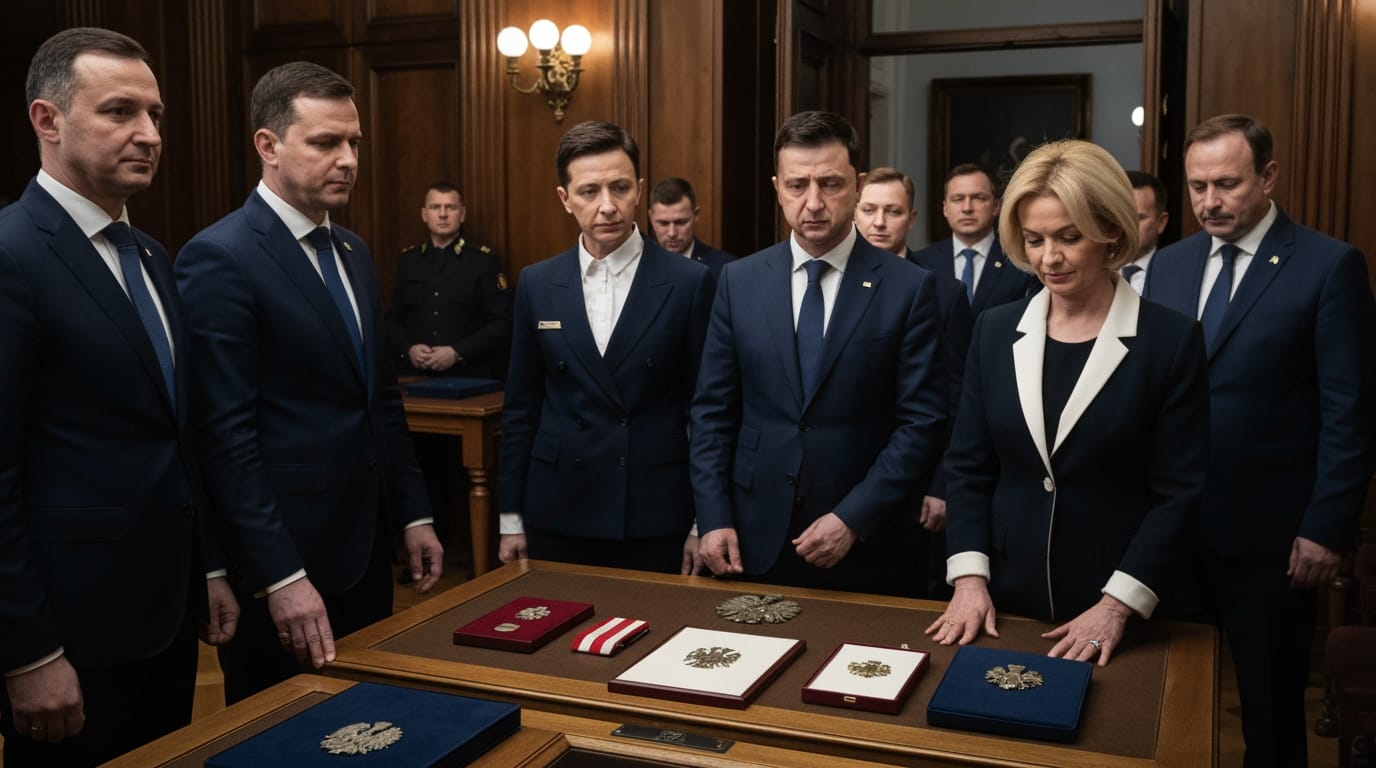
KYIV/WARSAW – A significant diplomatic rift has emerged between Ukraine and Poland, key allies against Russian aggression, after Polish President Karol Nawrocki on June 19 stripped Ukrainian President Volodymyr Zelenskyy of the Order of the White Eagle, Poland's highest state honor. The move, prompted by Ukraine's decision to name a military unit after the controversial Ukrainian Insurgent Army (UPA), has led to several high-ranking Ukrainian officials announcing the return of their own Polish state awards, signaling a deepening crisis in bilateral relations.
The unprecedented escalation underscores persistent historical tensions that continue to challenge the otherwise strong strategic partnership forged in the face of a shared external threat. While both nations emphasize their unity against Moscow, the symbolic gestures from both sides highlight deep-seated disagreements over the interpretation of World War II history and national memory.
The Spark: UPA Unit Naming and Award Revocation
The immediate catalyst for the diplomatic fallout was President Zelenskyy's decision in late May to grant a Ukrainian Special Operations Forces unit the honorary designation "named after the Heroes of the UPA." This decision ignited widespread criticism in Poland, where the UPA is inextricably linked to the massacres of Polish civilians in the Volhynia region during World War II. Polish President Karol Nawrocki publicly denounced the move, describing it as "outrageous," "incomprehensible," and "deeply disappointing."
On June 19, President Nawrocki acted on this sentiment, announcing his decision to revoke the Order of the White Eagle, an honor previously bestowed upon President Zelenskyy by former Polish President Andrzej Duda in April 2023. Nawrocki stated that the glorification of the UPA was "inexplicable and deeply disappointing," undermining the trust built between the two nations over years. He maintained that his decision was not directed against the Ukrainian people and would not alter Poland's commitment to supporting Ukraine against Russian aggression.
Ukrainian Response: A Coordinated Return of Honors
In a swift and coordinated diplomatic protest, multiple high-ranking Ukrainian officials announced their intention to return Polish state decorations. Ukrainian Foreign Minister Andrii Sybiha declared he would return his Commander's Cross with Star of the Order of Merit of the Republic of Poland, an award he received in October 2022. Sybiha criticized Nawrocki's actions as a "strategic mistake" that would only benefit Moscow, regretting that "emotions have prevailed in Warsaw and prompted Polish politicians to take unjustified, impulsive and disrespectful steps."
Joining Sybiha, Kyrylo Budanov, Head of Ukraine's Presidential Office, stated he would renounce the Golden Officer's Cross of the Order of Merit of the Republic of Poland, which he received last year. Budanov emphasized that such actions were "a gift to the Moscow aggressor" and questioned the logic behind the Polish president's decision, citing historical examples such as Benito Mussolini still retaining the Order of the White Eagle. Ukraine's Ambassador to Poland, Vasyl Bodnar, also announced he would return his Knight's Cross of the Order of Merit of the Republic of Poland, calling the decision to strip Zelenskyy of the honor "historically unjust" and particularly painful during wartime. Additionally, Deputy Head of the Presidential Office Ihor Zhovkva announced he would return his Knight's Cross of the Order of Merit of the Republic of Poland, calling the decision morally unjust and politically unjustified.
These officials underscored Ukraine's right to its own national memory and dignity, while still hoping for a return to "equal dialogue befitting the allied relationship between the two countries."
The Shadow of History: UPA's Divisive Legacy
The core of the dispute lies in the divergent historical narratives surrounding the Ukrainian Insurgent Army (UPA). For a significant portion of Polish society, the UPA is remembered for its brutal campaigns of ethnic cleansing against Poles, particularly the Volhynia massacres between 1943 and 1945, which are recognized as genocide by the Polish parliament. Polish historians estimate that tens of thousands of Polish civilians, including women and children, were killed by UPA units during this period.
Conversely, in Ukraine, the UPA is often viewed through the prism of a struggle for national independence against both Nazi Germany and the Soviet Union, with its members hailed as heroes who fought for a sovereign Ukraine. This stark contrast in historical interpretation has frequently surfaced as a point of contention in Polish-Ukrainian relations, despite periods of close cooperation.
Diplomatic Fallout and Future Implications
The deepening row has drawn reactions from within Poland's political landscape. Polish Prime Minister Donald Tusk criticized President Nawrocki's decision, cautioning that escalating disputes between Warsaw and Kyiv risk serving Russian interests. Tusk emphasized that while difficult historical issues should be discussed, the focus must remain on the common enemy. He also noted that Nawrocki's decision to strip Zelenskyy of the award would require his sign-off to become effective, hinting at potential internal governmental disagreement.
The dispute risks driving relations between the two countries to a fresh low, potentially impacting crucial areas of cooperation. Analysts suggest that further escalation could lead to broader consequences, including Poland obstructing parts of Ukraine's European Union accession process. The incident also comes at a sensitive time, just before the Ukraine Recovery Conference scheduled to begin in Gdańsk on June 25, raising questions about President Zelenskyy's participation and the conference's overall future.
The current situation highlights the delicate balance between historical memory and present-day geopolitical alliances. While both nations acknowledge the strategic importance of their partnership against Russia, the inability to reconcile divergent historical narratives continues to pose a significant challenge to their long-term relationship. The coming weeks will likely reveal the true extent of the damage to Polish-Ukrainian ties and whether cooler heads can prevail to prevent further erosion of trust between two essential European allies.


