Hope on the Horizon: Germany Mobilizes in Unprecedented Rescue Bid for Stranded Humpback Whale "Timmy"
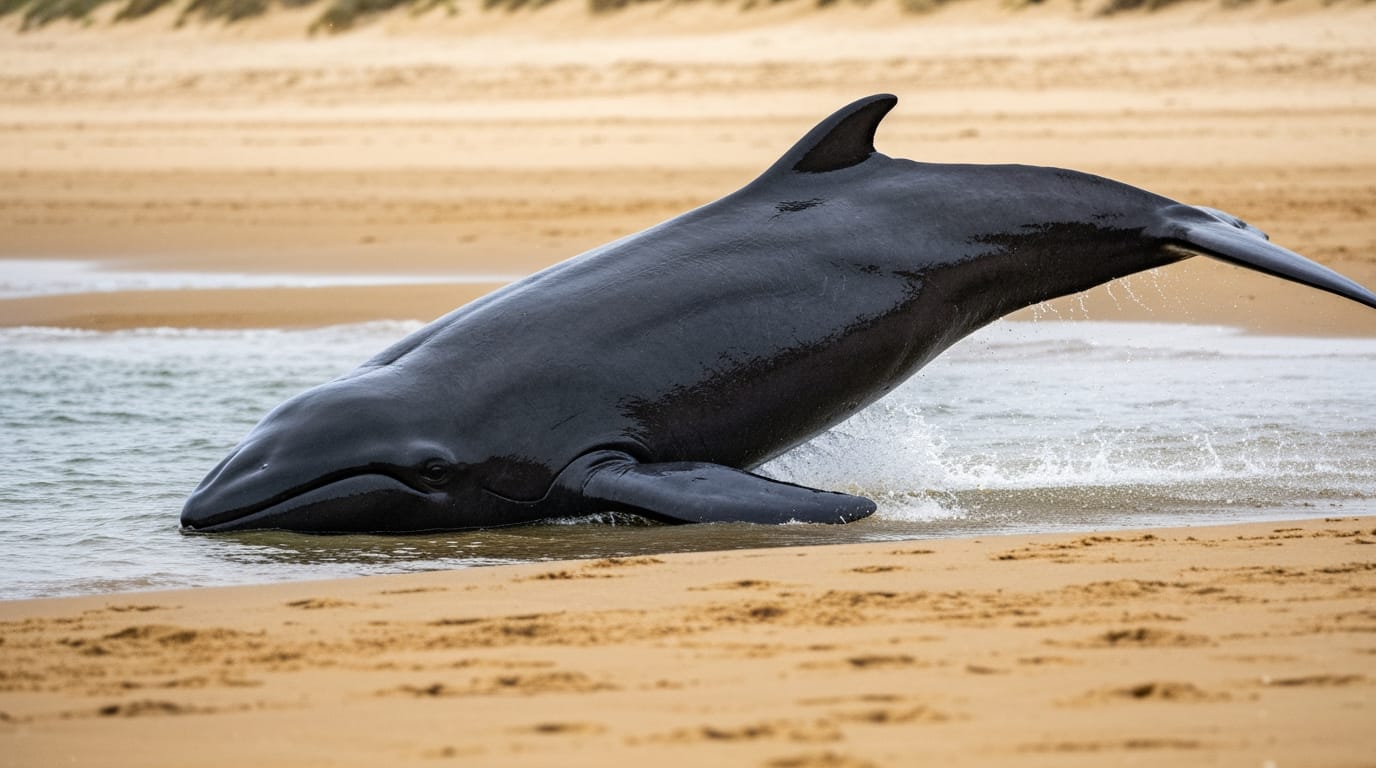
A colossal effort is underway off Germany's Baltic Sea coast, as an ailing humpback whale affectionately nicknamed "Timmy" embarks on a perilous journey back to the open ocean. After weeks of repeated strandings and dwindling hopes, a privately funded, unprecedented rescue operation—dubbed "Operation Cushion"—aims to transport the 12-tonne mammal hundreds of kilometers to the North Sea, a desperate gambit that has captivated a nation and ignited intense debate over the ethics of human intervention in the natural world. Timmy's precarious passage represents a critical moment, not only for the individual whale fighting for survival but also for the collective human response to the increasing vulnerability of marine life in an anthropogenically impacted environment.
The Baltic's Unsuitable Depths: A Whale's Fight for Survival
Timmy, a male humpback whale measuring between 12 and 15 meters in length, first appeared in the shallow waters of the Baltic Sea near Timmendorfer Strand on March 3rd. Far from his natural Atlantic habitat, his presence in the low-salinity, nutrient-scarce Baltic has posed a continuous threat to his health and survival. Experts suggest the whale may have lost its way while pursuing a shoal of herring or during migration, an increasingly common occurrence for marine mammals whose navigation can be disrupted by a multitude of factors.
Since his initial sighting, Timmy has become a symbol of resilience, repeatedly freeing himself from sandbanks only to become re-stranded in other shallow areas, notably near Wismar and Poel Island in Wismar Bay. Each stranding has taken a toll on the magnificent creature. Photographs and live streams revealed visible skin damage and infection, attributed to prolonged exposure to the Baltic Sea's low salt content, which is detrimental to marine mammal skin. Beyond external wounds, there are suspicions of internal injuries, possibly from ship strikes or entanglement in fishing gear, further compounding his weakened state and leading to severe dehydration. Efforts by various groups, including attempts to refloat him with police boats and even excavators to dig escape channels, provided temporary relief but ultimately failed to guide him out of the treacherous waters. Officials had reached a point where allowing nature to take its course seemed the only remaining, albeit tragic, option.
"Operation Cushion": A Risky, Unprecedented Undertaking
Just as regional authorities appeared ready to concede defeat, a remarkable intervention emerged. Two multimillionaires, Walter Gunz, founder of a prominent electronics retailer, and equestrian event organizer Karin Walter-Mommert, stepped forward to privately finance a daring, last-ditch rescue mission. Their swift action garnered state approval for "Operation Cushion," a highly complex and never-before-attempted plan to manually transport the colossal whale.
The innovative strategy involves the use of inflatable air cushions to gently lift Timmy from the seabed. Once afloat, he is to be carefully positioned onto a reinforced tarpaulin, which will then be attached to a tugboat. The ultimate objective is to tow the whale along the coast, navigating around Denmark and eventually into the North Sea, where he would have a greater chance of finding food and ultimately returning to the Atlantic. Described by officials as "minimally invasive," the operation is nonetheless fraught with high risks for an animal already severely compromised by weeks of illness and stress. The sheer scale and delicacy of maneuvering a 12-tonne, weakened whale across hundreds of kilometers of sea represent an immense logistical and veterinary challenge. A veterinarian from Hawaii was reportedly expected to join the rescue efforts, with authorities expediting qualification approvals in light of the urgency.
A Nation's Gaze: Empathy, Debate, and the Human Element
Timmy's struggle has transcended a mere wildlife incident, evolving into a national saga that has captured the hearts and minds of the German public. Local media have provided round-the-clock coverage, including live streams, and online newspapers have issued frequent alerts detailing every minor development in the whale's health and the ongoing rescue attempts. This intense public fascination has fostered a blend of deep empathy and fervent debate.
The decision to proceed with "Operation Cushion" was not without controversy. Environmental groups, notably Greenpeace, expressed strong reservations, arguing that the whale's severely weakened state rendered its chances of survival vanishingly low and that further intervention could inflict additional harm. They highlighted reports from institutions like the German Oceanographic Museum and the Institute for Terrestrial and Aquatic Wildlife Research, which underscored the grim prognosis. Conversely, proponents of the rescue, including the generous donors and some officials, maintained that even a slim chance of saving Timmy was worth the monumental effort, echoing the sentiment, "At least if you try something you have a chance of saving it". The debate also touched upon political dimensions, with critics suggesting that an upcoming election in Mecklenburg-Western Pomerania, the state where Timmy was stranded, might be influencing the official stance on the high-profile rescue. The sheer public interest necessitated a 500-meter protection zone around the whale to prevent curious bystanders from inadvertently causing further stress.
Beyond Timmy: Broader Implications for Marine Conservation
While Timmy's individual plight has commanded immediate attention, his story also illuminates broader challenges facing marine ecosystems. The Baltic Sea, a semi-enclosed body of water, is not a typical habitat for humpback whales, which primarily inhabit the North Sea and Atlantic Ocean. Whale strandings in general have seen a rise across Europe, with recent scientific research suggesting that humpback whales are, in fact, reclaiming feeding grounds in the North and Baltic Seas that they occupied over a millennium ago before being driven out by medieval whaling. However, this return also places them at increased risk in heavily trafficked and often polluted coastal waters.
Possible causes for strandings are varied and complex, including navigation errors due to natural phenomena like solar flares, but also human-induced factors such as noise pollution from shipping and industrial activities, chemical contamination, ship strikes, and entanglement in fishing gear. Germany has a stated commitment to marine conservation, with the Federal Government implementing a "marine offensive" to protect marine biodiversity and combat pollution, including significant investments in initiatives like the "Clean Oceans Initiative" and the "Blue Action Fund". The German Ocean Foundation also actively works to raise awareness and promote sustainable use of the ocean. Timmy's struggle serves as a poignant, tangible reminder of the intricate connections between human activity and marine health, underscoring the urgent need for continued and enhanced conservation efforts.
An Uncertain Future, A Resounding Message
As "Operation Cushion" progresses, Timmy's future remains uncertain. His journey back to the Atlantic is long, arduous, and fraught with peril, a testament to the immense odds stacked against him. Environment Minister Till Backhaus acknowledged the whale's severely damaged condition but maintained that "there's still life in him," a sentiment echoing the hope many Germans hold. The outcome of this unprecedented rescue will not only determine the fate of one whale but also offer profound insights into the possibilities and limitations of human intervention in the face of ecological challenges. Regardless of the final outcome, Timmy's story has indelibly etched itself into the national consciousness, serving as a powerful and enduring symbol of both the fragility of marine life and the unwavering human capacity for compassion and determination in its defense.


