Humpback Whale's Epic Struggle for Survival Grips Germany's Baltic Coast
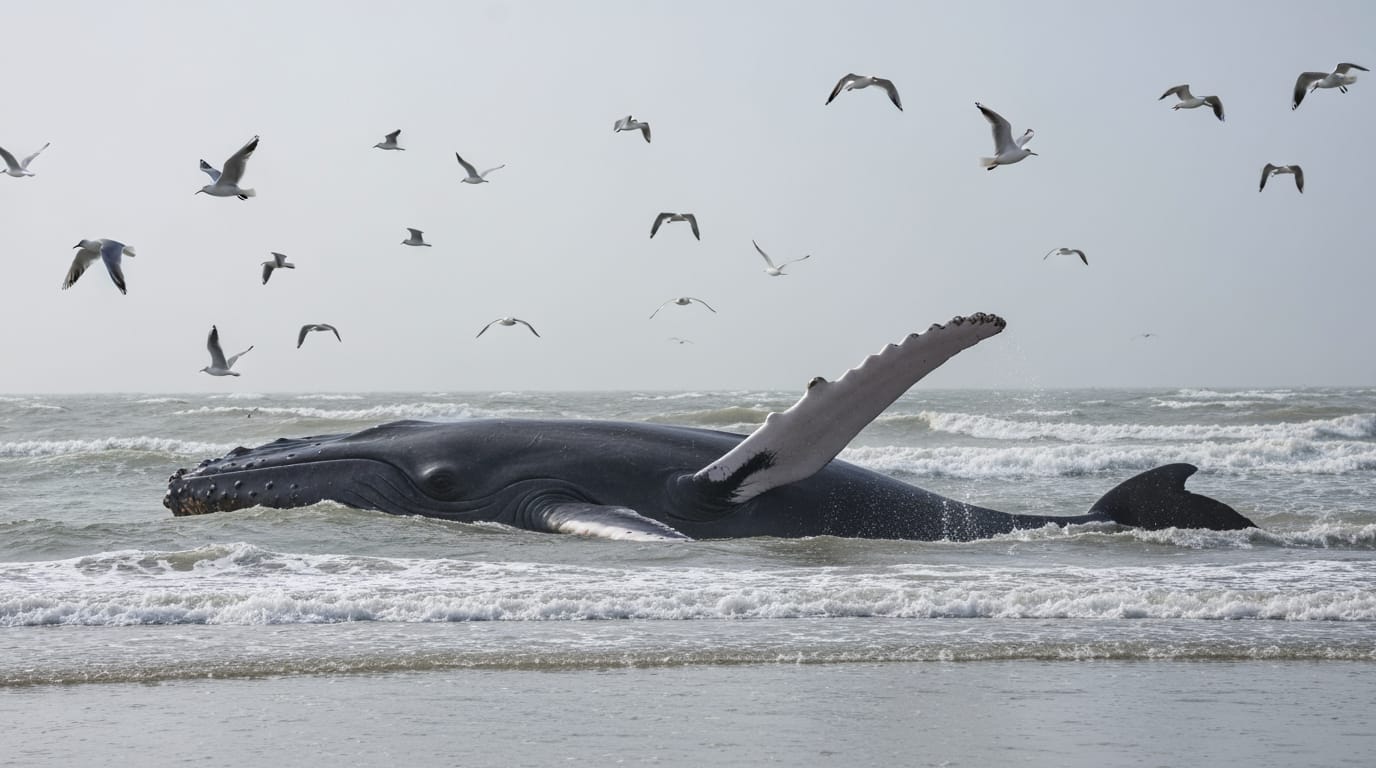
Timmendorfer Strand, Germany – A dramatic multi-day rescue operation on Germany's Baltic Sea coast culminated in the precarious freedom of a young humpback whale this week, as the massive marine mammal finally dislodged itself from a sandbank after a prolonged battle against shallow waters and human intervention. While the immediate danger of stranding has passed, the whale's arduous journey is far from over, as it now faces the formidable challenge of navigating the unfamiliar and dangerous confines of the Baltic Sea to reach the open Atlantic. The unfolding saga has captured national attention, highlighting both the vulnerability of marine life and the dedicated efforts of conservationists and emergency services.
The Initial Distress: A Whale Adrift in Unfamiliar Waters
The ordeal began on Monday, March 23, 2026, when hotel guests near Timmendorfer Strand in Lübeck Bay alerted authorities to the presence of a distressed humpback whale. Its deep moans echoed across the water, signalling a dire situation for the estimated 10- to 15-meter (30- to 49-foot) long mammal, believed to be a young male. Experts from the Institute for Terrestrial and Aquatic Wildlife Research (ITAW) and marine conservation group Sea Shepherd quickly assessed the whale, confirming it was alive, breathing, and occasionally lifting its head, but its condition was deteriorating with each passing hour.
Humpback whales are a rare sight in the Baltic Sea, a semi-enclosed, brackish body of water that is vastly different from their natural open ocean habitats in the Atlantic and high-latitude feeding grounds. Marine scientists suggest their presence in the Baltic often indicates navigational errors, particularly for juveniles, and the region is frequently described as a "trap" due to its complex geography and shallow shelf. The stranded whale was believed to be the same one spotted in recent weeks in the port of Wismar, eastern Germany, where it had previously been partially freed from fishing net remnants. Rescuers at Timmendorfer Strand also discovered and removed additional parts of a fishing net wrapped around its body, underscoring human impact on marine ecosystems.
Initial attempts to free the whale proved unsuccessful. Police boats, inflatable vessels, and even firefighter drones were deployed to guide and encourage the animal, but the lack of sufficient high tides prevented it from swimming free. Rescuers carefully tried to turn the whale's head toward deeper water, hoping it would instinctively swim away, but the animal consistently returned to its previous position on the sandbank. The sheer weight of the several-ton mammal also precluded active pulling, as such an attempt could inflict serious injury. To minimize stress on the already vulnerable animal, police cordoned off the beach, keeping large crowds of onlookers at a distance.
A Desperate Race Against the Clock
As days passed, the urgency of the situation intensified. Sven Biertümpfel of Sea Shepherd warned that every hour the whale remained stranded, its condition worsened, and that remaining on the beach amounted to a "death sentence". The Baltic Sea's unique characteristics, specifically its lack of strong tides, further complicated rescue efforts that might have naturally freed the whale in other coastal environments.
On Thursday, March 26, the rescue operation escalated with the introduction of heavy machinery. Excavators were brought in to dig a channel in front of the whale's head, aiming to create a navigable path into deeper water. Marine biologist Robert Marc Lehmann was on site, guiding the challenging excavation process. The work continued well after sunset under floodlights, with rescuers carefully working to accustom the whale to the noise of the machinery to avoid further distress. The intensive, 76-hour effort demonstrated a profound commitment from local authorities and marine experts to save the animal's life.
A Glimmer of Hope: The Self-Liberation
In a surprising turn of events, after the formal rescue operations concluded for the night on Thursday, the humpback whale managed to free itself. Early on Friday morning, March 27, it became apparent that the whale had swum off the sandbank and was no longer stranded. Experts believe that a combination of factors contributed to its liberation: the newly dredged channel, an overnight rise in water levels in Lübeck Bay due to strong winds, and the period of calm once human activity ceased.
"Experts suspect that the calm at night after the rescue was called off helped," reported one source. The whale, now swimming several hundred meters off the coast, is being closely monitored and accompanied by a coast guard ship and other vessels. Dr. Stephanie Gross of the ITAW expressed cautious optimism, stating, "The whale is making its way out of the bay and is currently allowing the boats to follow it closely". The hope is to escort the whale through Danish waters and ultimately to the North Sea.
The Perilous Journey Ahead
Despite this significant breakthrough, the whale's situation remains critical. The Baltic Sea is fundamentally an unsuitable habitat for a humpback whale, posing numerous long-term threats to its survival. Its enclosed nature and shallow depths limit the whale's ability to navigate effectively, as humpbacks rely on deep oceanic channels for echolocation. The lower salinity of the Baltic Sea, compared to the open ocean, can also cause physiological stress for a large marine mammal adapted to oceanic conditions.
Furthermore, the Baltic is a busy waterway, and the constant presence of noise from shipping traffic can disorient whales, which are sensitive to sound. Food scarcity is another major concern; the whale has reportedly not eaten for a long time, further weakening its condition. The journey to the North Sea and then the Atlantic will require navigating hundreds of kilometres through complex German and Danish waters, a route fraught with potential hazards. Marine scientists are currently investigating whether oceanic anomalies or specific prey-chasing behaviors led this whale so far off its typical course.
A Call for Greater Marine Stewardship
The dramatic rescue of the humpback whale off Timmendorfer Strand serves as a poignant reminder of the delicate balance between human activity and the natural world. While the immediate intervention saved a life, the broader implications of such events call for urgent attention to marine stewardship. The increased frequency of humpback whale sightings in the Baltic Sea, though rare, signals a need for deeper understanding of migratory anomalies and the environmental shifts that may be driving these majestic creatures into vulnerable territories.
As monitoring vessels continue to track the whale's progress, the collective relief is palpable. However, experts emphasize that true success lies not just in rescuing individual animals, but in addressing the underlying factors that lead to such desperate situations. The continued focus on protecting marine ecosystems, mitigating threats from human activities like fishing and maritime traffic, and understanding the impacts of environmental change will be crucial for the long-term survival of all marine life, particularly those that stray far from their natural homes. The world watches and hopes as this resilient humpback whale attempts its extraordinary journey home.


